
Run a Four Week Pilot for Community Gamification in Paid Hubs
Playbook for community managers of paid hubs and coaching cohorts. Run a four-week pilot, prioritize member listening, and set fairness and quality...
By the Hopper team
Community gamification works when the mechanics reward specific, high-value behaviors tied to real goals, not when they turn a community into a game for its own sake. The right first move isn't picking badges. It's a short listening survey with your members and naming one or two behaviors worth rewarding before you build anything else.
TL;DR:
- Points should be weighted by effort and value, requiring meaningful contributions like detailed answers rather than easy actions like likes.
- Leaderboards are most effective when limited to weekly or monthly cycles and supported by a critical mass of participants to prevent alienation.
- Building a pilot with a small, diverse group allows measurement of both participation and content quality, reducing community backlash and false engagement signals.
- Rewards should connect directly to real outcomes, such as course completion or member milestones, rather than rewarding volume or superficial activities.
- Integrating gamification into a unified platform that supports content, community, and commerce ensures data consistency and enhances member engagement.
Table of Contents
- What Is Community Gamification, Really?
- Why Members Respond to Games (and When It Backfires)
- Points, Badges, Leaderboards, and Levels: What Actually Works
- Building Your Gamification Rollout: Plan, Pilot, Scale
- Keeping It Fair: Governance Rules That Prevent Abuse
- Which Metrics Actually Prove Gamification Is Working?
- Running Gamification Inside a Paid Coaching Hub
- What Legal and Ethical Lines Should You Watch?
- How Do You Personalize Gamification for Different Members?
- What Do Successful Gamification Programs Actually Look Like?
- What Tools Support Community Gamification?
- Why Most Gamification Advice Undersells the Listening Part
- Run Gamification Without the Platform Juggling
- Sources
- FAQ
What Is Community Gamification, Really?
Community gamification is the strategic use of game mechanics to push members toward behaviors that matter to your business, not to entertain them. Gainsight's implementation guide frames it as a behavior-reward loop built around specific business outcomes, whether that's answering peer questions, finishing a course module, or showing up to a live coaching call. The goal is sustained participation, not a fun distraction layered on top of your existing community.
Here's what it is not: a scoreboard slapped onto your Discussions tab because a competitor has one. If your leaderboard rewards posting volume instead of helpful answers, you'll get more posts and less substance. That's the trap. Gamification should point at outcomes you'd want even without the game.
A few behavior-to-goal mappings that hold up in practice:
- Answering a peer's question thoroughly → rewarded with points, because it builds a self-sustaining knowledge base.
- Completing a course module → tracked with progress bars, because it drives retention and outcomes.
- Welcoming a new member in their first week → recognized with an onboarding badge, because early connection predicts long-term participation.
- Attending a live cohort session → marked with a streak counter, because consistency correlates with course completion.
Each of those ties a mechanic to a behavior you already wanted. The game layer just makes it visible and rewarding.
Why Members Respond to Games (and When It Backfires)
Points and badges work because they tap into four well-documented drivers: achievement, recognition, competence, and social proof. A member who sees a "Top Contributor" badge next to their name gets a small hit of status. A progress bar that's 80% full creates a pull to finish. None of this is manipulation. It's the same psychology behind fitness apps and language-learning streaks.
The catch is balance. Extrinsic rewards (points, badges, leaderboard rank) work best when they sit on top of intrinsic motivation that's already there, like genuine interest in the topic or a desire to help peers. Layer extrinsic rewards onto a community with no intrinsic pull, and you'll get short bursts of gamed behavior that vanish the moment the incentive changes.
Higher Logic's analysis of gamification in online communities confirms this two-sided effect: gamification lifts participation and knowledge sharing, but poorly aligned programs generate low-value activity and unfair competition just as easily. Three failure modes show up repeatedly:
- Participation theater. Members post to earn points, not to help anyone. Volume goes up; usefulness goes down.
- Toxicity. Public rankings turn collaborative spaces competitive, and members start gaming or gatekeeping.
- Crowding-out. Once a reward disappears (or a member hits the top rank and has nowhere left to climb), engagement drops below where it started, because the extrinsic reward replaced the intrinsic reason to participate.
Pro Tip: Ask yourself whether a member would still do the behavior if the points disappeared tomorrow. If the honest answer is no, you're rewarding the wrong thing.
Points, Badges, Leaderboards, and Levels: What Actually Works
Every gamification system is built from the same five mechanics. Hivebrite's breakdown of community gamification lists points, badges, leaderboards, levels, and challenges as the core toolkit, and each one carries its own design traps.
-
Points. Weight them by effort and value, not by ease of action. A thorough answer should earn more than a like. Hivebrite's own pattern data shows communities that weight answers above likes see stickier, higher-quality participation. Set a minimum content length or require moderator approval for point-earning actions to stop one-line spam from gaming the system.
-
Badges. Split them into three types: onboarding badges (first post, profile completed) that welcome new members, expertise badges (verified skill or certification) that build trust, and milestone badges (100 posts, one year active) that reward tenure. Mixing all three into one undifferentiated badge wall dilutes the signal.
-
Leaderboards. Time-box them weekly or monthly instead of running one all-time ranking that the same five people dominate forever. If your community is relatively small, skip cross-member leaderboards entirely. Hivebrite's guidance and the broader research consensus agree that competitive ranking needs critical mass. Below that, a leaderboard just alienates everyone who isn't in the top five.
-
Levels and progression. Tie levels to real privileges, like posting in restricted spaces, early access to a new cohort, or a direct line to office hours, not just cosmetic titles. A level that unlocks nothing feels hollow within a month.
-
Challenges and quests. Structure these around a defined start and end date (a two-week onboarding quest, a 30-day posting challenge) rather than leaving them open-ended. Open-ended challenges lose urgency fast.
-
Progress tracking. A visible progress bar toward course completion or a milestone activates intrinsic motivation on its own, no points required. This is the one mechanic that works almost entirely without extrinsic reward layered on top.
Pro Tip: Use tiered badges (bronze, silver, gold) with escalating privileges instead of one flat badge per achievement. It gives members something to keep climbing toward instead of a single ceiling.
Building Your Gamification Rollout: Plan, Pilot, Scale
Skip the temptation to design mechanics first. The order matters, and most failed gamification programs failed because they started at step three.
-
Set goals and name target behaviors. Pick one or two behaviors that map directly to a business outcome, like course completion or peer support volume. Resist the urge to gamify everything at once.
-
Research your members before designing anything. The CDC's Principles of Community Engagement makes a point that applies directly here: effective engagement requires understanding culture and building trust before you introduce any intervention, not after. A quick survey or five member interviews will tell you whether your audience responds to competition or quietly resents it.
-
Pick mechanics that match your community's size and culture. A 40-person mastermind group needs progress bars and milestone badges. A 4,000-member public community can support time-boxed leaderboards. Segment your motivations map by:
- Community size (leaderboards need scale; small groups need personal progress)
- Member type (new members respond to onboarding quests; veterans respond to expertise recognition)
- Existing culture (collaborative communities tolerate competition poorly if it's introduced abruptly)
-
Build a pilot with a defined cohort and timeline. Gainsight's implementation guide recommends recruiting a diverse pilot group rather than rolling out to everyone at once. A pilot of several weeks with a diverse group of members gives you enough signal without risking a community-wide backlash if something misfires.
-
Measure both numbers and words. Track participation rate and completion rate, but also collect qualitative feedback through a short survey or a few direct conversations. A member who says the leaderboard feels unfair is telling you something your dashboard won't show.
-
Scale with governance built in. Once the pilot proves out, document the rules (how points are earned, how badges are awarded, how leaderboards reset) and publish them where members can see them. Set a refresh cadence, quarterly is the common rhythm, so the system doesn't calcify around the same top performers indefinitely.
The through-line across all six steps: listen first, reward second, and never skip the pilot no matter how confident you feel about the design.
Keeping It Fair: Governance Rules That Prevent Abuse
Every gamification system eventually gets tested by someone trying to game it. Build the guardrails before that happens, not after.
Points should map to actions you'd want even without a reward attached, answering questions thoroughly, mentoring newer members, contributing genuinely useful resources. Add quality thresholds so the system can't be gamed by volume alone:
- Minimum content length before a post qualifies for points.
- Peer upvotes required before a contribution counts toward a badge.
- Moderator verification for high-value badges, like expertise or certification tags.
- Leaderboard resets on a monthly or quarterly cycle so newer members always have a real shot at the top.
Transparency matters as much as the rules themselves. Publish how points are earned and how badges get awarded somewhere members can actually find it, and give members a way to flag a decision they think was unfair. A quiet appeals process, even something as simple as a moderator DM channel, defuses most resentment before it becomes a public complaint thread.
Watch for early warning signs of abuse: point totals climbing faster than content quality, the same handful of names dominating every leaderboard cycle, or members openly discussing how to "farm" points in side channels. Any of those three is your signal to tighten quality thresholds immediately, not next quarter.
Pro Tip: Run a monthly audit comparing your top ten point earners against a manual quality review of their actual contributions. If the lists diverge sharply, your point weighting needs adjustment.
Which Metrics Actually Prove Gamification Is Working?
Track four categories: active participation rate, completion rate for your target behaviors, contribution quality, and retention. Vanity metrics like total posts or total points awarded tell you activity happened, not whether it mattered.
Pair every quantity metric with a quality signal. If posting volume rises 30% but peer upvotes per post stay flat, you've triggered participation theater, not engagement. A useful dashboard tracks:
- Weekly active participants as a percentage of total members.
- Completion rate for the specific behavior you gamified (course modules finished, questions answered).
- Average peer rating or upvotes per gamified contribution.
- 90-day retention rate for members who engaged with the gamification system versus those who didn't.
Run small A/B tests where you can, like offering a badge to half a new cohort and comparing their 60-day retention against the control group.
Cadence matters as much as the metrics themselves. Check dashboards weekly during your pilot, when you're still catching design flaws early. After launch, shift to quarterly reviews for refreshes: reset leaderboards, retire stale badges, and adjust point weighting based on what the data actually shows.
Running Gamification Inside a Paid Coaching Hub
Gamification changes shape once money is involved. In a paid coaching cohort or membership hub, the goal isn't just activity, it's course completion, cohort momentum, and renewal. A progress bar tracking module completion, paired with a milestone badge for finishing a cohort, does more for retention than a public leaderboard ever will in a smaller, paid setting.
Operationally, running this well is easier when your community, content library, and storefront live in one place instead of three. A platform like Hopper, where members, hubs, and products are unlimited and pricing stays flat as the community grows, removes the friction of stitching gamification logic across a course host and a separate community tool. Cohort-based challenges tied directly to course modules, with recognition delivered inside the same space members already use to learn, tend to hold attention better than a bolted-on rewards plugin.
What Legal and Ethical Lines Should You Watch?
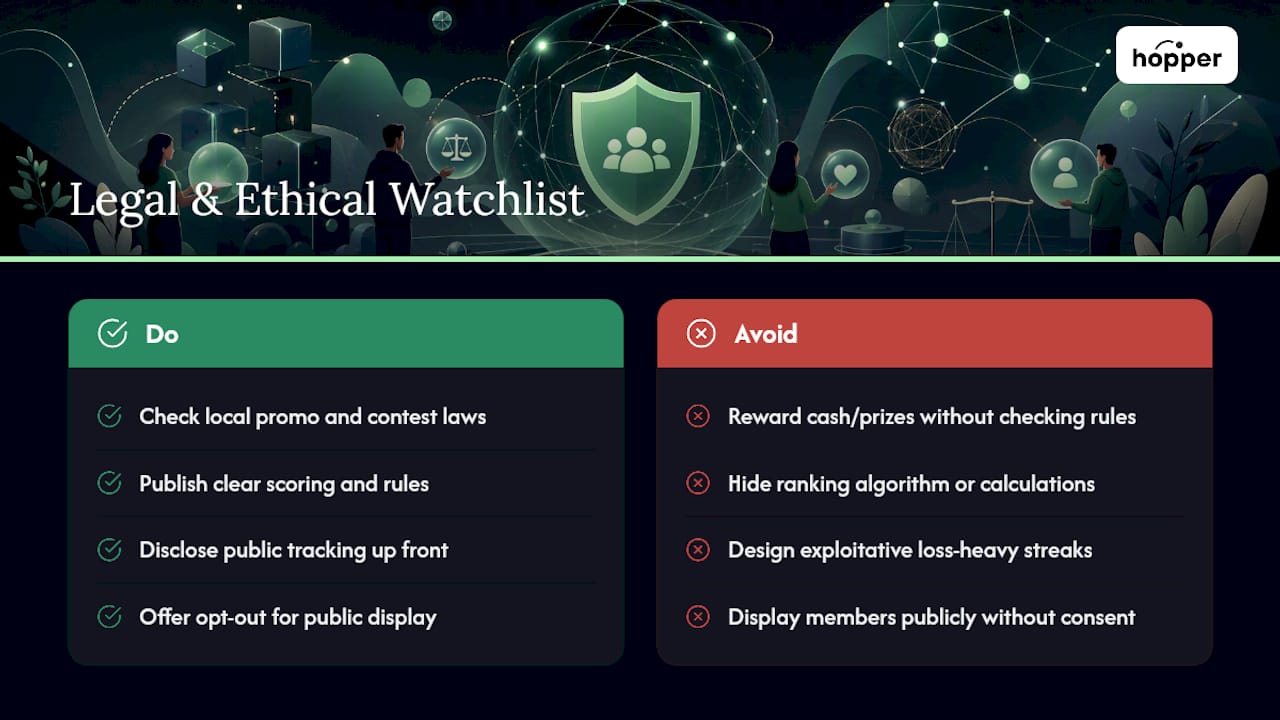
Points and badges aren't regulated the way sweepstakes or paid prize contests are, but the moment your gamification program touches money, physical prizes, or anything resembling a raffle, you cross into territory governed by consumer protection and prize-promotion law in most jurisdictions. If you're rewarding top contributors with cash, gift cards, or free access tiers, check your local rules on promotional contests before launching. Requirements vary by country and even by state, so what's fine in one market may require official rules and disclosures in another.
The ethical questions matter even when the legal ones don't apply. Publish your rules. Members should be able to see exactly how points are earned and how a leaderboard rank was calculated, not guess at a hidden algorithm. Avoid designing mechanics that exploit compulsive behavior, endless streaks with steep loss penalties, for instance, in a way that pressures members to engage past the point of genuine value to them.
Data handling deserves a mention too. If your gamification system tracks and displays member activity publicly (posts, attendance, completion), tell members that upfront and give them a way to opt out of public display even if they still participate. A member who didn't expect their name on a public leaderboard, and who now feels exposed, is a trust problem you created, not one they signed up for.
None of this should scare you away from gamification. It should just mean you treat the rulebook with the same care you'd give any other member-facing policy.
How Do You Personalize Gamification for Different Members?
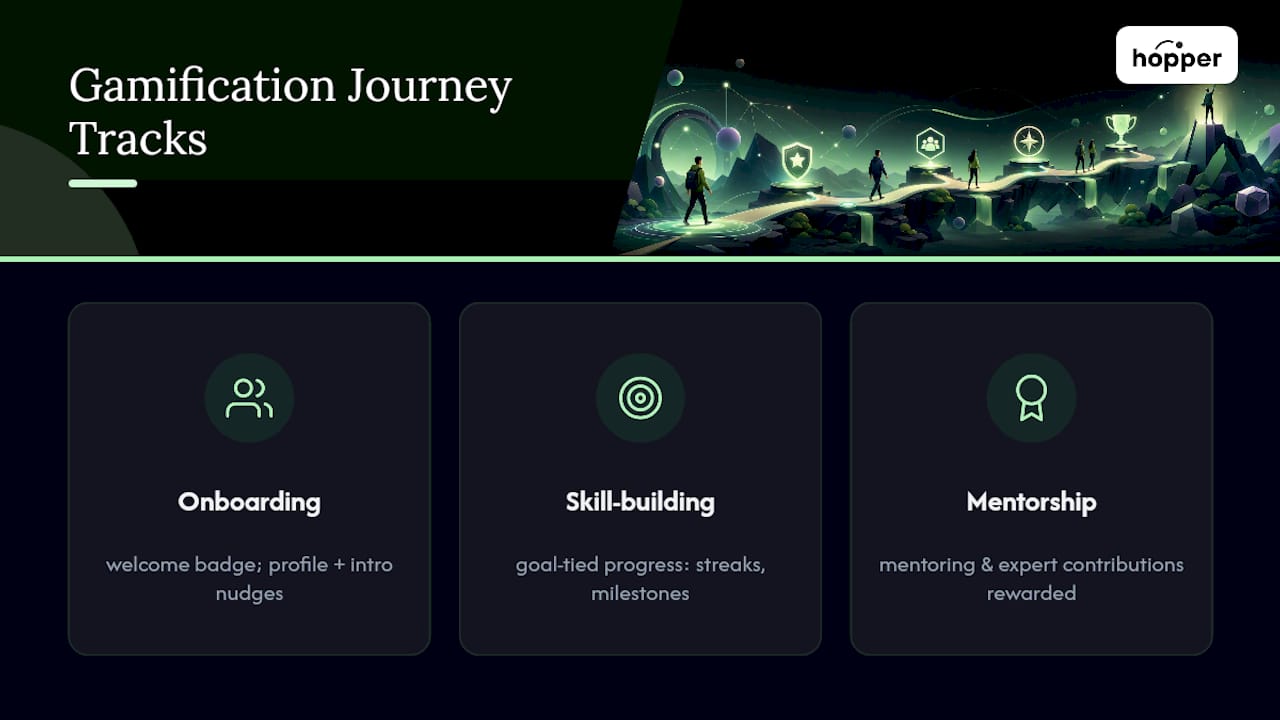
A single leaderboard treats a brand-new member the same as a two-year veteran, and that's usually a mistake. New members need onboarding quests scaled to their first 30 days: a welcome badge, a "complete your profile" nudge, an invitation to introduce themselves. Veterans need recognition tracks that reward depth, mentoring newer members, contributing expert-level content, showing up consistently over months.
Segment by more than tenure. Members who joined for a specific outcome, weight loss, launching a business, learning a skill, respond better to progress mechanics tied to that specific goal than to generic community-wide points. A fitness coaching hub might track workout streaks and milestone badges tied to actual physical progress, while a business coaching cohort tracks completed action items and revenue milestones shared voluntarily.
Behavioral segmentation matters just as much as demographic segmentation. Gainsight's guide recommends linking recognition to actual member journey milestones, like a first sale, a completed course, or a first mentoring session, so the reward feels earned rather than arbitrary. A badge for "100 posts" means nothing to a member who joined to finish one course and leave. A badge for "course completed" means everything.
The practical move: build two or three journey tracks instead of one universal point system. New-member onboarding, core skill-building, and advanced mentorship each deserve their own mechanics, calibrated to what that segment actually came for. Communities that personalize this way see stickier participation than those running one flat rewards system for everyone, according to the segmentation logic in Hivebrite's community gamification overview, particularly in communities under a few hundred active members where a single leaderboard would otherwise alienate most participants.
What Do Successful Gamification Programs Actually Look Like?
The most durable examples share a common thread: mechanics tied to a specific, real outcome, not activity for its own sake. Higher Logic's overview of gamification in online communities points to onboarding quests, weekly challenges, expert Q&A badges, and cohort-based completion pathways as patterns that consistently show up in associations and product communities that stick with gamification long term.
An onboarding quest that walks a new member through five specific actions in their first week — introduce yourself, comment on a post, attend a live session, complete your profile, join a sub-group — front-loads engagement exactly when drop-off risk is highest. A weekly challenge with a two-week structure and a visible end date keeps a community's energy renewing instead of stagnating around the same static leaderboard.
Expert Q&A badges work particularly well in knowledge-based communities, because they reward exactly the behavior (a thorough, helpful answer) that makes the community valuable in the first place. And cohort-based completion pathways, where course progress and community recognition move together, show up repeatedly in paid coaching and education contexts because they connect the reward directly to the outcome the member paid for.
What none of these examples do is reward raw volume. A points system that pays out for every post, regardless of quality, is the pattern that shows up in the failure cases, not the successes.
What Tools Support Community Gamification?
Standalone gamification plugins exist for platforms that lack native mechanics, but they add a layer of integration work: syncing point data, badge displays, and leaderboard rankings across a separate course host, community tool, and storefront. That sync gap is where a lot of gamification programs quietly break, a badge that displays on the community but not on the course dashboard, for instance.
Platforms with gamification built into the same space as the community, content, and commerce avoid that sync problem entirely, because there's no second system to keep in step. Beyond the platform layer, a genuinely useful complement is designing the challenges and quests themselves well. Resources on active learning techniques and study group communication patterns offer solid frameworks for structuring peer challenges and cohort check-ins that gamification mechanics can then reinforce, rather than replace.
Whatever platform you choose, prioritize one thing above feature lists: whether the gamification data lives in the same place as your member activity and content progress, or whether you'll be reconciling numbers across three dashboards every week.
Why Most Gamification Advice Undersells the Listening Part
That's backwards. The research on effective community engagement is consistent that listening and trust-building come before any intervention design, not after, and gamification is exactly the kind of intervention that fails when it skips that step.
What gets underweighted is fairness infrastructure. Community managers design the points system, launch it, and move on to the next project, then get blindsided three months later when members start complaining about a stale leaderboard or a badge that feels arbitrary. Build the audit cadence and the appeals process into the launch plan itself, not as a fix you scramble for later.
The single highest-leverage move for most community managers reading this: pick one target behavior, run a four-week pilot with a real cohort, and measure quality alongside quantity before you touch a second mechanic. Communities that try to gamify everything at once almost always end up diluting the signal on the one behavior that actually mattered.
— Cedrik
Run Gamification Without the Platform Juggling
Gamification only works when the reward system lives where members actually spend their time, and Hopper keeps community, content, coaching, and commerce in one hub instead of scattered across separate tools. That matters for gamification specifically: a badge, a progress bar, or a milestone means more when it shows up next to the course a member is actually completing and the storefront where they bought it, not on a disconnected community plugin.

The platform runs on native iOS and Android apps, supporting unlimited members, moderators, and hubs, so a gamified cohort challenge scales without hitting contact caps or per-seat fees. Pricing structures that reward member longevity can help support retention goals aligned with your gamification system. If you're moving off a stack of separate tools, free migration support means you can bring your existing community and content over without rebuilding it from scratch.
See how the Hopper platform fits your hub, or check what current users say about the switch before you commit.
Sources
- Community Gamification: A Step-by-Step Implementation Guide | Gainsight
- Community Gamification: Definition, Examples, Benefits | Hivebrite
- Principles of Community Engagement, 3rd Edition (ATSDR / CDC)
- Gamification in online communities | Higher Logic
FAQ
What Are the Four Types of Gamification?
Community gamification programs typically draw from four mechanic categories: points and rewards, badges and achievements, leaderboards and competition, and levels or progression systems, often combined with time-limited challenges layered on top.
Can You Give Examples of Community Games or Gamified Activities?
Common examples include onboarding quests for new members, weekly or monthly challenges with a defined end date, expert Q&A badges for helpful contributors, and cohort-based completion pathways that pair course progress with community recognition, according to Higher Logic's research on gamification.
Does Gen Z Respond Well to Gamification?
Gen Z generally engages readily with progress tracking, badges, and milestone recognition, since these mechanics mirror the gaming and app experiences this generation already uses daily, though the same rules about intrinsic motivation and fairness still apply regardless of age group.
What Are Some General Examples of Gamification Outside Communities?
Fitness apps use streaks and levels, language-learning apps use points and daily challenges, and loyalty programs use tiered status, all patterns that translate directly into community settings when tied to a specific behavior worth reinforcing.
How Long Should a Gamification Pilot Run Before Scaling?
A four to six week pilot with a defined cohort gives most communities enough signal to evaluate participation and quality before a full rollout, following the pilot-first approach Gainsight recommends.
Recommended
On our list and want off? .