
Start Small: Points, Progress Bar, One Badge for Course Creators
A practical, low-effort approach to gamifying courses: start with points, a progress bar, and one meaningful badge. Pilot with a small cohort and measure...
By the Hopper team
Gamification can raise course engagement and completion when game mechanics are mapped to clear learning objectives. Start small: add points, a progress bar, and one badge to a formative task before you touch anything bigger. Skip narrative, avatars, or full leaderboards until you've confirmed the basics move the needle on actual learning, not just clicks.
TL;DR:
- Starting with simple mechanics like points, progress bars, and one badge can significantly improve learner engagement without requiring complex features upfront.
- Avoid rewarding activities that do not demonstrate skill or knowledge, as this undermines the credibility of the gamification system and reduces learner trust.
- Pilot gamification on a single module and track key metrics such as completion rates, quiz retries, and learner feedback before expanding to more advanced features.
- Use an all-in-one platform like Hopper to streamline content, community, and progress tracking for smoother pilot implementation and evaluation.
- Incorporate gamification as an extension of existing instructional design frameworks, aligning mechanics with learning objectives and mastery levels for optimal results.
Table of Contents
- What Is Gamification for Courses, Really?
- Core Gamification Elements You Can Actually Use
- Why Does Gamification Actually Improve Learning?
- How Do You Add Gamification to an Existing Course?
- What Pitfalls Should You Watch For?
- How Do You Measure Whether Gamification Worked?
- How Does an All-In-One Platform Simplify a Gamification Pilot?
- Does Gamification Fit With Other Instructional Design Approaches?
- A Practical Perspective on Where Gamification Actually Pays Off
- Ready to Pilot Gamification Without the Tool Sprawl?
- Sources
- FAQ
What Is Gamification for Courses, Really?
Gamification means applying game design elements, points, badges, progress bars, leaderboards, to course content that was never a game to begin with. Kennesaw State University's Academic Affairs office defines it this way, and the distinction matters more than most course creators assume.
Game-based learning is different. That's building an entire game, quests, characters, a scoring engine, as the primary vehicle for instruction. It costs more, takes longer, and only pays off when the subject matter genuinely benefits from simulation or role-play (think emergency response training or language immersion).
Most courses don't need that. They need a nudge system layered on top of existing lessons. Hitchens and Tulloch frame gamification as a response to how a generation raised on games and apps expects to interact with content, which is a fair argument for why points and progress feel more motivating than a plain checklist ever did.
Core Gamification Elements You Can Actually Use
Every mechanic below serves a specific function. Pick based on the behavior you're trying to reinforce, not on what looks impressive in a demo.
- Points and XP reward incremental practice. Award them for completing drafts, answering formative quizzes, or showing up to a live session, not just for logging in.
- Badges and micro-credentials signal mastery of a discrete skill. A "Data Cleanup" badge tells a learner and future employer something specific; a generic "Participant" badge tells them nothing.
- Progress bars and level unlocks scaffold pacing. Locking module 3 until module 2's quiz score clears a threshold keeps learners from skipping foundational content.
- Leaderboards and social features tap competition and accountability, but they work best as optional, not mandatory, since not every learner is motivated by public ranking.
The Level Up XP plugin for Moodle is a useful real-world reference point. It's one of the more widely installed gamification plugins in the Moodle ecosystem, and it packages points, levels, and leaderboards into settings you configure rather than code. That's the model worth copying even if you're not on Moodle: mechanics as configuration, not custom development.
Why Does Gamification Actually Improve Learning?
The mechanism isn't magic. It's feedback timing. Points and progress indicators give learners immediate signals about where they stand, which supports retrieval practice and spacing, two of the more durable levers in learning science. A quiz that scores itself instantly and shows a running XP total turns a passive check into active feedback.
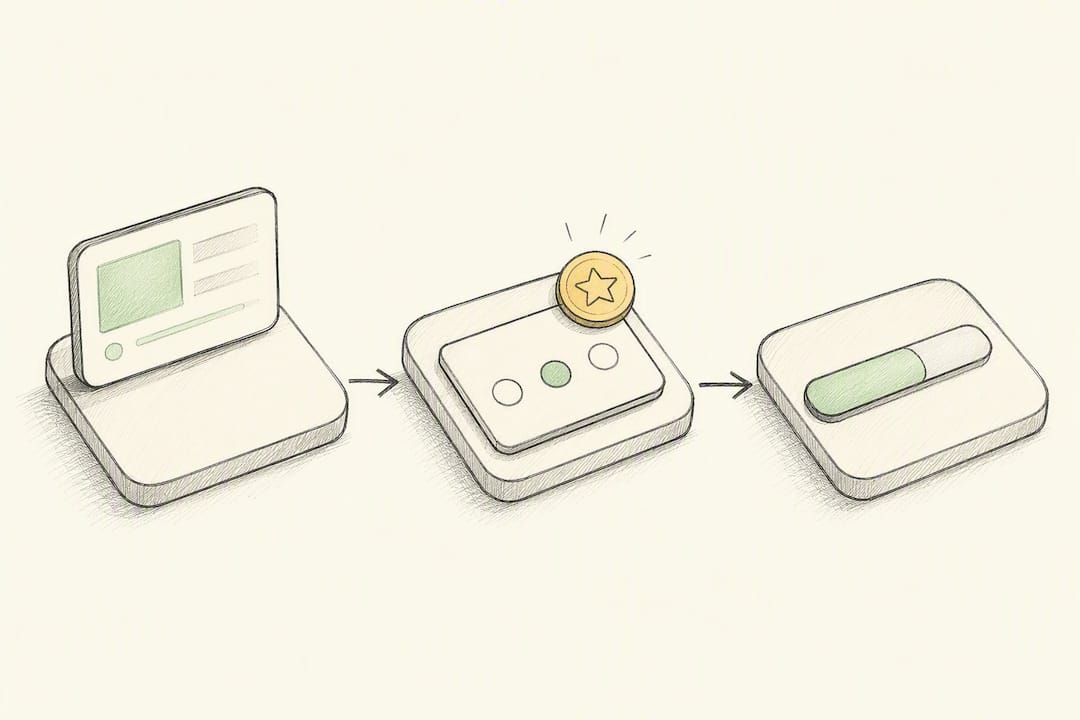
Progress visualization also shapes how competent a learner feels mid-course, which affects whether they push through a hard module or quietly drop off. Social mechanics, done well, add relatedness and light accountability, the same reason study groups outperform solo cramming for many learners.
None of this replaces good instruction. Interactive techniques improve outcomes when they're implemented coherently with clear learning objectives, not bolted on as decoration. That shifts your role from lecturer to coach: you're watching analytics, spotting who's stuck, and delivering feedback instead of just broadcasting content.
How Do You Add Gamification to an Existing Course?
You don't need a redesign. You need a sequence.
- Audit your learning objectives first. Pick one or two formative tasks, quizzes, practice drills, peer reviews, that would benefit most from immediate feedback and reward.
- Pre-assess your learners. Skipping this step is the most common beginner mistake; without knowing where learners start, you'll set difficulty too high for beginners or too low to matter for advanced ones, per Eastern Connecticut State University's teaching resources. Pairing item difficulty models with pre-assessment data, similar to the question difficulty progression guidance from BoardMaster, helps you calibrate before you build anything.
- Prototype with micro-gamification. Add a progress bar, a points system on formative quizzes, and one meaningful badge. Nothing more yet.
- Pilot with a small cohort. A small pilot cohort is enough to see whether completion rates or quiz retries shift.
- Collect metrics and direct feedback, then iterate before expanding.
- Scale what worked. Add narrative, branching paths, or team leaderboards only if the pedagogy genuinely calls for it, not because competitors have it.
Pro Tip: Run your pilot on a single module, not the whole course. A four-week module gives you enough data to judge engagement without risking learner trust if the mechanics need a rework.
Adaptive gamification, assigning different mechanics to different learner types, cuts down on the risk of alienating anyone, and it's worth building into step 3 once your prototype proves out. Research on adaptive gamification shows personalized game elements outperform one-size-fits-all setups, especially in mixed-skill cohorts.
What Pitfalls Should You Watch For?
The single most common failure is point-washing: slapping points on activities that don't actually measure skill or practice. If a badge doesn't correspond to demonstrated mastery, it teaches learners that the reward system is decorative, and they'll stop trusting it fast.
- Avoid rewarding clicks instead of competence. Points should track evidence of learning, not login streaks.
- Make leaderboards optional. Public ranking motivates some learners and demoralizes others; a team-based or private-progress alternative keeps both groups engaged.
- Design for accessibility. Badge icons, color-coded progress bars, and timed leaderboards all need to work for learners using screen readers or facing cognitive load challenges.
- Watch what you're incentivizing. A rewards system built around speed can quietly train learners to skim instead of think.
How Do You Measure Whether Gamification Worked?
Track a small set of numbers: course completion rate, time on task, quiz retry frequency, and formative assessment scores before and after you add mechanics. A simple pre/post comparison across one cohort, or an A/B split between two sections of the same course, tells you more than intuition ever will.
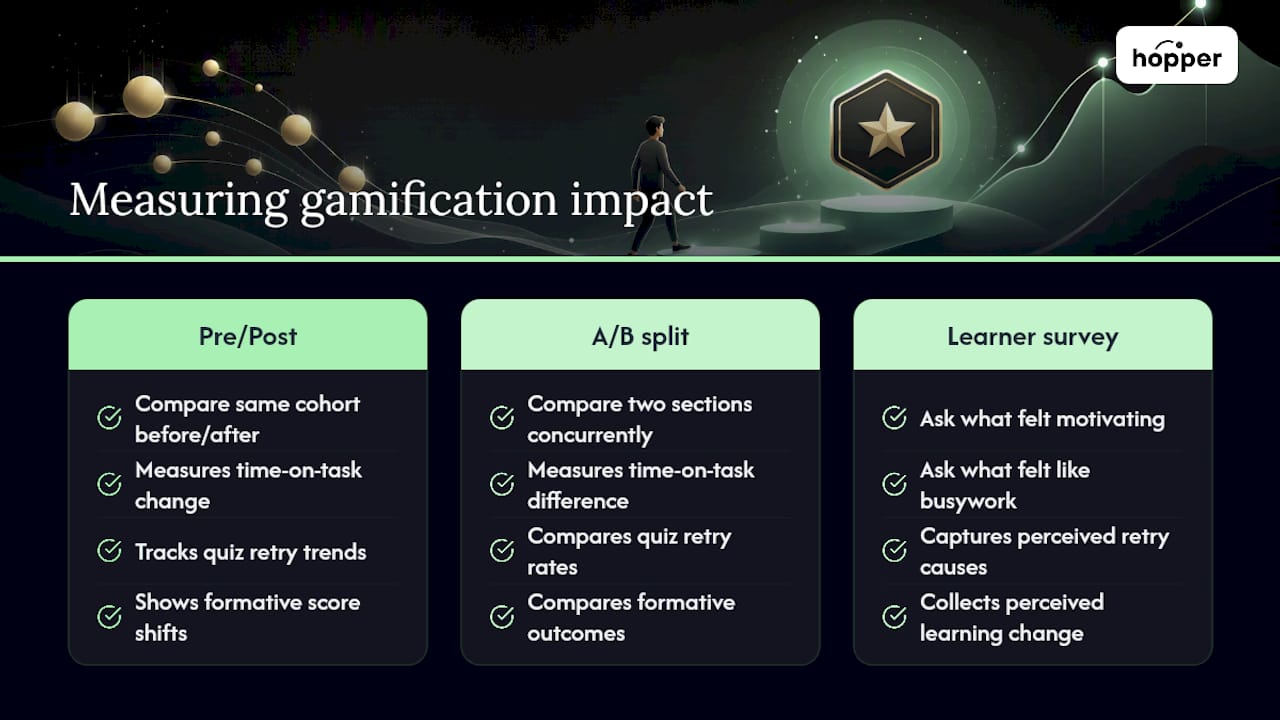
Pair the numbers with a short learner survey. Ask what felt motivating and what felt like busywork; qualitative feedback catches problems metrics miss. Harvard Business Review's coverage of gamified training is a useful gut check here: engagement often rises fast, but durable learning gains take longer to show up and require deliberate measurement to confirm. Expect an early bump in activity, and treat it as a signal to keep watching, not proof you're done.
How Does an All-In-One Platform Simplify a Gamification Pilot?
Running a pilot usually means juggling a course host, a community tool, and a separate tracker for progress data. Every extra tool is another login, another export, another place feedback gets lost.
Hopper folds content, community, progress tracking, and a storefront into a single hub, which removes most of that friction for a pilot. A few specifics that matter for gamification testing:
- Multiple hubs, members, and products, so a pilot cohort doesn't need a separate paid tier or a workaround for member caps.
- Access via iOS and Android apps, useful if your learners check progress and badges from their phones between sessions.
- Pricing mechanisms that can reward learners for staying enrolled longer, a mechanic that pairs naturally with the progress and unlock systems described above.
- Support for creators moving an existing course and community over rather than starting from zero.
A practical scenario: run a six-week pilot inside a private cohort hub, track progress bars and a badge or two through the built-in analytics, and decide whether to expand based on completion and retry data rather than gut feel.
Does Gamification Fit With Other Instructional Design Approaches?
Gamification isn't a standalone methodology. It's a layer that sits on top of whatever instructional framework you're already using, and it tends to work better as reinforcement than as replacement.
If your course follows Bloom's Taxonomy, map mechanics to cognitive levels rather than treating every task the same. Points for a recall-level quiz should carry less weight than a badge earned for an application-level project. If you're using backward design, where you start from the assessment and work backward to lesson content, gamification slots in at the assessment layer: XP and progress bars make formative checkpoints visible without changing what those checkpoints measure.
Mastery-based learning pairs especially well with level unlocks, since both approaches already gate advancement on demonstrated competence rather than time spent. If you're running a flipped classroom or blended model, gamified pre-work, quick quizzes with instant point feedback, can replace passive reading checks and give you data on who's actually prepared before a live session.
The mistake to avoid is treating gamification as a separate initiative that competes with your instructional design for attention. Build it as an extension of the framework you already trust. If backward design tells you what to assess, let gamification tell you how to make that assessment visible and motivating, not what to assess in the first place.
A Practical Perspective on Where Gamification Actually Pays Off
Most course creators overinvest in the wrong layer. They build leaderboards and narrative arcs before confirming that a simple progress bar changes completion rates. Start with the cheapest mechanic that targets a real objective, and only add complexity when a pilot proves the simple version isn't enough.
Three moves matter more than any framework: pick one mechanic, run a small pilot, and measure before you expand. Let learner data, not instinct, decide what comes next.
— Cedrik
Ready to Pilot Gamification Without the Tool Sprawl?
If you've been testing progress bars in one tool, quizzes in a second, and community feedback in a third, you already know how much friction that creates before you even get to results. Hopper puts your content library, cohort discussions, progress tracking, and storefront in one hub, so a six-week gamification pilot doesn't require stitching together four subscriptions to see if it works.

Because Hopper runs on loyalty pricing and unlimited members per hub, you can test a badge system or a points structure on a real cohort without worrying about hitting a contact cap mid-pilot. If you're moving an existing course over from another platform, the free migration support handles the heavy lifting so you can focus on the mechanics, not the move. Start a trial and run your first pilot module this month.
Sources
- Gamifying Course Content - Academic Affairs (Kennesaw State University)
- Level Up XP - Gamification 🏅: Product details — Moodle Marketplace
- Interactive teaching methods and empirical evaluation protocol (PMC)
- Does gamified training get results? — Harvard Business Review (2023)
FAQ
What Is the Difference Between Gamification and Game-Based Learning?
Gamification applies game elements like points and badges to existing course content, while game-based learning builds an entire game as the primary instructional vehicle, a distinction Kennesaw State University's faculty guidance draws explicitly.
How Do I Start Gamifying My Online Course?
Audit your learning objectives, pre-assess learners to calibrate difficulty, then prototype with a progress bar, points on one formative task, and a single badge before expanding to anything more complex.
Do Leaderboards Actually Help Learning?
Leaderboards can boost engagement for competitive learners but demotivate others, so making them optional or shifting to team-based scoring avoids the drop in motivation that a mandatory public ranking often causes.
What's the Biggest Mistake Course Creators Make With Gamification?
Point-washing, adding points or badges that don't correspond to actual skill or practice, is the most common failure, since it teaches learners the reward system is decorative rather than meaningful.
Can I Run a Gamification Pilot Without Building Custom Software?
Yes. Plugins like Level Up XP for Moodle or an all-in-one platform such as Hopper let you configure points, progress tracking, and badges without custom development, which keeps a pilot's cost and timeline low.
Recommended
On our list and want off? .