
20 seat founding cohort: Launch a Paid Online Community for Coaches
Launch a paid community for coaches & educators with a 20 seat founding cohort, one weekly ritual, and a 60–90 day plan to boost activation.
By the Hopper team
Start paid with a 20 seat founding cohort, one protected weekly ritual, and a one-sentence transformation promise. Price that first cohort in a tested band, typically a moderate amount depending on how much of the value comes from content versus connection, and recruit those 20 members through direct, personal outreach before you ever open the doors publicly.
TL;DR:
- Building a successful paid community begins with recruiting a small, targeted founding cohort through personal outreach and offering a discounted, fixed number of seats.
- Clear, specific one-sentence promises that define the audience, outcome, timeframe, and obstacle are critical to aligning pricing and attracting the right members.
- Communities with predictable rituals and member-to-member value retain members longer than those relying solely on content libraries, making ritual design essential.
- Pricing should match the value offered: $26–$50 for connection, $79–$149 for transformation, and over $197 for premium access with direct coaching.
- Using an all-in-one platform like Hopper eliminates technical friction, simplifies management, and supports growth through native mobile apps and integrated content, payments, and coaching tools.
Table of Contents
- Why Paid Communities Work for Coaches: What Members Actually Pay For
- Define the Transformation: Write a One-Sentence Offer That Aligns Pricing and Delivery
- Validate and Recruit Founding Members: The 30 to 60 Day Founding Cohort Playbook
- Platform and Tech Checklist: The Minimum Capabilities You Need
- Pricing and Revenue Models: How to Structure Tiers and Build a Revenue Stack
- Launch Plan: A 60 to 90 Day Schedule to Reach Your First Paying Group
- Engagement and Retention Playbook: Rituals, Onboarding, and Moderation
- Growth and Monetization Levers: Referrals, Content, and Paid Acquisition
- Metrics That Matter: Churn, LTV, and Simple Dashboards
- How Hopper Supports Launching and Operating a Paid Community
- An Editorial Perspective on Launching a Paid Community
- Why Coaches Are Evaluating Hopper for Their Paid Community
- Sources
- FAQ
Why Paid Communities Work for Coaches: What Members Actually Pay For
People do not pay for access to a chat room. They pay for a change in their life, a sense of belonging to people like them, or a shortcut to information they would otherwise have to hunt down alone. Every pricing decision you make later traces back to which of these three you are actually selling.
- Transformation led offers sell an outcome, like losing 20 pounds or landing three new clients, and can command $79 to $149 or more because the coach's guidance is doing real work.
- Connection led offers sell belonging: peer accountability, shared struggle, a room of people who get it. These tend to sit in the $26 to $50 range because the coach's direct labor per member is lower.
- Access led offers sell proximity to an expert or a body of work, VIP hours, a content library, or direct feedback, and can push past $197 when the access itself is scarce.
Harvard Business Review's reporting on paid communities makes a point worth taking seriously here: the communities that retain members are the ones built around predictable rituals and member to member value, not just content dumps. That single insight should shape your pricing conversation before it shapes your feature list. A connection community with a strong weekly ritual will outlast a content library that nobody logs into after week two.
Define the Transformation: Write a One-Sentence Offer That Aligns Pricing and Delivery
Every paid community that grows past its founding members can trace its success back to one sentence. Not a page. A sentence you could say out loud to a stranger and have them understand exactly why they'd pay.
The formula looks like this:
- Name the audience. Who exactly is this for? Not "entrepreneurs." Freelance copywriters. New personal trainers. First time yoga studio owners.
- Name the outcome. What changes for them? Not "grow your business." Book five new coaching clients. Hit your first $10,000 revenue month.
- Name the timeframe. Vague promises don't convert. "In 90 days" or "in your first quarter" gives the offer a shape.
- Name the obstacle you remove. This is the part most coaches skip. "Without cold outreach" or "without burning out" tells the reader what pain disappears.
Put together, it reads like: "Join [Community Name] and book five coaching clients in 90 days without a single cold DM."
Once you have that sentence, your deliverables write themselves. A business coach selling that exact promise needs a weekly hot seat call, a starter course on warm outreach, and monthly office hours. A fitness coach promising a 12 week body recomposition without extreme dieting needs a workout library, a weekly check-in thread, and a private feedback channel for form checks. A creative professional promising a finished portfolio in 60 days without working for free needs peer critique sessions and a submission ritual.

Pro Tip: Write your one-sentence promise, then hand it to five people who are not in your audience. If they can guess what you're selling, you've written it too vaguely. Specificity is what makes people reach for their wallet.
Validate and Recruit Founding Members: The 30 to 60 Day Founding Cohort Playbook
Nobody should open a paid community to the public on day one. The smarter path is a private validation cohort that proves people will actually pay before you build anything permanent.
- Pick 30 people from your existing audience who match your one-sentence promise almost exactly, whether that's email subscribers, past clients, or social followers who've engaged with your content.
- Reach out one by one, not with a mass email. A short, personal message asking if they'd want early access at a discounted founding rate gets far better response than a broadcast ever will.
- Offer a locked-in founding member rate, often 30 to 50% below what you'll charge publicly. GreyJournal's breakdown of paid community launches points to this exact pattern, small founding cohorts recruited through direct outreach, as the path several successful communities used to reach their first 50 paying members within 60 days.
- Set a hard cap, something like 20 or 30 seats, and say so publicly. Scarcity here is not a trick; it is what keeps the first room small enough for you to actually know everyone in it.
- Run the cohort for 30 days before opening to the public, using that window to test your ritual, your pricing, and your onboarding flow while the stakes are low.
During those first 90 days, make three commitments to yourself and stick to them. Reply to every new post within 24 hours. Never skip the weekly ritual, even if only three people show up. Build an onboarding flow that gets every new member to post or introduce themselves within their first week. Communities that skip this step lose members quietly, the kind of churn you don't notice until the room feels empty.
Platform and Tech Checklist: The Minimum Capabilities You Need
Tool sprawl kills momentum faster than almost anything else. Coaches routinely stitch together a course host, a separate community tool, a checkout page, and a link-in-bio tool, and end up paying four different bills for a system that still feels disconnected.
Before you commit to any platform, confirm it handles these without a workaround:
- Native payment processing so members can subscribe without manual invoicing.
- A mobile app, ideally on mobile devices, since most engagement in an active community happens between desk hours, on a phone, in short bursts.
- Single sign-on so members log in once and reach content, discussions, and coaching in the same place.
- A content library that supports video, audio, and live replays without a separate hosting subscription.
- An events or calendar function tied to your weekly ritual, not a separate calendar link members have to hunt for.
- Member search and directory tools so people can find each other, which matters more for connection-led communities than any other feature on this list.
- Moderation tools, including the ability to pin posts, set community guidelines, and remove or mute disruptive members quickly.
The tradeoff between an all-in-one platform and a stitched-together stack usually comes down to migration pain, member discovery, and cost. A stitched stack means members log in to one place for courses and another for community, which quietly kills engagement because half your members forget the second login exists. When evaluating any platform, ask directly: does this cap my members or contacts at a certain tier? Does the mobile app cost extra? What happens to my content and member list if I need to leave?
Pricing and Revenue Models: How to Structure Tiers and Build a Revenue Stack
Pricing a paid community is not about finding the "right" number. It's about matching the price to the value type you identified earlier, then building additional revenue layers once the core membership is stable.
A workable tier structure often looks like this:
- Entry tier ($26 to $50): community access, the weekly ritual, and a starter course. This is where most connection-led communities live.
- Core tier ($79 to $149): everything in entry plus a deeper content library, group coaching calls, and priority support.
- Premium tier ($197+): everything above plus 1:1 or small-group async coaching, VIP events, or direct feedback from the coach.
Shopify's guide to membership sites notes that most successful memberships settle on two or three tiers rather than five or six. Too many tiers confuses the buying decision and makes support harder to manage.
Once the core membership is generating steady revenue, layer in additional streams rather than raising your base price every few months. Scrile's research on community monetization describes this as a resilience strategy: memberships first, then coaching upsells, then live events, then digital products, then sponsorships once your audience is large enough to interest a brand partner. Communities that depend on a single income stream tend to feel every market dip; a layered stack absorbs the shock.
A useful early benchmark: if your entry tier sits around $30 a month, 50 paying members gets you to $1,500 monthly recurring revenue before any upsell, coaching offer, or event ticket is sold.
Launch Plan: A 60 to 90 Day Schedule to Reach Your First Paying Group
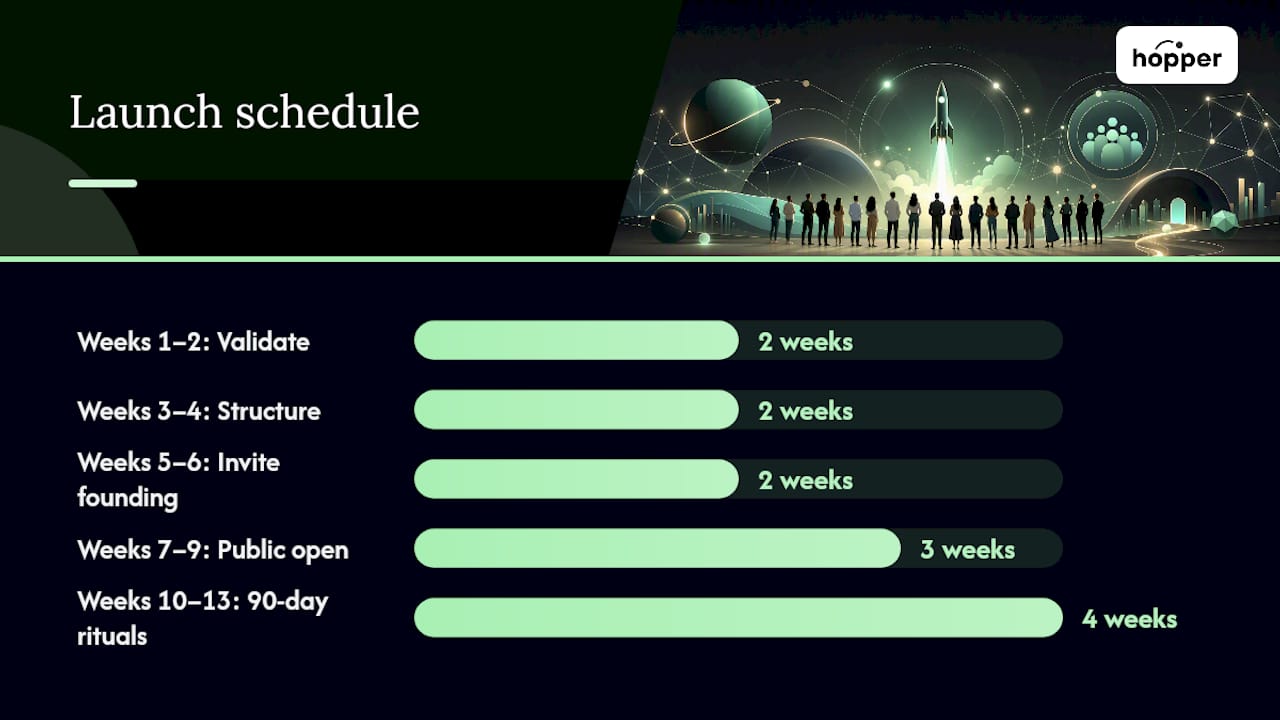
Turning validation into a real launch works best on a calendar, not a vague intention to "get it live soon."
Weeks 1 to 2: Validate.
- Draft your one-sentence promise and test it on five to ten people in your existing audience.
- Set your founding member price and seat cap.
Weeks 3 to 4: Structure.
- Build the minimum viable setup: a pinned welcome post, one short starter course, and a scheduled weekly ritual.
- Write your onboarding sequence, three to five emails that walk a new member from signup to their first post.
Weeks 5 to 6: Invite founding members.
- Send personal outreach to your target 20 to 30 names.
- Run the private cohort and adjust pricing, ritual timing, or content based on what actually gets used.
Weeks 7 to 9: Public open.
- Open enrollment publicly, using founding member testimonials and early wins as proof.
- Set a soft enrollment deadline to create urgency without gimmicks.
Weeks 10 to 13: First 90-day rituals.
- Protect the weekly ritual no matter attendance size.
- Track early engagement weekly, not monthly, so you catch drop-off before it becomes churn.
A few things separate a launch that fizzles from one that sticks:
- Onboarding emails that push toward one specific action (introduce yourself, join the next call) rather than a general "welcome, look around."
- A founding-member incentive, locked pricing or a bonus session, that rewards people for joining before public buzz exists.
- Tracking your invite-to-paid conversion rate from week one. If fewer than 1 in 5 people you personally invite convert, your offer or price needs adjusting before you scale outreach.
Engagement and Retention Playbook: Rituals, Onboarding, and Moderation
Retention gets decided in the first seven days, not the first month. A new member who posts once, gets a reply, and shows up for the next ritual is a member you'll likely keep for a year. A new member who logs in once and sees silence is gone within two weeks.
- Design onboarding around a forced early interaction. A welcome thread that asks a specific question, not "introduce yourself" but something like "what's the one thing you want out of this group," gets far higher response rates.
- Protect your single weekly ritual even when attendance dips. A call with three people who show up consistently builds more trust than a call with thirty that happens sporadically.
- Introduce accountability pods once you pass 40 or 50 members. Small subgroups of five to eight people create the kind of intimacy a large main feed can't replicate.
- Hand out member roles, like a "founding member" badge or a rotating discussion host, once the community is stable. Letting members carry small pieces of the culture reduces how much weight sits on the coach alone.
Pro Tip: Track who posts in someone else's thread during their first week, not just who posts their own introduction. Members who reply to others before they're asked to are the ones most likely to stick around and eventually moderate for you.
Growth and Monetization Levers: Referrals, Content, and Paid Acquisition
Once the founding cohort is stable, growth should come from channels you can actually measure, not just hope.
- Referral programs work best when the reward benefits both sides: a free month for the referrer and a discount for the new member, rather than a reward for one party only.
- Content funnels built from real member wins, a short case study, a screenshot of a transformation, a quote from inside the community, convert better than generic promotional posts because they show the actual promise being kept.
- Guest appearances on podcasts, newsletters, or other coaches' communities can drive founding-style urgency if you offer a limited-time rate to that specific audience.
- Paid acquisition should wait until you know your numbers. Run a small test budget, track cost per acquired member against your average member lifetime value, and only scale spend once that ratio clearly favors you.
Partnership-driven growth, cross-promoting with adjacent coaches or businesses serving the same audience, tends to outperform cold paid ads for small communities because the trust transfer happens instantly. A shared audience already believes the referring partner, which shortens the path to a first paid signup.
Metrics That Matter: Churn, LTV, and Simple Dashboards
You need five numbers, tracked weekly, not a dashboard full of vanity metrics.
- Churn rate: the percentage of members who cancel each month. Early-stage communities should aim to keep this under 10%.
- Activation rate: the percentage of new members who complete a meaningful first action, posting, attending the ritual, within seven days.
- LTV (lifetime value): average monthly price multiplied by average months a member stays.
- ARPA (average revenue per account): total monthly revenue divided by total members, useful once you have multiple tiers.
- Event conversion: the percentage of free webinar or content attendees who convert to paid.
You do not need enterprise software for this. A Stripe dashboard for payment and churn data, your email platform for open and click rates, and a shared spreadsheet tying it together is enough for the first year. Webflow's guide to membership sites recommends starting lean here too: instrument the basics before investing in anything more elaborate.
How Hopper Supports Launching and Operating a Paid Community
Most of the friction in the steps above, payments, mobile access, content hosting, coaching delivery, comes from running four separate tools that don't talk to each other. Hopper was built to remove that specific problem.
- Native iOS and Android apps at every pricing tier, so your weekly ritual and discussions live where members actually check their phones.
- Unlimited members, moderators, and products, with no contact caps forcing you into a higher tier as you grow.
- Async coaching built in, so members can get direct feedback without a separate booking tool.
- A single storefront for courses, community access, and digital products, replacing the checkout-plus-link-in-bio combination most coaches assemble by hand.
Switching platforms is usually the slowest part of any migration, moving payment processors and member lists tends to eat more time than anything else. A platform built to handle that transfer directly removes a real source of delay for coaches consolidating their stack.
An Editorial Perspective on Launching a Paid Community
Three mistakes sink most launches. First, opening publicly to an empty room, which is why the founding cohort matters more than any feature list. Second, pricing too low out of fear, which attracts price-sensitive members who churn at the first dip in attention. Third, the founder going quiet after the first excitement fades, which kills momentum faster than bad content ever could. When growth stalls, resist the urge to add features; fix retention first. Commit to 90 days of visible presence before you judge whether the model works at all.
— Cedrik
Why Coaches Are Evaluating Hopper for Their Paid Community
If you've read this far, you already know the real cost of building a paid community isn't the idea, it's the plumbing: getting payments, mobile access, a content library, and coaching delivery to work together without four separate bills. Hopper puts all of it in one hub, with unlimited members and products at a flat monthly rate instead of a per-tier tax on growth.

If you're currently stitching together tools and wondering what a consolidated hub actually looks like, the Hopper homepage walks through the full feature set, and the free migration program exists specifically for coaches moving their existing members and content over without rebuilding from scratch.
Sources
- How to create an online community that people will pay for (HBR)
- Monetize an Online Community: Proven Steps 2026 - Scrile
- How to create a membership website (Webflow blog)
- How to Build a Paid Community That Makes Money (GreyJournal)
FAQ
How Can I Create My Own Online Community?
Start with a one-sentence transformation promise, recruit 20 to 30 founding members through direct outreach, and protect one weekly ritual before you open the doors publicly.
What Are the Main Types of Paid Communities?
Most fall into three categories: transformation-led communities built around an outcome, connection-led communities built around peer belonging, and access-led communities built around proximity to an expert or exclusive content.
What Makes an Online Community Successful?
Predictable rituals and real member-to-member value drive retention more than any single feature or content library, according to Harvard Business Review's reporting on paid communities.
How Much Should I Charge for a Paid Community?
Price according to value type: $26 to $50 for connection-led communities, $79 to $149 for transformation-led coaching, and $197 or more for premium access with direct coaching or feedback.
Do I Need a Course Platform and a Community Tool Separately?
Not necessarily. An all-in-one platform like Hopper combines a content library, community discussions, checkout, and async coaching in one hub, which avoids the login friction and per-tier cost increases that come with stitching together separate tools.
Recommended
On our list and want off? .