
Charge Premium: Revenue Math and 2026 Benchmarks for Coaching Programs
Run a revenue first cost floor, test prices with paid discovery calls, use 2026 benchmarks, and consolidate tools to support premium coaching fees.
By the Hopper team
Price your coaching program around the transformation you deliver, not the hours you spend delivering it. Start with a cost-floor-plus-revenue-goal formula to find the number you can't drop below, then build three packaged tiers positioned inside real market benchmarks. Test the offer with a small paid discovery call before you commit to the price publicly.
TL;DR:
- Pricing should be based on the value and transformation delivered, not hours spent, with three-tier packages positioned within market benchmarks for your niche.
- Calculating your cost floor requires accounting for your minimum income, fixed costs, taxes, and realistic billable hours, with a common recommendation of budgeting 12 to 15 hours per week.
- Market benchmarks suggest coaching packages generally range from lower-tier options in wellness niches to premium prices in executive coaching, depending on experience and proof of results.
- Designing a good package structure involves offering a middle default option priced to feel like the best value, with clear spacing and justifications for add-ons to drive conversions.
- Using a consolidated platform can enhance perceived value and operational margins, supporting the ability to charge premium prices and deliver a seamless client experience.
Table of Contents
- How to Price a Coaching Program: Choosing the Right Model
- How Do You Calculate Your Coaching Program Cost Floor?
- What Should You Charge? Coaching Rate Benchmarks by Experience and Niche
- Designing a Good/Better/Best Coaching Package Structure
- How Do You Price a Group Coaching Program?
- Payment Plans, Deposits, and Cancellation Policies That Protect Your Revenue
- Six Pricing Mistakes That Quietly Cost Coaches Thousands
- How Do You Test and Raise Coaching Prices Without Losing Clients?
- Why a Consolidated Delivery Platform Supports Premium Coaching Prices
- An Editorial Take on Pricing Confidence
- Where to Host and Sell a Premium Coaching Program
- Sources
- FAQ
How to Price a Coaching Program: Choosing the Right Model
Every coach eventually asks the same question: charge by the hour, or charge for the outcome? The answer shapes everything downstream, from how you talk about your work to how much you actually keep at the end of the year.
Hourly pricing is the easiest model to explain and the hardest one to scale. You trade time for money, which means your income has a hard ceiling the moment your calendar fills up. It works fine for consulting-style engagements or a first few clients while you're testing your niche, but it punishes you for getting efficient. The better you get, the less each hour is worth to you personally.
Packages bundle a set number of sessions, plus support between calls, into one price. This is the model most established coaches land on, because it lets you price the transformation instead of the clock. Clients also commit more fully when they've bought a defined container rather than a loose string of appointments.
Retainers work like a subscription: a flat monthly fee for ongoing access, often used by executive or business coaches whose clients need standing support rather than a fixed curriculum. Retainers create predictable revenue but require you to keep proving value every single month, since there's no natural end point to remind the client why they signed up.
Value-based pricing sets the fee according to the result, a promotion, a revenue increase, a health outcome, rather than the time it took to get there. It's the hardest model to master because it demands real proof of outcomes, but it produces the highest margins once you have that proof.
Most coaches end up running a hybrid: a signature package priced on value, with an hourly or retainer option reserved for outlier requests. Here's a quick way to match model to goal:
- Want predictable monthly income? Lean toward retainers or memberships.
- Want premium positioning fast? Build value-based packages with strong outcome framing.
- Want to grow client volume? Use tiered packages with a clear entry point.
- Still validating your niche? Hourly or short packages buy you data without overcommitting.
How Do You Calculate Your Coaching Program Cost Floor?
Your cost floor is the price below which you lose money or burn out. Almost every underpriced coach skipped this step and went straight to guessing based on what a competitor charges.
Here's what you need to plug in:
- Personal minimum take-home — the income you need monthly to cover your life, not your ideal income, your floor.
- Fixed business costs — software, insurance, contractor fees, marketing spend.
- Taxes — self-employment tax and income tax reserves, often 25 to 30% depending on your situation and location.
- Realistic billable capacity — the actual number of sessions you can run in a month, not the theoretical maximum.
That fourth input trips up more coaches than any other. You might imagine you can run 25 client sessions a week. In practice, admin time, sales calls, content creation, and simple fatigue eat into that number fast. Axiom Workspace's cost-floor methodology recommends budgeting for 12 to 15 realistic billable hours per week for most solo coaches, not 30 or 40.
Pro Tip: *Track your actual billable hours for one full month before you set any price.
The formula looks like this:
(Personal minimum take-home + fixed costs + tax reserve) ÷ realistic billable sessions per month = your per-session floor
Here's a worked example. That's roughly $8,056 in required monthly revenue.
The formula in action: Paperbell's revenue-first model runs a similar calculation for a coach targeting $120,000 a year, landing on a minimum hourly rate near $179 an hour once utilization assumptions are applied. Your own number will move depending on your income target and how many hours you're realistically willing to sell.
Utilization rate is the piece most pricing calculators skip. If you assume you'll sell every single available hour, your floor looks artificially low, then you miss your income goal by a wide margin the first month bookings slow down. Build in the gap on purpose.
What Should You Charge? Coaching Rate Benchmarks by Experience and Niche
Once you know your floor, you need a ceiling that doesn't sound made up. Market benchmarks tell you what buyers in your niche are already conditioned to pay, so your price doesn't create sticker shock before the sales call even starts.
Industry data groups coaching packages into three broad tiers based on experience and proof of results:
These ranges come from current 2026 benchmarking data on coaching packages, and they shift meaningfully by niche. Executive and business coaching commands the top of the range because the outcome is measurable in dollars: a promotion, a revenue increase, a funding round closed. Life and wellness coaching tends to sit lower, not because the work matters less, but because the financial ROI is harder for a buyer to quantify upfront.
Rather than copying a single competitor's number, look at a cluster of five to ten coaches in your niche and note where most of them land. One outlier charging double everyone else usually has a specific reason, a book, a certification, a visible client roster, that you may not have yet. The cluster tells you the real market range; the outlier tells you where you're headed.
Pro Tip: If your niche has thin public pricing information, ask three coaches at a similar experience level what they charge for a comparable package. Most will tell you, especially if you're not a direct competitor.
Designing a Good/Better/Best Coaching Package Structure

Three tiers do something a single price can't: they let the client choose their own commitment level while you steer them toward the option you actually want to sell. The middle tier, not the cheapest one, should be your default recommendation, because it's positioned to look like the obvious value once the client sees it next to the other two.
A workable structure looks like this:
- Starter tier: A shorter engagement, fewer touchpoints, designed as a lower-friction entry point rather than your core offer.
- Signature tier: Your flagship package, built around the full transformation you're known for, with the session count and support level that gets your best results.
- VIP tier: Everything in the signature tier plus faster access, more direct contact, or bonus components like done-with-you materials.
Spacing matters more than the absolute dollar figures. If your starter tier is $1,500 and your signature tier is $1,700, there's no incentive to upgrade. If the signature tier is $3,200 against a $1,500 starter, the gap makes the middle option feel like the sensible middle ground rather than a leap. Tiered pricing frameworks consistently show that the spacing between tiers drives conversion more than the individual numbers do.
Add-ons should carry their own clear justification, an extra async check-in, a workbook, priority scheduling, rather than feeling like padding to inflate the top tier. Price an add-on the way you'd price anything else: what does it cost you in time or delivery, and what's it worth to someone who wants it badly enough to pay extra?
Pro Tip: Keep your single-session price 20 to 30% higher than the effective per-session rate inside your package. That gap is what makes the package the rational choice on the sales call.
How Do You Price a Group Coaching Program?
Group programs change your math entirely, because you're now selling one delivery slot to many people instead of one client at a time. The starting point is always your 1:1 baseline price, discounted per person to reflect the shared, less individualized format.
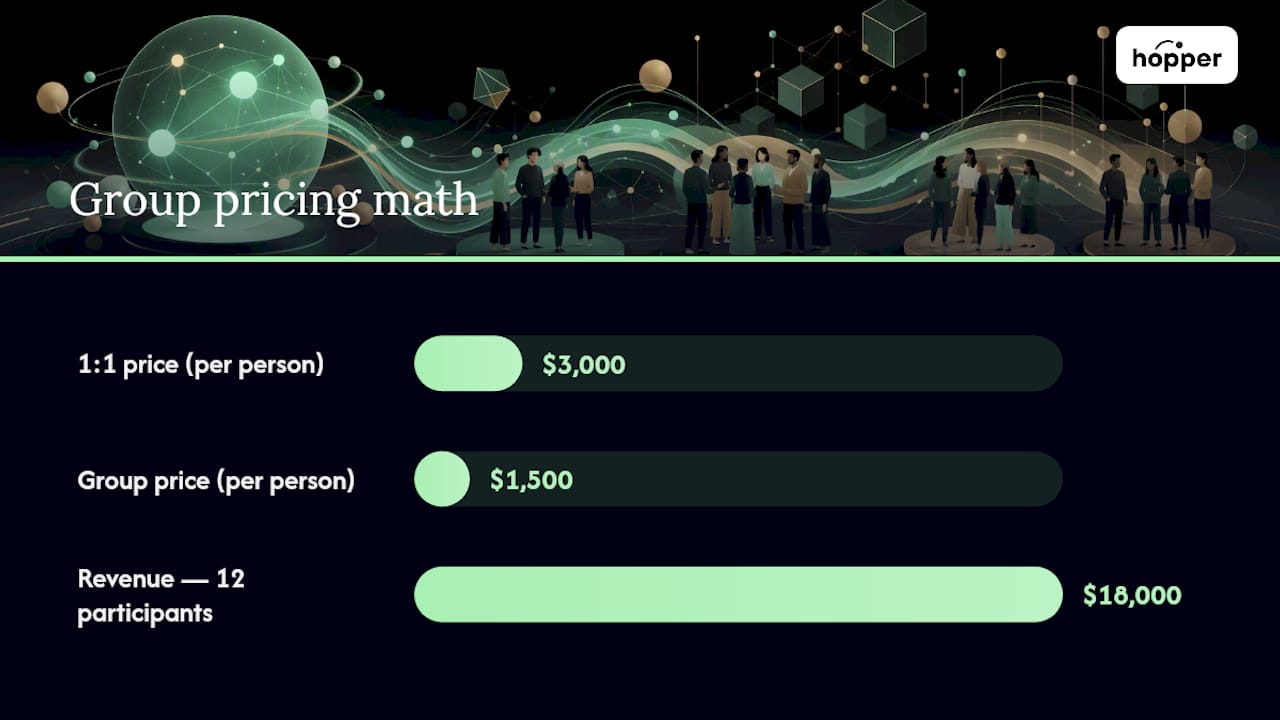
The revenue upside is real: a $3,000 1:1 package earns you $3,000. A $1,500 group offer sold to 12 people earns $18,000 for a comparable time investment, which is why so many coaches eventually add a cohort option even when 1:1 work remains their core service.
Format changes the price ceiling too:
- Small cohorts (6 to 10 people) support a smaller discount, since participants still get meaningful individual attention.
- Large open groups (20+ people) need a steeper discount, since the value shifts from personal coaching toward community and curriculum.
- Hybrid formats, group calls plus limited 1:1 check-ins, sit in between and price accordingly.
Don't forget to price in the overhead a group format actually creates. Facilitation time, tech for hosting calls or a member community, and the marketing push needed to fill a cohort by a fixed start date all cost more than a rolling 1:1 intake. Build those costs into the per-person price before you commit to a launch date, not after you've already sold seats.
Payment Plans, Deposits, and Cancellation Policies That Protect Your Revenue
Payment mechanics decide how much of your quoted price you actually collect. Get them wrong and you'll spend as much energy chasing invoices as you do coaching.
- Offer installments at price parity or a small premium. A three-payment plan should cost the same as paying in full, or slightly more, five to ten percent, never less. Discounting installments trains clients to expect a discount for the privilege of paying you slower.
- Set deposits between 20 and 50% of total package value. A deposit secures the client's spot and covers your time if they don't show up ready to commit. Make the crediting rule explicit upfront: is it refundable, transferable to a future date, or forfeited on no-show?
- Define a cancellation window in writing. A 24 to 48 hour window for session rescheduling is standard. Anything canceled outside that window should either be forfeited or charged a late fee, stated in your contract before the first session, not improvised after the third no-show.
These policies aren't about being strict for its own sake. They're about making sure your calendar, and your income, isn't at the mercy of a client's changing schedule.
Six Pricing Mistakes That Quietly Cost Coaches Thousands
Most pricing damage happens quietly, one underpriced client at a time, until a coach looks up a year later and wonders why they're exhausted and still broke.
- Copying a competitor's price without knowing their costs, niche, or proof. Their number reflects their business, not yours.
- Underpricing to seem accessible. This usually attracts clients who negotiate everything else too, not more clients overall.
- Charging only by the hour. It caps your income at your calendar's physical limit.
- Forgetting to price for non-session work. Prep, follow-up messages, and materials all cost time that has to be baked into the package price, not donated.
- Apologizing for your price on the sales call. Hedged language signals to the client that even you aren't sure the number is fair.
- Skipping the math entirely and pricing on vibes. Common pricing errors almost always trace back to a coach who never ran a cost-floor calculation in the first place.
Pro Tip: If you catch yourself justifying your price mid-sentence on a call, that's the signal to revisit your container, not your confidence. A clearly defined package rarely needs a defense.
The fix for all six is the same: run the formula, build a defined offer with clear boundaries, and start collecting outcome evidence from your first clients. That evidence becomes your best pricing leverage six months from now.
How Do You Test and Raise Coaching Prices Without Losing Clients?
Pricing isn't a one-time decision. It's a hypothesis you test, measure, and adjust.
- Run a small paid discovery call priced at $25 to $50 instead of offering free consultations. This filters for serious prospects and gives you a real signal: a stranger willing to pay a small amount to talk to you is a much stronger buyer than someone who books a free call out of curiosity.
- Track close rate and booking velocity for at least a month before changing anything. If your close rate sits above 40% consistently, your price is probably too low relative to demand.
- Watch four core metrics: conversion rate from discovery call to paid client, average order value, churn on payment plans, and time-to-close from first contact to signed agreement.
- Raise prices in 15 to 25% increments, not doubling overnight. Axiom Workspace's guidance suggests anchoring your first meaningful increase to a proof milestone, after five clients complete your program with measurable results, rather than an arbitrary calendar date.
- Grandfather existing clients at their original rate for their current package term, and give past clients advance notice before a public price change. It preserves trust without capping your growth.
A simple script for the increase itself: "Starting [date], the [package name] will be $X. Anyone who books before then locks in the current rate." No apology needed, just a clear date and a clear number.
Why a Consolidated Delivery Platform Supports Premium Coaching Prices
Charging premium prices requires a delivery experience that matches the price tag. A client paying top-tier rates who has to juggle a course platform, a separate community app, and a clunky checkout link is going to notice the gap between what they paid and what they got.
Consolidating your tools into one delivery hub does two things at once: it removes friction for the client, and it frees up margin you were losing to a stack of separate subscriptions, especially when supported by effective dance studio management software that handles classes, payments, and livestream seamlessly. One Hopper user, Daniel Lim, cut $6,000 a year simply by moving his course, community, and storefront off separate tools and into a single platform. That's $6,000 back into either your personal take-home or your marketing budget, straight from a tooling decision, not a pricing decision.
Operational levers worth checking against your current stack:
- A built-in storefront instead of a separate checkout tool
- Unlimited members and products with no contact caps forcing a plan upgrade
- Native iOS and Android apps at the base price, not gated behind a top tier
- Async coaching support so clients get value between live sessions, not just during them
- A single flat monthly cost instead of stacked subscriptions across four tools
An Editorial Take on Pricing Confidence
Most coaches don't have a pricing problem. They have a proof problem they're trying to solve with a discount. The instinct to lower the price when a sales call gets quiet is almost always backwards, since the hesitation usually comes from unclear packaging, not an unaffordable number.
Here's what to do in the next seven days: run the cost-floor formula with your real numbers, publish one three-tier package on your site or in your sales deck, and offer a $25 to $50 paid discovery call to your next five leads. Then track exactly one metric for 90 days: your discovery-to-close conversion rate. That single number will tell you more about your pricing than any competitor's rate card ever could.
— Cedrik
Where to Host and Sell a Premium Coaching Program
Once your pricing reflects real value, your delivery has to hold up its end of the deal. Hopper gives coaches one hub for the community, content library, async coaching, and storefront that a premium price implies, instead of stitching together the course tool, the community app, and the checkout link separately.

Members, products, and hubs are unlimited, so a growing roster of clients does not force you into a more expensive plan just to keep serving them. If you're currently running your program across Kajabi, Circle, or a similar stack, Hopper's free migration service moves your content and clients over without a rebuild, the same path that helped Daniel Lim cut $6,000 a year in tool costs. Start a trial and see what your program looks like with everything under one roof at Hopper.
Sources
The pricing ranges, formulas, and benchmarks referenced throughout this guide draw on current practitioner research, including Talkspresso's 2026 coaching pricing guide, Paperbell's tiered rate benchmarks, Axiom Workspace's cost-floor methodology, Amanda Walker's guide to common pricing mistakes, and Core Coach's value-based pricing framework. Check these directly if you want to build your own spreadsheet version of the cost-floor formula.
- How to Price Your Coaching Services in 2026 (with Real Rate Benchmarks by Tier)
- How to Price Coaching Packages
- How to Price Your Online Coaching: Stop the Race to the Bottom in 2026
FAQ
What Is a Good Price to Charge for Coaching Sessions?
Single-session pricing typically ranges widely depending on the coach's experience and niche, though most coaches earn more by selling packages instead of individual sessions. Your specific number should come from your cost-floor calculation, then get checked against the benchmark ranges for your experience tier.
What Is the 70/30 Rule in Coaching?
The term gets used inconsistently across the industry, and there's no single agreed-upon definition tied to pricing specifically. If you've seen it referenced as a pricing rule, treat it cautiously and verify the source before applying it to your own rates.
What Is the 80/20 Rule in Coaching?
Like the 70/30 rule, this phrase is used differently depending on the source, sometimes referring to client focus, sometimes to session structure. It isn't a standardized pricing formula, so it shouldn't replace the cost-floor and revenue-first calculation covered earlier in this guide.
How Do I Market My Coaching Business?
Effective coaching marketing usually starts with a clear, tiered offer that's easy to explain in one sentence, backed by visible proof of client outcomes. A platform that combines your content, community, and storefront in one place, like Hopper, also makes it easier for prospects to see your full offer and commit without hunting across multiple links.
How Often Should I Raise My Coaching Prices?
Raise prices when you hit a proof milestone, such as five completed clients with measurable results, rather than on a fixed schedule.
Recommended
On our list and want off? .