
Validate First: Launch an Online Coaching Business in 9 Steps
Nine step playbook to start an online coaching business. Validate with five prospects, price by outcome, use a lean tool stack, and land clients fast.
By the Hopper team
Pick one narrow niche and validate the offer with five real prospects before you build anything else. That single move separates coaches who land paying clients within weeks from those who spend months polishing a website nobody visits. The full path runs eight to nine steps: niche and validation, program design, pricing, legal setup, tools, a simple sales page, first clients, then delivery and iteration.
TL;DR:
- Validating your niche by talking to five to ten ideal clients ensures your offer resonates and reduces the risk of investing in a misaligned program.
- Pricing should be based on outcomes and packages, with a discounted founding client rate, rather than hourly rates, to maximize value and credibility.
- Setting up basic legal, administrative, and essential launch tools before taking clients prevents common pitfalls and keeps administrative costs manageable as your business grows.
- Building a simple one-page sales and booking funnel with proof and a clear call to action improves conversion rates for early coaching offers.
- Most coaches launch within a few weeks, acquire their first clients through outreach to their network, and refine their program using feedback and testimonials to scale effectively.
Table of Contents
- How Do You Start an Online Coaching Business Step by Step?
- How Do You Price a Coaching Program?
- What Legal Steps Do You Need Before Accepting Payment?
- What Tools Do You Actually Need to Launch?
- How Do You Build a Sales Page That Converts?
- How Do You Get Your First Coaching Clients?
- How Do You Deliver and Improve Your Coaching Program?
- What Should You Actually Expect in Your First Year?
- Why Some Coaches Move Their Whole Stack to One Platform
- Sources
- FAQ
How Do You Start an Online Coaching Business Step by Step?
Most new coaches get stuck because they try to do everything at once. Build the site, design the curriculum, set the price, chase clients, all in the same overwhelmed week. The coaches who move fastest do the opposite. They sequence things, test small, and only build what the last step proved they needed.
Here is the order that actually works, based on how practitioner guides and working coaches consistently sequence a launch.
1. Choose a specific niche and write your ideal client sentence
Vague positioning kills more coaching businesses than bad marketing ever does. "I help people improve their lives" tells a prospect nothing and convinces nobody. Instead, write one sentence: "I help [specific person] achieve [specific outcome] in [specific timeframe]." A guide from LocusFounder makes the same point: narrow positioning built around an outcome converts better than broad, generalist framing since the prospect immediately recognizes themselves in the pitch.
"New moms returning to strength training after birth" beats "fitness coaching for women." "Mid-career engineers negotiating their first management role" beats "career coaching." Specificity is not a limitation. It is the thing that makes a stranger stop scrolling.
2. Validate the offer before you build it
Talk to five to ten people who match your ideal client sentence. Ask what they have already tried, what failed, and what they would pay to solve it. This is not market research theater. You are listening for the exact words they use to describe their problem, because those words become your sales copy later.
Three validation tests work well before you invest real time:
- Discovery calls: Ten short conversations reveal whether your outcome resonates or falls flat.
- A paid pilot: Charge a reduced rate to three or four people in exchange for feedback and a testimonial.
- A landing page test: Build one page describing the offer and see if strangers will join a waitlist or book a call.
If nobody bites at any of these, the niche or the framing needs work, not the marketing budget.
3. Package the outcome into a signature program
Coaches who sell "sessions" compete on price. Coaches who sell a transformation with a defined arc compete on value. Structure your program around milestones, not hours: a 6 week or 12 week arc with a clear starting point, checkpoints along the way, and a defined finish line.
A signature program typically includes:
- A named framework or methodology (even a simple 3 phase model gives clients a mental map)
- Session cadence (weekly, biweekly) and format (live calls, async check ins, or both)
- Concrete deliverables at each milestone, not just "support"
- A defined end state so the client knows what "done" looks like
This is also where a clear methodology pays off. Clients trust a system more than they trust a personality, and a defined framework gives you something repeatable to refine after every cohort.
4. Set your initial price with the founding client offer
Price the program, not the hour, using the cost plus value method detailed further below. For your first five to ten clients, price it as a founding client offer: a reduced rate in exchange for honest feedback and, ideally, a testimonial once they see results. This tactic shows up again and again in practitioner guidance because it solves two problems simultaneously. It lowers the buying decision's risk for early clients, and it generates the social proof you need before you can charge full price with confidence.
5. Handle the legal and administrative basics
Before you accept a single payment, register your business structure and put a written agreement in place. This sounds unglamorous, but skipping it is the single most common regret among coaches a year into the business. Full detail follows in the dedicated section below.
6. Set up your essential launch tools
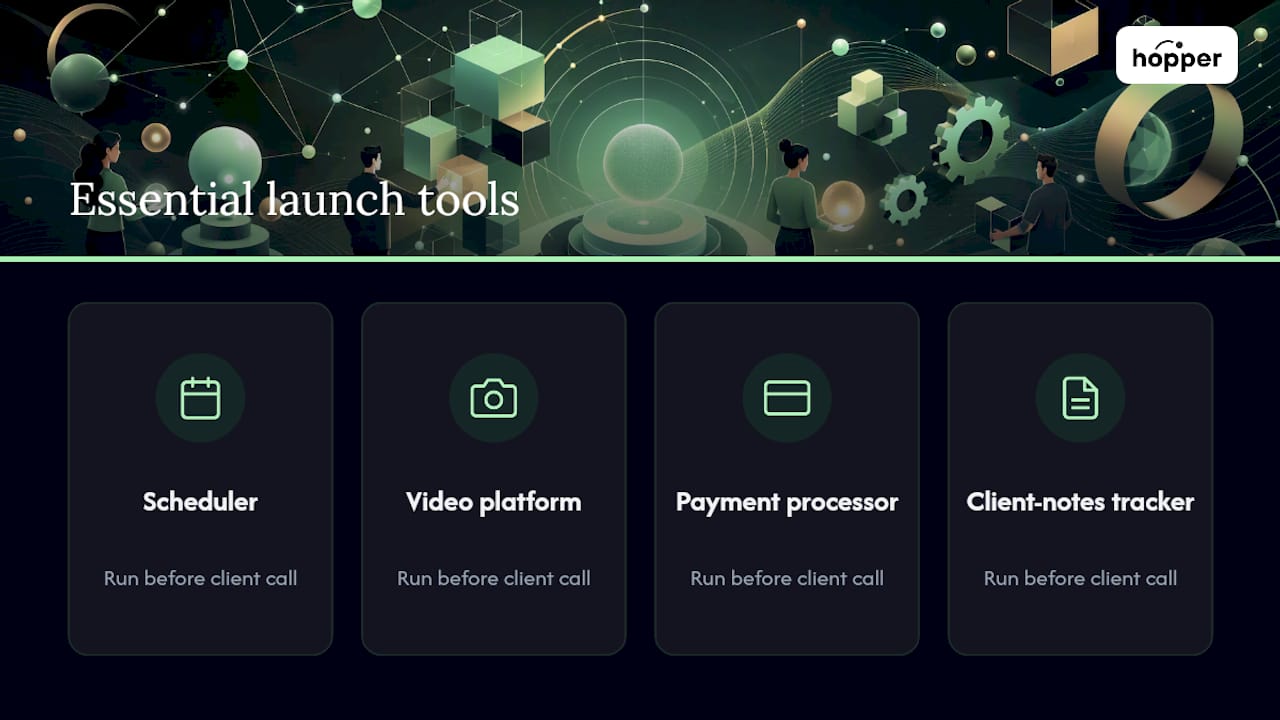
You need four things running before you take a client call: a scheduler, a video platform, a payment processor, and somewhere to track client notes. Nothing more elaborate is required to start.
Pro Tip: Resist the urge to build a "full platform" before you have five paying clients. Every extra tool you adopt before you need it is a subscription you will forget to cancel and a login you will forget how to use.
7. Build a one-page sales or booking funnel
One page. Headline, what's included, proof, a single clear call to action. That is the entire funnel most coaches need in month one. Complexity comes later, once you know what's converting and what's not.
8. Find your founding clients and start delivering
Outreach to your network, one platform where you post consistently, and direct messages to people who match your ideal client sentence. This is where most of the real work happens, and it's covered in full in the "first clients" section further down.
9. Deliver, collect proof, and refine
Run the program, document outcomes, ask for testimonials at the right moment, and use what you learn to tighten the next cohort. A coaching business that never revisits its own program design stalls. One that iterates every few months compounds.
The International Coaching Federation's 2023 Global Coaching Study documents continued growth in the coaching profession worldwide, which means the market opportunity is real. It also means the coaches who win are the ones who execute this sequence with discipline, not the ones who wait for the "right" moment to start.
How Do You Price a Coaching Program?
Price by outcome and package, never by the hour. Hourly pricing punishes you for getting efficient and caps your income at the number of hours you can physically deliver. A package price tied to a result lets you raise rates as your results and reputation improve, independent of how many hours the work takes.
Start by calculating your true per-client cost. Add up:
- Session time (the calls themselves)
- Prep and follow-up time (usually 30 to 50% of session time)
- Admin (scheduling, invoicing, messaging)
- Payment processing fees
- Marketing cost per client acquired (even if it's just your own time)
Once you know the real cost, layer in value pricing. A three-tier structure gives prospects a comparison point and tends to lift average order value:
- Entry tier: A lighter, shorter engagement or a group format at a lower price point.
- Core tier: Your signature program, the one you actually want to sell most.
- Premium tier: More access, faster response times, or added 1:1 depth at a premium price.
Decide early whether you'll require payment upfront or offer a payment plan, and test both with your founding clients to see which converts better without hurting your cash flow.
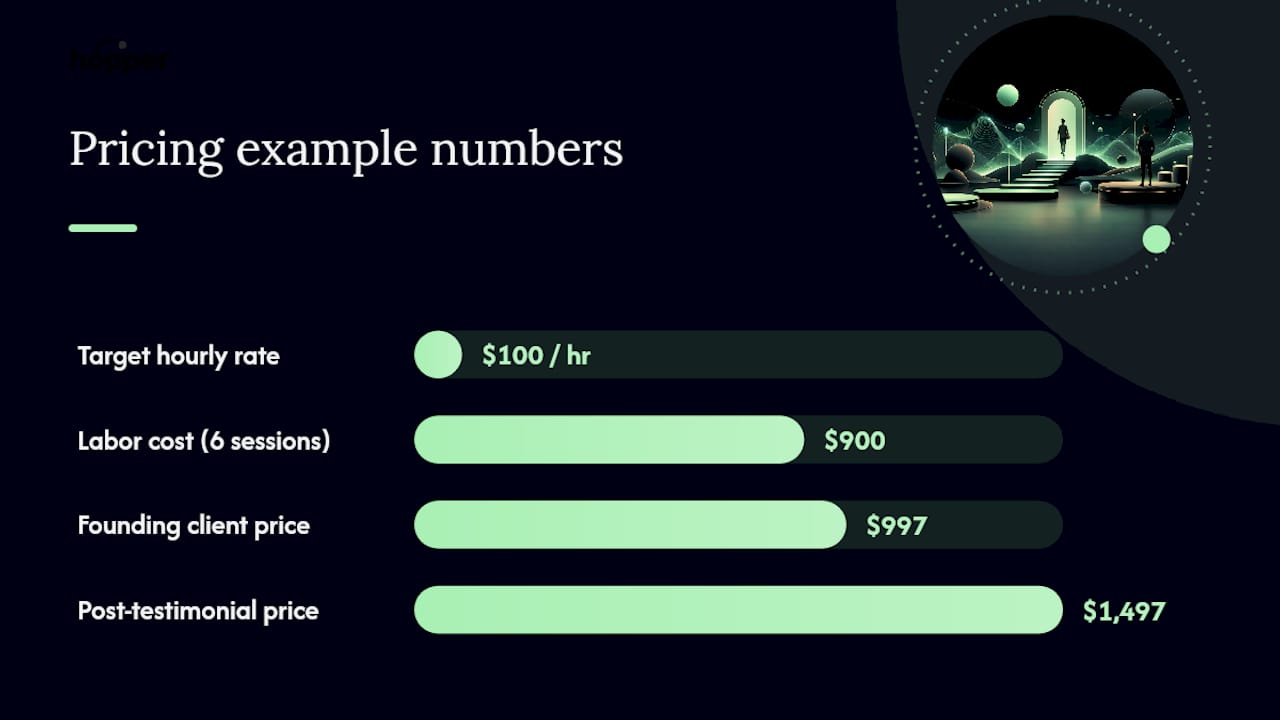
Here's a worked example for a 6 session package. If each session runs 60 minutes with 30 minutes of prep and follow-up, that's 9 hours of total time. At a target of $100 per hour of your own time, the labor cost alone is $900. Add processing fees (roughly 3%) and a modest marketing allocation, and a founding client price of $997, rising to $1,497 once you have testimonials, is a realistic entry point for many first-time coaches. Statista's research on shopper behavior shows a high share of buyers read reviews before purchasing, which is exactly why that first round of testimonials matters more than the price increase itself.
What Legal Steps Do You Need Before Accepting Payment?
Register your business structure before your first invoice goes out, not after. The Small Business Administration's guidance on registering a business walks through the common structures (sole proprietorship, LLC, and others) and where to file depending on your state, and it's the right starting point rather than piecing advice together from forum posts.
A coaching agreement is not optional paperwork. At minimum, yours needs:
- Scope of work: what's included, session count, and cadence
- Payment terms: price, due dates, and what happens with late payment
- Cancellation and refund policy: stated clearly, before a dispute forces you to improvise one
- Liability disclaimer: especially important for health, fitness, or financial coaching, where outcomes carry real risk
Insurance matters more in some niches than others. Fitness and wellness coaches typically carry more risk than a career or business coach, so professional liability coverage is worth pricing out early if your niche touches physical or mental health outcomes.
Keep basic bookkeeping from day one: every invoice, every receipt, and a simple ledger of income and expenses. It takes ten minutes a week now and saves a painful scramble come tax season. Consult an accountant once revenue becomes consistent, and a lawyer if your contract covers a regulated area like health or financial advice.
On credentials: formal certification isn't legally required to call yourself a coach in most jurisdictions, but it can matter for client trust. The ICF's credentialing standards outline what different certification levels signal, which is worth reviewing if you're deciding whether to invest in one before or after your first clients.
What Tools Do You Actually Need to Launch?
You need five tools, not fifteen. A scheduler like Calendly, a video platform like Zoom or Google Meet, a payment processor like Stripe or PayPal, a simple landing page, and a spreadsheet or lightweight CRM to track client notes and follow-ups. That's the entire stack required to run your first cohort of clients.
Prioritize by two questions: does this get me live faster, and does it cost me anything before I have revenue to justify it? Free or nearly free tools win at this stage every time.
- Scheduler: Removes the back-and-forth of finding call times.
- Video call: Zoom or Meet, whichever your clients already have installed.
- Payments: Stripe or PayPal for straightforward one-time or recurring charges.
- Landing page: One page is enough; a full website is not.
- Client tracking: A spreadsheet is genuinely fine until you're past ten active clients.
Pro Tip: Track every tool's monthly cost against your active client count. The moment your per-client tool cost creeps above what a single session is worth, that's your signal to consolidate rather than add another point solution.
Consolidation becomes worth considering once admin time starts eating into coaching time, once you outgrow a single tool's member caps, or once you want a branded mobile app without paying a separate fee for it. An all-in-one platform trades several monthly subscriptions and several logins for one flat cost, which tends to lower total fees and cut the busywork of connecting tools that were never built to talk to each other.
Whatever you choose, keep your client data exportable. Avoid any platform that locks your contact list, your content, or your payment history behind a wall you can't get out of. That flexibility matters more in year one than most new coaches realize, because your needs will change faster than you expect.
How Do You Build a Sales Page That Converts?
One page. That's the entire ask for launch. The elements matter more than the design polish, and a plain page with the right elements will outconvert a beautiful page missing them.
Your headline needs your target client and their outcome in the same line: "A 12 week program for new managers who want to stop dreading one on ones." Under it, a short bulleted list covering what's included and the session cadence:
- Number of sessions and length of the program
- Format (live calls, async support, or both)
- What the client walks away with, not just what they attend
Proof comes next. A testimonial, a credential, or a small before and after outcome carries more weight here than any adjective you could write about yourself. This is the exact reason the founding client offer matters so much early on: without proof, this section is empty, and an empty proof section is the most common reason a good offer doesn't convert.
End with one clear call to action. "Book a call" works better for higher priced or more customized programs, since it lets you qualify the prospect before they commit. "Buy now" works better for lower priced or standardized offers, where the friction of an extra call actually costs you sales. Pick one, not both.
Cheap page builders and even a single well formatted document can carry this page in your first month. The copy matters far more than the software behind it.
How Do You Get Your First Coaching Clients?
Your first clients come from people who already know you, not from strangers who found you on a platform you haven't built an audience on yet. Outreach and referrals convert faster than any paid strategy in your first ninety days.
- Message your existing network directly. Not a vague social post asking if anyone needs a coach. A direct message to specific people who match your ideal client sentence, offering a founding client rate in exchange for their honest feedback and a testimonial if it goes well.
- Ask for referrals with a specific, direct ask. "Do you know anyone dealing with X?" gets far better results than "let me know if you hear of anyone."
- Pick one platform and show up consistently. LinkedIn works especially well for career, business, and executive coaches; a practical breakdown of B2B lead generation tactics on LinkedIn is worth studying if that's your audience. The goal is useful, consistent posts, not chasing a viral moment.
- Offer a low-cost entry point for hesitant buyers. A single paid discovery session, priced modestly, converts people who aren't ready to commit to a full program but are curious enough to try something small.
- Put your testimonials to work the moment you have them. A specific result, quoted in the client's own words, does more to close a sale than another paragraph about your methodology.
Pro Tip: Set a standing weekly target of five direct outreach messages to people who genuinely match your ideal client profile. Five real conversations a week, sustained for two months, will outperform almost any amount of passive content posting during your first quarter.
How Do You Deliver and Improve Your Coaching Program?
Structure every session around a measurable milestone, not a vague "check in." Clients stay engaged and renew when they can see specific progress, and specific progress requires you to track something concrete from day one.
- Use a short intake form before session one to capture baseline numbers, goals, and context.
- Track progress with a simple form after each milestone, not just casual notes.
- Ask for testimonials right after a client hits a visible win, when the result is fresh and specific in their mind.
- Turn repeatable material into a group program or self-paced course once you've run the same core content with three or four individual clients and refined what actually works.
That last point is where scaling begins. The parts of your program that repeat almost word for word across clients are the parts ready to become a group cohort or an async course, freeing your 1:1 time for the clients who need it most.
What Should You Actually Expect in Your First Year?
Most coaches land their first paying client within zero to three months of consistent outreach, assuming they've picked a real niche and are actually reaching out weekly. Building a repeatable pipeline, one that doesn't rely on begging your existing network, takes closer to three to twelve months. That gap frustrates a lot of new coaches, and it shouldn't. It's the normal shape of the ramp.
The mistakes that stall people longest aren't tactical. They're positioning that stays too vague to attract anyone specific, pricing set out of fear rather than calculated cost and value, and tool sprawl that eats admin hours before there's enough revenue to justify it. The single habit that moves the needle most consistently: five qualified outreach conversations every week, without exception, for the first two months. It's unglamorous, and it works better than almost anything else on this list.
— Cedrik
Why Some Coaches Move Their Whole Stack to One Platform
Most coaches launch with the lean stack this article just walked through, and that's the right call at the start. But once you're juggling a course host, a community tool, a checkout page, and a separate link-in-bio, the seams start to show. That's the exact moment coaches start looking at an all-in-one coaching platform instead of another point solution.

An all-in-one coaching platform replaces that scattered stack with one hub: a community feed, a content library, async coaching, and a built-in storefront, all under a flat price. Hopper Base runs on a monthly subscription with a transaction fee, and Hopper Pro runs on a monthly subscription without transaction fees, with unlimited members, moderators, and products on either plan. This matters once your client list outgrows the caps that come standard on single-purpose tools, and if you want a native iOS and Android app without paying extra to access it.
If you're already running your business elsewhere and the thought of rebuilding everything from scratch is what's holding you back, Hopper's migration service moves your courses and payment setup over starting at $588, so you switch without starting from a blank page. Real coaches who've made the move share their savings and reasoning on Hopper's customer stories page. If tool sprawl is already costing you more in admin time than it's worth, user stories can help you understand what switching actually looks like.
Sources
A few sources back the claims in this guide and are worth keeping handy as you launch. The SBA's guide to registering your business is the clearest official starting point for choosing a legal structure, whatever state you're in. The ICF's 2023 Global Coaching Study documents the industry's continued growth, useful if you ever need to justify the market opportunity to a skeptical friend or spouse.
If you're weighing certification, the ICF's credentialing and standards page explains what each credential level actually signals to clients. For the sales page section, Statista's data on shopper review habits explains exactly why testimonials carry so much weight. And the Hostinger tutorial on starting an online coaching business offers a practical, sequenced walkthrough that lines up closely with the steps covered here.
- Register your business | SBA
- 2023 ICF Global Coaching Study — Executive Summary
- Share of shoppers reading reviews before buying | Statista
FAQ
How Long Does It Take to Start an Online Coaching Business?
Most coaches can be live and taking discovery calls within two to four weeks if they focus on niche validation and a simple one-page funnel instead of a full website build. Landing your first paying client typically happens within zero to three months of consistent, direct outreach.
Do You Need a Certification to Become an Online Coach?
No, formal certification isn't legally required in most jurisdictions, but it can build trust faster with certain client types. The ICF's credentialing standards explain what different levels signal, which is worth reviewing if your niche involves higher stakes outcomes like health or executive performance.
How Much Should You Charge for Your First Coaching Package?
Price by the outcome and the package, not the hour, and use a founding client discount for your first five to ten clients in exchange for feedback and a testimonial. A worked example earlier in this guide shows a 6 session package priced around $997 to $1,497 once true costs and a testimonial are factored in.
What's the Cheapest Way to Set Up a Coaching Business Online?
A free or low-cost scheduler, Zoom or Google Meet, Stripe or PayPal for payments, and a single landing page are enough to launch without spending anything meaningful upfront. Consolidating onto a platform like Hopper becomes worth the flat monthly cost once you're paying for four or five separate subscriptions just to run one client base.
Do You Need a Website to Start Coaching Online?
You don't need a full website, just one page with a clear headline, what's included, proof, and a single call to action. A full site can wait until your program and pricing are validated by real paying clients.
Recommended
On our list and want off? .