
What Kajabi Really Costs in 2026 (And Who It's Worth It For)
Discover Kajabi's updated costs for 2026 and find out if it's the right fit for your business needs. Get all the details here!
By the Hopper team
Kajabi's public pricing after its 2026 update runs $179 a month for Basic, $249 for Growth, and $499 for Pro, dropping to $143, $199, and $399 a month if you pay annually. It fits creators who plan to run their entire business (courses, email, funnels, community) inside one system and actually use most of it. If you just need a place to host a course and take payments, it pauses well before you hit "worth it."
Two things change your real number every month: processing fees and which add-ons you turn on.
- Sticker price ranges from $143 to $499 a month depending on plan and billing cycle
- Kajabi Payments advertises 0% platform fees, but card processing and some third-party surcharges still apply
- Annual billing cuts the effective monthly rate by roughly 20% across every tier
Key Takeaways
Kajabi's 2026 pricing runs $143 to $499 a month depending on plan and billing cycle, but contact caps and processing fees usually decide your real cost.
| Point | Details |
|---|---|
| Sticker price range | Kajabi runs $143 to $499 per month on annual billing across Basic, Growth, and Pro. |
| Annual billing saves money | Paying yearly cuts effective cost by about 20%, saving $432 to $1,200 a year depending on plan. |
| Processing fees aren't zero | Kajabi Payments waives platform fees but standard card processing and some surcharges still apply. |
| Contact limits drive upgrades | Most creators upgrade tiers because they hit a contact cap, not because they need a missing feature. |
| Hopper offers a flat alternative | Hopper starts at $58 a month with unlimited contacts and products, positioned for creators outgrowing tiered pricing. |
Table of Contents
- Kajabi Pricing at a Glance
- What You Actually Get on Each Plan
- The Hidden Costs Kajabi Doesn't Put on the Pricing Page
- How to Choose the Right Plan Without Overthinking It
- Two Worked Examples: What You'd Actually Pay
- Why We Built Hopper Around a Different Number
- What the Pricing Debate Gets Wrong
- A Flat-Rate Path If Kajabi's Math Doesn't Add Up
- Sources
- FAQ
Kajabi Pricing at a Glance
Here's the sticker price breakdown, plan by plan, with the caps that typically force an upgrade.
| Plan | Monthly Price | Annual Price (per month) | Contacts | Products | Websites | Admin Users |
|---|---|---|---|---|---|---|
| Basic | $179 | $143 | 2,500 | 5 | 1 | 2 |
| Growth | $249 | $199 | 25,000 | 50 | 1 | 11 |
| Pro | $499 | $399 | 100,000 | Unlimited | 3 | 26 |
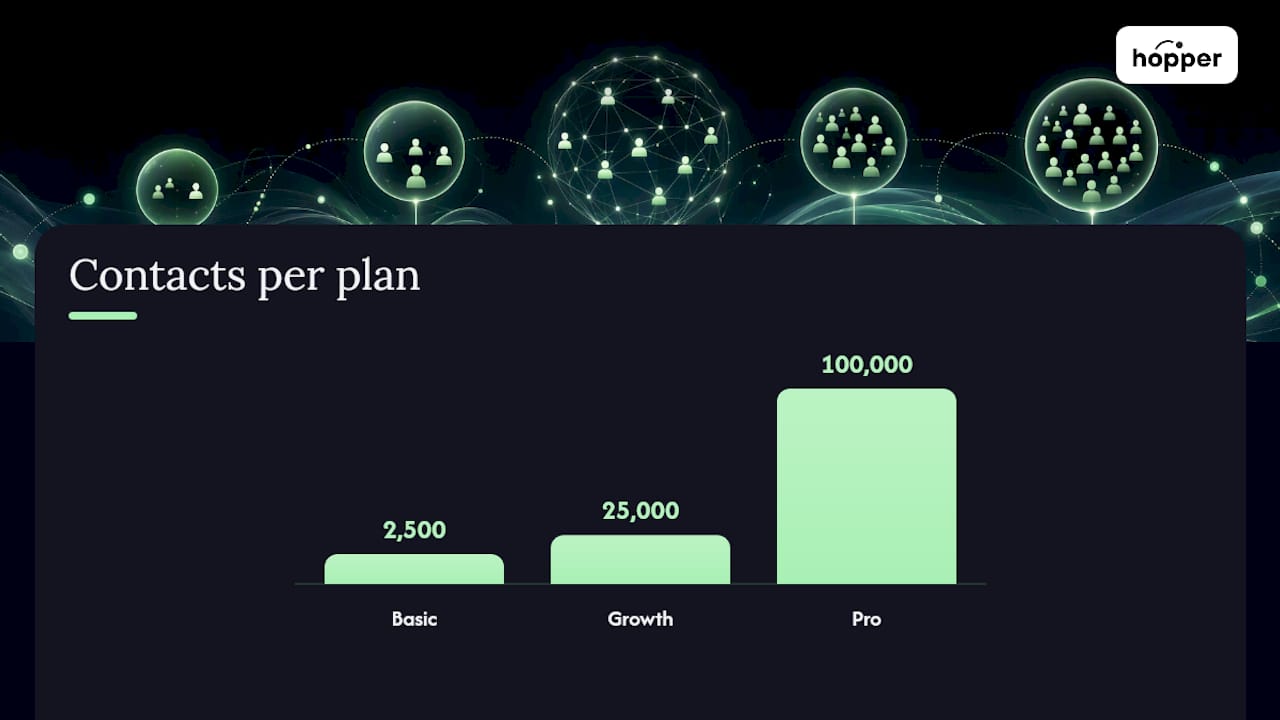
A few things jump out once you sit with these numbers. Basic looks approachable at $143 a month on annual billing, but a 2,500 contact ceiling and a five product limit mean it fits a narrow slice of businesses. Annual billing saves roughly $432 a year on Basic, $600 on Growth, and $1,200 on Pro, which is real money if you're confident you'll stick around.
Kajabi occasionally runs an intro offer for new signups, something like a discounted first stretch (past promotions have included a reduced rate for the first few months) alongside its standard trial window. Trial length and intro deals shift often enough that you should check the current offer on Kajabi's own pricing page before assuming a specific number applies to your signup.
What You Actually Get on Each Plan
Kajabi doesn't gate its core toolset by tier. Every plan gets the same course builder, email marketing, funnel tools, and community features. What changes is scale: how many people you can talk to, how many things you can sell, and how many hands can touch the account.
Basic works for a single flagship course or a small membership run by one person. You get one website, one product line capped at three offers, and a 10,000 contact limit. A solo coach launching their first signature course, with no team and a modest list, fits here comfortably.
Growth unlocks the pieces that matter once you're actually running a business instead of testing an idea. You get 15 products, 10 admin seats, automation tools, and an affiliate program. Contact capacity jumps to 25,000. This is the plan most established coaches or small course businesses land on, especially once a single flagship offer expands into a suite of products or a team starts helping run operations.
Pro is built for creators who need a branded mobile app, API access, or multiple sites under one account. It's the plan for education businesses running more than one brand, or ones that have outgrown Growth's contact ceiling entirely and need the 100,000 mark instead.
Pro Tip: Before you pick a plan based on features, count your email list first. Contact limits trigger more forced upgrades than any feature gap, since your list keeps growing even when your product count doesn't.
The Hidden Costs Kajabi Doesn't Put on the Pricing Page
The sticker price is the easy part. The real monthly cost depends on how you process payments and what you bolt on after signup.
You still pay standard card processing rates on every sale, and if you route payments through Stripe or PayPal instead of Kajabi's built-in processor, some markets see an added platform surcharge layered on top. That distinction rarely shows up until you're deep into checkout setup.
Add-ons and fine-print costs to check before you commit:
- Branded mobile app access, bundled into Pro but potentially an extra cost on lower tiers depending on current offer terms
- API access, which is typically Pro-only and matters if you're connecting Kajabi to other software
- Contact overage charges once you cross your plan's cap, which can arrive as an unplanned upgrade rather than a line-item fee
- International card transaction markups, which vary by the processor and your customers' card-issuing country
- Third-party processor surcharges in specific markets when you skip Kajabi Payments
How to Choose the Right Plan Without Overthinking It
Work through these four questions in order, and the right tier usually becomes obvious.
- Estimate your contact list a year from now, not today. If you're adding subscribers through lead magnets or a growing audience, size up rather than starting tight against a cap.
- Count how many separate things you'll actually sell. A single course fits Basic. A course plus a membership plus a digital product pushes you toward Growth.
- Check who else touches the account. If you have a team member managing content or a virtual assistant handling support, Basic's single admin seat will not stretch far enough.
- Decide if you need a branded app or API integration now, not eventually. If yes, Pro is the only plan that gets you there without a mid-year upgrade.
A starter coach usually lands on Basic, a scaling course business on Growth, and a multi-brand education company on Pro.
Two Worked Examples: What You'd Actually Pay
Numbers change everything once you attach them to a real business. Here are two scenarios worth running against your own volume.

| Scenario | Plan | Monthly Sticker | Monthly Sales | Est. Processing Fees | Effective Monthly Cost |
|---|---|---|---|---|---|
| Early creator (12 sales/mo at $97) | Basic, monthly | $179 | $1,164 | ~$37 | $216 |
| Established creator (60 sales/mo at $197) | Growth, annual | $199 | $11,820 | ~$375 | $574 |
The early creator scenario shows fixed costs eating a large share of revenue when volume is low. As volume grows, that ratio flips. The established creator's example spends the same rough percentage on processing but the $199 subscription now represents under 2% of revenue, which is where Kajabi's all-in-one pitch starts to make financial sense. Swap in your own average order value and monthly sales count to see where you land.
Why We Built Hopper Around a Different Number
I'll say this plainly: most pricing pages are designed to make comparison hard, not easy. Kajabi's tiers look simple until you're three sales in and realize your effective cost includes processing fees, an admin seat you needed, and a contact overage you didn't see coming.
Hopper's model skips that math.
- Unlimited contacts and products on every plan, no overage charges
- Native iOS and Android app included at the flat price, not gated behind a top tier
- Migration support for creators moving an existing course and community stack over
Pro Tip: If you're paying for Kajabi's Pro tier mainly for the branded app and API, that's often the exact signal that a flat-rate alternative will cost less for the same capability.
What the Pricing Debate Gets Wrong
Most pricing breakdowns treat the monthly fee as the whole story, then act surprised when a reader's actual bill looks nothing like the homepage number. The sticker price was never the full picture. Processing fees, contact overages, and the add-ons buried in fine print routinely add 15 to 20 percentage points to what a course creator actually pays relative to revenue.
The conventional advice, "pick the cheapest plan that fits your current list size," also misses the timing problem. Creators don't upgrade because they outgrew a feature. They upgrade because a list grew past a cap mid-launch, usually at the worst possible moment to be renegotiating a subscription.
Flat, predictable pricing without a contact ceiling isn't a nice-to-have for a growing creator business. It changes whether a launch's success creates a pricing headache or just more revenue.
A Flat-Rate Path If Kajabi's Math Doesn't Add Up
If you've run your own numbers and Kajabi's contact caps or processing math feel like a moving target, Hopper gives you a fixed number instead.

Hopper is built for coaches and course creators who want their community, content library, and storefront in one hub without tracking which plan unlocked which feature. If you're migrating an existing course and audience over from another platform, Hopper's migration support helps you move without rebuilding from scratch. Check your current contact count and monthly sales volume, then see how Hopper's flat pricing compares to what you're paying now.
Sources
- Kajabi Pricing (2026) | Use Our Fee Calculator To Find Actual Cost
- Kajabi Pricing 2026: The Real Cost, From Someone Who Actually Pays It
- Kajabi Pricing 2026: Real Cost After the Price Rise
FAQ
How much does Kajabi typically cost?
Kajabi runs $179 to $499 a month billed monthly, or $143 to $499 a month billed annually, depending on whether you choose Basic, Growth, or Pro.
Is Kajabi worth the price in 2026?
It's worth it if you'll use the full stack (courses, email, funnels, community) and your contact list justifies the plan you pick; if you only need course hosting, the sticker price often outweighs the value.
Why is Kajabi so expensive compared to other platforms?
Kajabi bundles course hosting, email marketing, funnels, and community tools into one subscription, which raises the base price compared to single-purpose tools, though it can replace several separate subscriptions.
What changed in Kajabi's pricing for 2026?
Kajabi's January 2026 restructure raised Growth and Pro pricing and introduced a platform surcharge in some markets for creators using third-party payment processors instead of Kajabi Payments.
What's a good alternative to Kajabi if the pricing doesn't fit?
Hopper offers a flat $58 to $108 a month model with unlimited contacts and products, which suits creators who've hit Kajabi's contact caps or want predictable pricing without tier upgrades.
Recommended
On our list and want off? .