
Capture 2–4% More Margin: Loyalty Pricing for Educators
Practical loyalty pricing playbook for educators and community operators. Design and pilot programs that protect margin, with a 90 day checklist.
By the Hopper team
A loyalty pricing strategy rewards customers with better prices as their relationship with a business deepens, tying discounts or perks to tenure, spend, or specific behaviors instead of handing them out to everyone. The strongest approach combines pricing levers with loyalty tiers or behavior-based rewards rather than blanket discounts, because it protects margin while still lifting retention. This guide walks through the core models, a step-by-step build, and the measurement discipline that keeps the whole thing profitable.
TL;DR:
- Loyalty pricing should focus on specific customer segments, with loyal, low-price sensitivity clients responding better to recognition than discounts.
- Establishing a clear data foundation and measuring against a holdout group is essential to prove program impact and prevent scaling ineffective strategies.
- Combining tiered, points-based, and behavior-based models allows customization, but each adds operational complexity that must be managed carefully.
- Setting margin guardrails, explicit rules, and using automation tools reduces risk of fraud, discount fatigue, and misinterpretation of breakage and redemption data.
- A well-designed program enhances brand perception by signaling recognition and status, but careless execution risks incentivizing negotiations and undermining trust.
Table of Contents
- What Is Loyalty Pricing and Why Does It Matter for Retention?
- Tiered, Points-Based, and Behavior-Based Loyalty Pricing
- How Do You Design and Launch a Loyalty Pricing Strategy?
- [## When Should You Segment Customers and Time Discounts?](#when-should-you-segment-customers-and-time-discountshttpsstudioflareioiclassipro-alternative)
- What KPIs Prove a Loyalty Pricing Program Is Working?
- What Are the Most Common Loyalty Pricing Mistakes?
- What Tools Do You Need to Run Loyalty Pricing?
- What Does a 90-Day Loyalty Pricing Pilot Look Like?
- What Are the Legal and Ethical Considerations in Loyalty Pricing?
- How Does Loyalty Pricing Change How Customers See Your Brand?
- When Should Loyalty Pricing Actually Be a Priority?
- A Simpler Way to Run Loyalty Pricing
- Sources
- FAQ
What Is Loyalty Pricing and Why Does It Matter for Retention?
Loyalty pricing is the practice of adjusting prices based on a customer's relationship history rather than offering the same discount to every buyer. A member who has stayed for a year pays less than someone who joined last week. A customer who hits a spending threshold unlocks a rate the average shopper never sees. That's the whole idea, and it's fundamentally different from a sitewide sale, which just trains everyone to wait for the next markdown.
The difference matters because a blanket discount treats loyal and disloyal customers identically. Loyalty pricing does the opposite: it recognizes the people already committed to you and gives them a reason to stay committed. Common forms include:
- Tenure-based pricing — rates drop the longer someone remains a member or subscriber.
- Spend-threshold pricing — crossing a cumulative purchase amount unlocks a lower price or bonus tier.
- Points-based pricing — actions earn currency that offsets future purchases.
- Behavior-based pricing — specific actions (referrals, engagement, renewals) trigger price benefits.
Retention economics explain why this works. Acquiring a new customer has grown more expensive across most direct-to-consumer categories in recent years, which puts more pressure on businesses to extract value from the customers they already have rather than constantly refilling the top of the funnel. Loyalty pricing is one of the few levers that does both: it keeps existing customers around longer and increases what each one spends over their lifetime.
Statistic callout: Businesses that combined pricing levers with loyalty programs and strong analytics saw 2 to 4 percentage point gross-margin improvements in McKinsey's pilot studies, a meaningful gain in categories where margins are already thin.
That's not a coupon-code result. It's what happens when pricing and loyalty stop operating as separate departments and start working as one system.
Tiered, Points-Based, and Behavior-Based Loyalty Pricing
Every loyalty pricing program is built on some combination of three models. Picking the right one, or the right blend, depends on your purchase frequency, your margin structure, and how much operational complexity you can support.
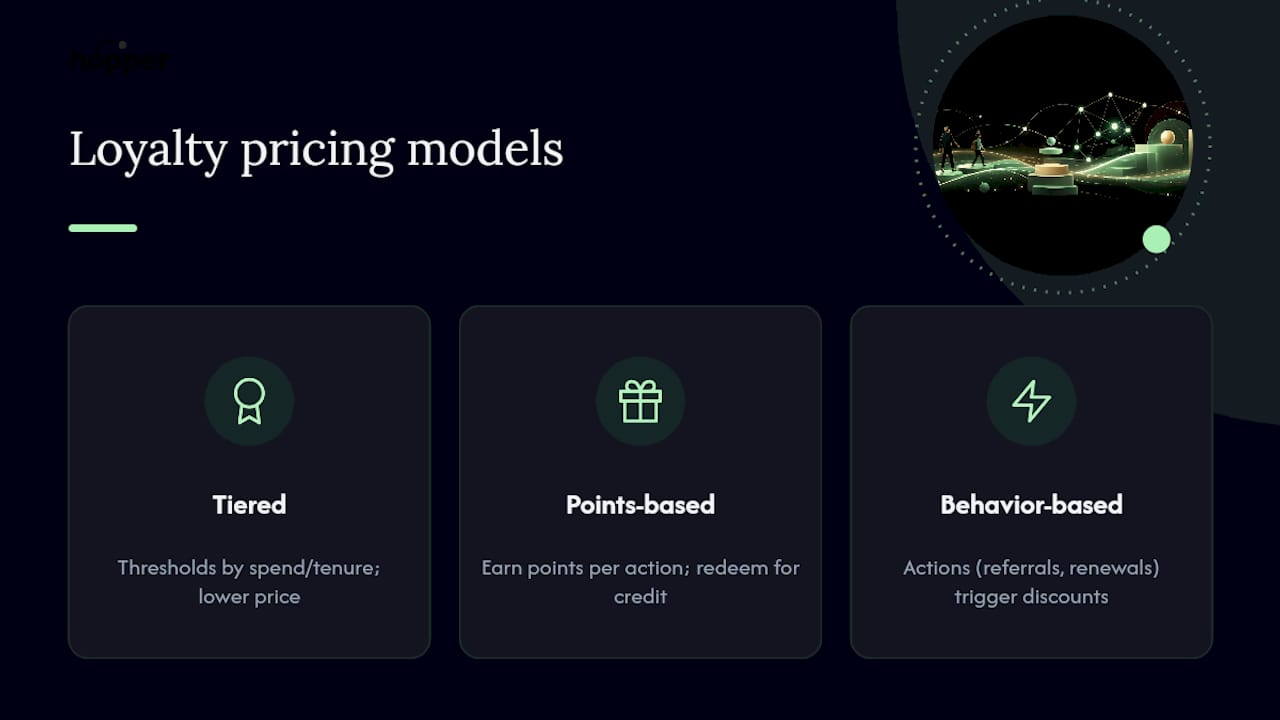
Tiered pricing groups customers into levels, often Bronze, Silver, and Gold, or simply named tiers tied to spend or tenure. Crossing a threshold moves a customer up, and each tier carries a specific price benefit: a lower rate, a percentage off, or exclusive access to premium inventory. Tiered pricing works best for businesses with clear, trackable spend or engagement volume: subscription software, membership communities, and retail brands with repeat purchase cycles. The trigger should be simple enough that a customer can calculate their own progress, because opaque tiers frustrate more than they motivate.
Points-based pricing assigns a currency to actions, usually purchases, and lets customers redeem accumulated points against future spend. The mechanics matter more here than in any other model. A points system needs a clear earn rate, a clear redemption value, and rules that don't expire value so aggressively that customers feel cheated. Airlines and hotel chains popularized this model, but course creators and subscription businesses use lighter versions of it too, rewarding completed lessons, community participation, or renewals with credit toward the next billing cycle.
Behavior-based pricing ties the price benefit directly to an action rather than a balance. Referring a friend unlocks a discount. Renewing before a deadline locks in a lower rate. Completing an onboarding sequence triggers a loyalty price on the next tier up. This model fits subscription and community businesses particularly well, because it rewards the exact behaviors that correlate with long-term retention instead of rewarding raw spend.
Most mature programs end up combining two of the three. A subscription business might run tenure-based tiers as the backbone, then layer in behavior-based bonuses for referrals or renewals. The trade-off is complexity: every additional rule is another thing your team has to track, explain, and audit.
Pro Tip: *Start with one model and one trigger.
How Do You Design and Launch a Loyalty Pricing Strategy?
Building a loyalty pricing program in the wrong order is the single most common way teams waste a quarter. Objectives first, mechanics second, technology last. Here's the sequence that avoids that trap.
-
Set objectives and margin guardrails before designing anything. Decide whether the program's job is to lift repeat purchase rate, extend average tenure, or increase average order value, because each goal points toward a different model. Set a maximum acceptable margin impact (say, 3 to 5 percent of revenue in the target segment) before you design a single reward, so the finance conversation happens up front instead of after launch.
-
Segment your customers and map behaviors to rewards. Pull purchase frequency, recency, and spend data to separate your genuinely loyal customers from your deal-prone ones. These two groups respond to entirely different incentives, and treating them the same is where most programs bleed margin.
-
Define your tiers, thresholds, and expiry rules on paper before you build anything. Write out exactly what triggers each price benefit, how long it lasts, and what happens when a customer drops below a threshold. Vague rules here become support tickets later.
-
Build tracking before you build rewards. You need a way to attribute a purchase or renewal to the loyalty program specifically, not just observe that loyal customers happen to buy more. Set up a holdout group, a segment of otherwise-similar customers who don't get the loyalty pricing, so you can measure incremental lift rather than assuming correlation is causation.
-
Pilot with a narrow segment before rolling out company-wide. Choose one customer segment, one tier structure, and a fixed window (60 to 90 days is typical). Measure against the holdout group weekly, not just at the end.
-
Set explicit scale criteria before the pilot starts. Decide in advance what result triggers a full rollout, what result triggers a redesign, and what result kills the idea. Reviewing this after you have results almost always leads to motivated reasoning.
Pro Tip: Write your holdout group size into the pilot plan before launch, not after. Teams that skip this step almost always end up with a program that "feels like it's working" but no clean way to prove it moved the needle beyond normal seasonal variation.
The hardest part of this sequence isn't the design work. It's the discipline to measure against a holdout group instead of declaring victory the moment repeat purchases tick up. Loyal customers were already going to buy again at some rate. Your job is to prove the program moved that rate, not just to watch it happen.
## When Should You Segment Customers and Time Discounts?
Not every customer responds to a price benefit the same way, and treating them as one audience is where many loyalty programs quietly lose money. Segmentation research on intertemporal pricing shows that firms can optimize profitability by targeting loyal and deal-prone customers with different price paths rather than applying one discount schedule to everyone.
Two segments matter most:
- Loyal, low price-sensitivity customers — high purchase frequency, high recency, and a track record of buying at full or near-full price. These customers respond better to status, access, and recognition than to deeper discounts.
- Deal-prone, price-sensitive customers — customers who show up mainly during promotions and disappear between them. Discounts move this group, but every discount also trains them to wait for the next one.
The academic framing for this is intertemporal pricing: the idea that a business can capture early premium value from loyal customers while offering deeper, later discounts to price-sensitive segments, without collapsing the two into a single race-to-the-bottom price. The switching point, when a business shifts from premium pricing to a discount offer, and the depth of that discount are both variables you can control deliberately instead of reactively.
The trap most businesses fall into is the loyalty–discount cycle: giving your most loyal customers progressively deeper discounts because they ask for them or because you assume loyalty deserves it. Research on price negotiations found that loyal customers who receive larger discounts often gain more perceived negotiating power, which pushes them to expect even larger discounts next time. The cycle erodes price integrity for exactly the customers you can least afford to lose.
Statistic callout: The same research shows this pattern is mitigated when businesses substitute relational and functional benefits, early access, recognition, dedicated support, for unconditional price cuts. The reward changes; the loyalty doesn't.
A few operating rules keep this in check: expire loyalty pricing on a fixed schedule rather than letting it compound indefinitely, communicate tier status transparently so customers understand why they have it, and reserve your deepest discounts for re-engagement campaigns aimed at lapsing customers, not as an ongoing perk for people who were never going to leave.
What KPIs Prove a Loyalty Pricing Program Is Working?
A loyalty pricing program that "feels successful" and one that is actually profitable are frequently different programs. The gap between them is measurement discipline.
Track these metrics from day one:
- Repeat purchase rate — the percentage of customers who buy again within a defined window.
- Churn rate — how many members or subscribers leave, and whether that rate improves for the loyalty cohort versus the holdout group.
- Customer lifetime value (LTV) — total revenue attributable to a customer over their full relationship with your business.
- Average order value (AOV) — whether loyalty pricing pushes customers toward larger purchases, not just more frequent ones.
- Redemption rate — the share of earned points, credits, or offers customers actually use.
- Breakage — the value of unredeemed rewards, which affects your accounting but can also signal disengagement.
The metric that separates a real result from a coincidence is incrementality, and the only reliable way to measure it is a holdout group. Take a segment of customers who match your loyalty cohort on frequency, recency, and spend, but exclude them from the program. Compare their behavior against the cohort that received loyalty pricing over the same window. If both groups behave the same, the program isn't driving the lift you're seeing elsewhere.
Statistic callout: McKinsey's pilot data on combined pricing and loyalty programs pointed to 2 to 4 percentage point gross-margin gains specifically when the analytics behind the program were strong enough to isolate that impact. Weak measurement doesn't just risk missing the result. It risks scaling a program that never actually worked.
Report on incremental margin, not just gross uplift. If your loyalty pricing generates $50,000 in additional repeat revenue but costs $40,000 in discounted margin to deliver it, your payback period and your actual profit contribution are the numbers leadership needs, not the top-line revenue figure alone.
What Are the Most Common Loyalty Pricing Mistakes?
Most loyalty pricing programs fail the same handful of ways, and nearly all of them are preventable with a rule set decided before launch rather than after a problem shows up.
- The loyalty–discount spiral. Watch for customers negotiating for deeper discounts than their tier grants, and hold the line with fixed, published thresholds instead of ad hoc exceptions.
- Misreading breakage. High unredeemed-point balances can look like a margin win on paper, but they often mean your rewards aren't relevant to what customers actually want. Run cohort analysis on breakage before treating it as good news.
- Fraud and gaming. Referral bonuses and points systems attract abuse, self-referrals, fake accounts, bulk redemption bots. Basic throttles (redemption caps per period, verification on referral bonuses, velocity checks on point accumulation) stop the majority of it.
- Discount fatigue eroding perceived value. If your loyalty pricing is just a recurring percentage off, customers stop noticing it. Status, early access, and community recognition tend to hold their value longer than a number on a receipt.
Pro Tip: Set a hard cap on discount depth per tier and put it in writing before your first customer complaint arrives. Once a support team starts approving exceptions case by case, the exception becomes the policy within a few months.
The businesses that avoid these traps tend to share one habit: they review loyalty program performance on a fixed cadence, monthly or quarterly, rather than only when something breaks. Catching a breakage spike or a fraud pattern in month two is a minor adjustment. Catching it in month eleven is a rebuild.
What Tools Do You Need to Run Loyalty Pricing?
Running loyalty pricing well requires infrastructure most businesses underestimate when they start. You need real-time balance tracking (a customer's tier or points balance has to update the moment they act, not overnight), tier logic that applies the correct price automatically at checkout, and analytics that can isolate incremental impact rather than just reporting raw engagement numbers.
Operationally, that means:
- Ledger accounting for points or credits, so every earn and redemption event is auditable.
- Support workflows for tier disputes, expired rewards, and redemption errors, which will happen regardless of how clean your rules are.
- Fraud detection built into the redemption flow, not bolted on afterward.
- Checkout integration that applies the correct price without manual intervention.
This is exactly where tool sprawl becomes a real cost. A business running a separate course platform, a separate community tool, and a separate checkout system has to sync loyalty logic across all three, and every sync point is a place where a customer's tier status can fall out of date. Hopper builds loyalty pricing directly into its storefront and community hub, so a member's tenure and tier apply automatically without a business stitching together three tools that were never designed to share loyalty data. That's a meaningfully smaller version of the tool-sprawl problem many coaching businesses run into when they patch together a course host, a community platform, and a checkout tool separately.
Statistic callout: Businesses that built a clean data foundation before layering in personalized pricing were the ones McKinsey found capturing the 2 to 4 percentage point margin gains mentioned earlier. Without that foundation, the same tactics tend to produce noise, not margin.
What Does a 90-Day Loyalty Pricing Pilot Look Like?
Before launch, confirm three things: your tracking can attribute purchases to the program, your holdout group is defined, and your finance team has signed off on the margin guardrail.
- Weeks 1 to 2: Finalize tier structure, thresholds, and expiry rules. Set up tracking and confirm holdout group assignment.
- Weeks 3 to 4: Soft-launch to the pilot segment. Monitor for tracking errors and support tickets, not results yet.
- Weeks 5 to 8: Let the program run undisturbed. Watch repeat purchase rate and redemption rate weekly against the holdout group.
- Weeks 9 to 12: Compare full results: incremental lift, margin impact, and redemption behavior.
- Day 90 decision point: Scale if incremental lift clears your margin guardrail with a reasonable payback period. Redesign if results are mixed. Kill it if the holdout group performed the same as the cohort.
What Are the Legal and Ethical Considerations in Loyalty Pricing?
Loyalty pricing sits close to a line that businesses need to respect: rewarding loyal customers is legal and common, but pricing that discriminates against protected characteristics, or that misleads customers about the value of a reward, is not. The distinction that matters is behavior versus identity. Pricing based on what a customer does (tenure, spend, referrals) is standard practice. Pricing based on who a customer is, in a way that disadvantages a protected group, creates legal exposure that varies by jurisdiction and should be reviewed with counsel familiar with your specific market's consumer protection and anti-discrimination statutes.
Transparency is the ethical baseline. Customers should be able to see how a tier or reward was earned and what it's worth. Programs that obscure redemption rules, quietly reduce point values, or let rewards expire without clear notice invite both regulatory scrutiny and reputational damage. The fairness research backs this up directly: consumers rate volume-based discounts, personalized coupons, and member-only pricing as fairer than policies that treat similar customers inconsistently for reasons they can't see or understand.
Data handling is the other piece. Loyalty pricing depends on tracking purchase history and behavior, which means the program lives inside whatever privacy regulation applies in your market, from general data protection frameworks to sector-specific rules. Collect only the behavioral data the program actually uses, disclose how it informs pricing, and give customers a clear way to understand their own status. A loyalty program that feels like surveillance loses the trust it was built to earn.
How Does Loyalty Pricing Change How Customers See Your Brand?
Price is never just a number. It's a signal, and loyalty pricing sends a specific one: this business notices who stays. That signal shapes brand perception in ways a generic sale never does, because a sitewide discount tells every customer the same thing, while a tenure-based rate or a status tier tells a specific customer their history with you counts for something.
The psychology behind this matters more than it looks. A customer who earns a lower price through eighteen months of membership experiences that price differently than a stranger who got the same rate from a coupon code. One feels earned. The other feels arbitrary. Research on emotional loyalty backs this up: programs built on experiential and status-driven benefits build more durable brand attachment than those built purely on transactional discounts, because status and recognition tap into identity in a way a percentage off never does.
There's a risk on the other side, too. Loyalty pricing done carelessly, especially unconditional discounts that deepen the longer a customer complains, can teach your most valuable customers that loyalty is a negotiating tool rather than a relationship. That's the psychological root of the loyalty–discount cycle covered earlier: once a customer learns that asking gets them a better deal, the price stops carrying any signal about the relationship at all.
Well-designed loyalty pricing does the opposite. It reinforces the idea that the relationship itself has value, independent of any single transaction, which is exactly the perception a subscription or membership business needs its best customers to hold.
When Should Loyalty Pricing Actually Be a Priority?
Loyalty pricing earns its place on the roadmap when a business already has decent retention data and a checkout or billing system that can support tiered logic without a rebuild. If you can already answer "who are my most loyal 20 percent of customers, and what do they have in common," you're ready to design around them. If you can't answer that question yet, building a loyalty pricing program before fixing your data foundation is building on sand. The McKinsey research on this is blunt: the clean data foundation is usually the harder problem, and skipping it produces programs that generate activity without proving incremental value.
I'd also push back on a common instinct: teams under pressure to show quick wins often reach for a loyalty discount because it's fast to launch and easy to explain to leadership. That's usually the wrong sequence. A discount is not a strategy. If your churn problem is actually a product problem, a support problem, or an onboarding problem, loyalty pricing will mask the symptom for a quarter or two and then stop working, because no price benefit fixes a bad experience for long.
For teams with limited resources, the prioritization test is simple: fix the reasons customers leave before you invest in rewarding the ones who stay. Once that foundation exists, loyalty pricing is one of the highest-leverage moves available, because it works on customers you've already earned rather than ones you still have to find.
— Cedrik
A Simpler Way to Run Loyalty Pricing
Most of the operational friction in loyalty pricing comes from running it across tools that were never built to share tier or points data. Hopper builds loyalty pricing directly into its community hub and storefront, so members automatically see better rates the longer they stay, without a coach or educator wiring together a separate loyalty plugin, a separate checkout tool, and a separate community platform.

Three things make it a practical starting point if you're building this from scratch: flat pricing at $58 a month on Base (with a 1% transaction fee) or $108 on Pro (with 0% fees), no per-seat costs to worry about as your loyalty tiers grow your member count; loyalty pricing as a native feature rather than a bolt-on integration; and free migration support if you're currently running your community and courses across separate tools and want to consolidate before building a loyalty program on top of a fragmented stack. If you're evaluating whether to build loyalty pricing into an existing patchwork or start clean, take a look at Hopper's platform and see what a single-hub setup looks like for your business.
Sources
- Members only: Delivering greater value through loyalty and pricing — McKinsey
- Unlocking Market Potential: Strategic Consumer Segmentation and Dynamic Pricing for Balancing Loyalty and Deal Seeking — MDPI
- Willing to Pay More, Eager to Pay Less: The Role of Customer Loyalty in Price Negotiations — Journal of Marketing / SAGE
- Can pricing strategies maintain customer loyalty? — Customer Experience Dive
FAQ
What Are the Four Main Types of Pricing Strategies?
The four most commonly referenced pricing strategies are cost-plus pricing, value-based pricing, competitive pricing, and penetration pricing. Loyalty pricing typically layers on top of one of these as a retention mechanism rather than replacing the underlying strategy.
What Are the Four Cs of Customer Loyalty?
Definitions vary across sources, but a common version centers on consistency, communication, community, and convenience as the drivers that keep customers loyal over time. Loyalty pricing tends to work best when it reinforces at least one of these, particularly consistency and community.
What Are the 5 Cs of Pricing?
The 5 Cs framework generally includes company (costs and objectives), customers (demand and price sensitivity), competitors, channels, and climate (market and regulatory conditions). Segmentation work in loyalty pricing draws heavily on the customer and competitor dimensions.
How Do You Avoid the Loyalty-Discount Cycle?
Replace unconditional discounts with relational rewards like early access, recognition, and dedicated support, and set fixed expiry rules on price benefits so they don't compound indefinitely. This approach is directly supported by research on customer loyalty in price negotiations.
Can an All-In-One Platform Handle Loyalty Pricing?
Yes. Platforms like Hopper build tenure-based loyalty pricing directly into the storefront and community hub, so tier logic applies automatically at checkout instead of requiring a separate loyalty tool synced across multiple systems.
Recommended
On our list and want off? .