
30 Day Microlearning Pilot for Coaches: Build Five 1–3 Minute Modules
Coach-focused playbook to design 1–3 minute micro modules, run a 30 day pilot with five modules, and measure practice and confidence to prove impact.
By the Hopper team
Microlearning works for coaching when each module tackles one objective and ends with real feedback, not when it becomes another content dump. It fits time-poor clients and behavior-change goals best, the two places most coaching stalls out. What follows is the practical part: how to design modules, deliver them without friction, measure what actually matters, and pilot the whole thing in 30 days.
TL;DR:
- Microlearning modules should focus on a single measurable objective and be delivered in short, action-oriented formats like videos, quizzes, or reflections.
- Delivering content via mobile apps with features like async replies, reminders, and bundling ensures higher completion and engagement.
- Measuring both engagement and coaching impact, such as practice attempts and confidence scores, helps evaluate microlearning effectiveness within a 30-day pilot.
- Starting small with a few modules and participants, then iterating based on feedback, prevents overbuilding and highlights real improvement gaps.
- Integrating microlearning into a unified platform reduces friction, lowers costs, and maintains the personal coaching relationship, making scaling easier.
Table of Contents
- What Is Microlearning for Coaches, and Does the Research Back It Up?
- Why Short Lessons Actually Change Client Behavior
- How Do You Design a Microlearning Module for Coaching?
- Where Should You Deliver Microlearning, and What Features Actually Matter?
- What Should Coaches Measure to Know Microlearning Is Working?
- How Do You Run a 30-Day Microlearning Pilot?
- What Building This Into a Platform Actually Teaches You
- Editorial Take: What the Research Actually Tells You to Do First
- A Simpler Way to Run Microlearning Alongside Your Coaching
- Sources
- FAQ
What Is Microlearning for Coaches, and Does the Research Back It Up?
Microlearning is targeted, action-oriented content delivered in seconds to a few minutes, built around one skill or idea instead of a full curriculum. That's the working definition from a PRISMA-based systematic review of 40 studies, which found consistent positive effects on recall, engagement, and motivation across the research it examined.
For coaches, that matters more than it might sound. Coaching already runs on short, high-leverage interactions, a session, a check-in, a nudge between calls. Microlearning simply extends that rhythm into the gaps. It also lines up with Bloom's Taxonomy: a two-minute video can build recall and comprehension, while a scenario or practice assignment pushes clients toward application and analysis, the levels where behavior actually shifts. The same review's companion framework recommends pairing specific objectives with personalized, interactive content, which aligns perfectly with practical microlearning for adults approaches that emphasize design templates and formats tailored to adult learners, bridging the gap between a coach who assigns homework and one who assigns a five-minute exercise with a built-in feedback loop.
Why Short Lessons Actually Change Client Behavior
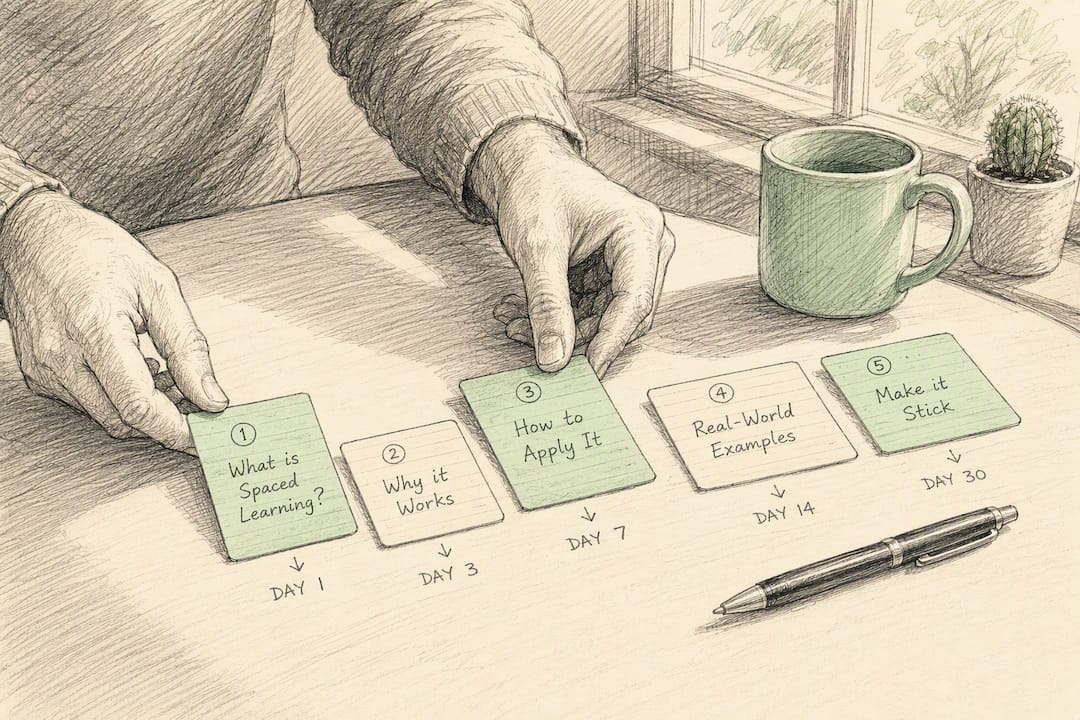
The mechanism is simpler than it sounds: smaller chunks reduce cognitive load, so clients retain more per minute of attention spent. Spacing that content out, rather than front-loading it into one session, triggers the same recall benefits that language apps and medical training programs have used for years. Active recall (a quiz question, a one-line reflection, a voice note) does more for retention than passive review ever will, a point practitioner guides on microlearning return to again and again.
Then there's access. A module a client can complete on a phone between meetings gets finished. A PDF workbook waiting in an inbox usually doesn't. Short tasks and light gamified nudges, a streak counter, a completion badge, keep that momentum going without turning coaching into a game.
Put together, these levers translate directly into coaching outcomes coaches already track: more practice reps between sessions, better recall of concepts you introduced weeks ago, and clients who show up to calls having actually done the thing. That's the real payoff, not engagement for its own sake.
How Do You Design a Microlearning Module for Coaching?
Every module should start with one measurable objective. Not "improve communication skills" but "identify one interrupting habit in your next team meeting." Vague objectives produce vague content, and vague content gets skipped.
From there, match the format to the goal:
- A 1 to 3 minute video for concept introduction or modeling a behavior.
- A single-question quiz to check understanding before moving forward.
- A micro-scenario that puts the client in a realistic decision point.
- A voice-note reflection prompt, useful when you want unfiltered, in-the-moment thinking.
- A short practice assignment with a clear, observable outcome.
Cadence matters as much as content. Most coaching contexts do well with two to three micro-modules a week rather than daily drips, enough spacing to let the last lesson settle before the next one lands. Build your content library around three focus areas: conversational coaching tactics (the "how do I say this" moments), real-world case scenarios drawn from actual client situations, and personalized low-stakes simulations that let clients rehearse before the stakes are real. That third category does the most work for behavior change, according to the design principles synthesized from recent microlearning research, because it lets clients fail safely before they fail publicly.
Pro Tip: Automate accountability with a simple numeric check-in, "rate your confidence 1 to 5 after today's module," paired with an automated reminder. It gives you near real-time visibility into practice without adding a single hour to your week.
Where Should You Deliver Microlearning, and What Features Actually Matter?
Delivery choices either lower friction or add it, so mobile-first access isn't optional. If a client has to open a laptop to watch a two-minute video, most won't. A native app with push notifications closes that gap in a way a browser bookmark never will.
Beyond mobile access, a few features separate a workflow that scales from one that buries you in admin:
- Async video replies, so clients can respond to a prompt on their own schedule and you can react without a live call.
- Threaded feedback, so a reflection or quiz answer gets a real response instead of disappearing into a folder.
- Scheduled nudges, so reminders go out automatically instead of relying on you to remember.
- Bundling and membership structures, so microlearning content sits alongside your existing programs instead of living in a separate tool.
The goal is productizing microlearning without losing the intimacy that makes coaching work. A bundled content library and a storefront let you package modules for sale or membership access, but the coaching still needs to feel personal. One practical fix: link every micro-module to a calendar-based task, so "watch this" always comes with "then do this by Thursday."
What Should Coaches Measure to Know Microlearning Is Working?
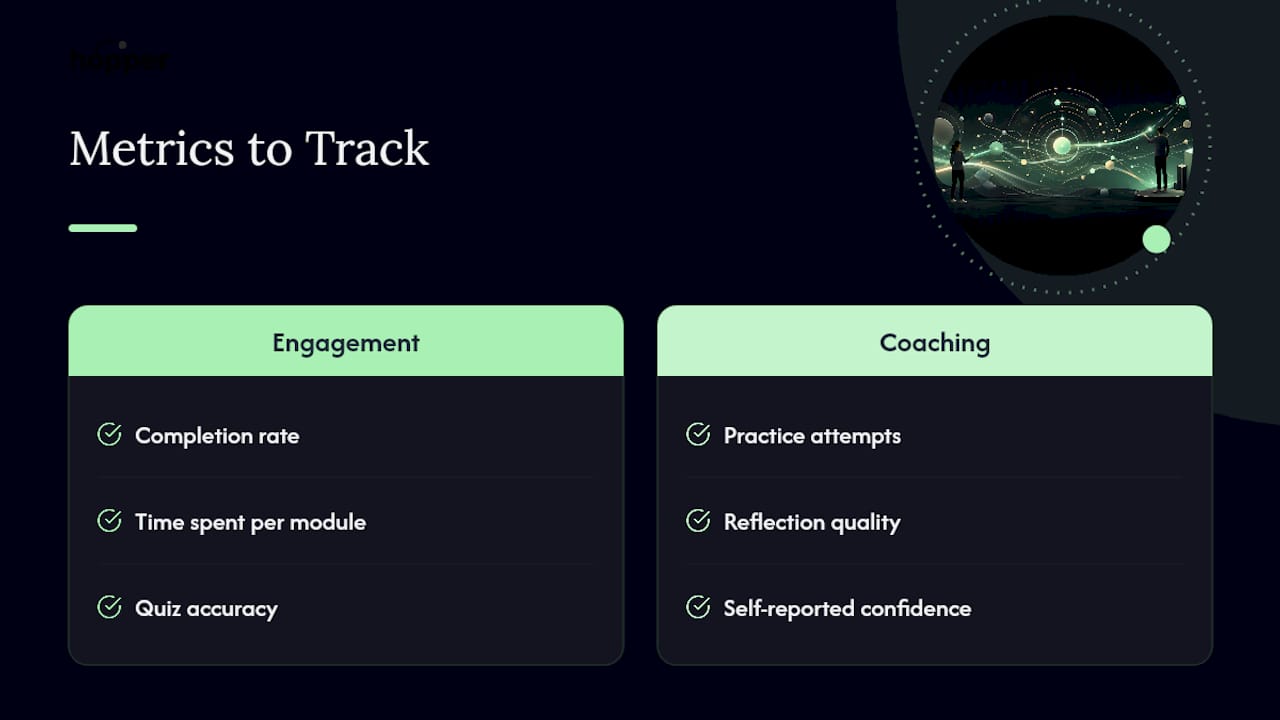
Track two categories, not one. Engagement metrics (completion rate, time spent per module, quiz accuracy) tell you whether people are showing up. Coaching metrics (practice attempts, reflection quality, self-reported confidence) tell you whether it's changing anything.
Set a target before you start, even a rough one, and run a 30-day check-in against it. If completion is high but confidence scores haven't moved, the content might be too passive; add a practice assignment. Feed what you find back into your actual coaching conversations instead of letting the data sit in a dashboard nobody opens.
The trap to avoid: optimizing for engagement alone. ATD's research on micro-coaching points to manager or coach involvement as the single biggest driver of whether learning actually transfers, which means your check-in conversations matter more than the analytics dashboard ever will.
How Do You Run a 30-Day Microlearning Pilot?
Keep the first pilot small enough to finish.
- Pick one or two coaching goals and recruit five pilot participants, no more.
- Build five micro-modules, each with one objective, one to three minutes of content, and one practice activity.
- Automate reminders and pick a single measurement, a five-point confidence scale or a one-question quiz works fine.
- Schedule a 30-day review and adjust cadence, format, or objectives based on what the data and the conversations actually show.
Five modules and five people is enough to learn what to fix before you scale it to your full roster.
What Building This Into a Platform Actually Teaches You
Watching coaches build microlearning into their practice on Hopper surfaces a pattern fast: the platform features that shorten time-to-launch are the ones that remove a decision, not the ones that add a feature. A native app that pushes a nudge without you touching it. Async sessions that let feedback happen without scheduling a call. A storefront that turns five modules into a saleable bundle without a separate checkout tool.
Daniel Lim's move onto Hopper, which cut $6,000 a year by consolidating his stack, is really a story about removing friction points that had nothing to do with coaching quality.
Editorial Take: What the Research Actually Tells You to Do First
The evidence is clear on one point most coaches get backwards: content quality matters less than cadence and feedback. A beautifully produced ten-minute video loses to a rough ninety-second voice memo followed by a real response, every time, because the review's own findings tie outcomes to engagement and behavioral follow-through, not production value.
The conventional advice, "build a course, then support it with coaching," has the order wrong. Microlearning should be the connective tissue between sessions, not a standalone product bolted on afterward. Coaches who treat it as homework delivery see completion rates. Coaches who treat it as a structured feedback loop see behavior change.
If you're starting from zero, don't build twenty modules before you've tested five. Pilot first, measure practice attempts and confidence scores, not just completion, and let the 30 day check-in tell you where the real gaps are. The manager-involvement research is blunt about this: the coach's presence in the loop is what makes any of it stick, and no amount of clever formatting substitutes for that.
*— Cedrik
A Simpler Way to Run Microlearning Alongside Your Coaching
If you're piecing this together across a course host, a scheduling tool, and a separate app for community, you already know where the friction lives. Hopper puts your content library, async coaching, community discussions, and storefront in one hub, with a native iOS and Android app included at every tier, not gated behind a top plan.

Coaches moving from a stitched-together stack, the kind Daniel Lim consolidated to save $6,000 a year, typically find the switch straightforward, and Hopper's free migration support means you don't rebuild your content from scratch. If you're ready to see whether a single hub fits your coaching workflow, take a look at Hopper's platform overview and start mapping your first pilot.
Sources
- Microlearning beyond boundaries: A systematic review and a novel framework for improving learning outcomes
- Microlearning beyond boundaries: A systematic review and a novel framework for improving learning outcomes
- What Is Microlearning and Why Is It Effective? | Articulate
FAQ
How Much Does Microlearning Typically Cost to Implement?
Costs vary widely depending on whether you build modules yourself or hire production help, but the bigger cost driver is usually the platform stack, not the content. Consolidating tools into one hub, rather than paying separately for a course host, community app, and scheduling tool, is often the larger saving.
What Is the 70/30 Rule in Coaching?
Definitions vary across coaching frameworks, and no single standard applies to microlearning specifically, so treat any specific ratio you encounter as a general guideline rather than a fixed rule.
Is Microlearning Actually Effective for Coaching?
Yes, when it's built around a single objective per module and paired with feedback. A systematic review of 40 studies found consistent positive effects on recall, engagement, and motivation, and ATD's research ties those gains to manager or coach involvement in the loop.
What Formats Work Best for Coaching Microlearning?
Short videos, single-question quizzes, micro-scenarios, and voice-note reflections all perform well, according to practical microlearning guides, because each pairs content with a small, immediate action rather than passive review.
Recommended
On our list and want off? .