
Payhip Alternatives Built for Coaches: Community, Native Apps
Compare Payhip alternatives for course creators and coaches that combine community, native mobile apps, and easy migration. See Hopper plans starting at...
By the Hopper team
Hopper is the strongest direct alternative to Payhip for coaches who need community, courses, and a storefront under one roof. If you sell simple downloads or software, Gumroad or Ko‑fi will feel lighter. If you sell globally and want tax handled for you, look at Lemon Squeezy. If you're funnel building on a tight budget, Systeme.io fits. The comparison table and checklist below sort out which one matches your revenue and product mix.
TL;DR:
- Hopper offers an all-in-one platform for coaches, combining community, courses, and storefronts at a fixed monthly cost with no hidden caps.
- For revenue under $500 monthly, free percent-based plans like Gumroad or Ko‑fi are more cost-effective, but flat-fee plans become cheaper beyond that threshold.
- Platforms like Lemon Squeezy handle EU VAT and tax filings for software sellers but charge higher transaction fees, making them suitable for international software sales.
- Reliability depends on high-traffic performance; Hopper's integrated infrastructure reduces outages common across stitched-together platform stacks.
- Support quality varies, with larger platforms providing tiered support and smaller ones offering responsive email support, so testing response times before committing is recommended.
Table of Contents
- Why Look Beyond Payhip in the First Place?
- Comparing the Best Payhip Alternatives Side by Side
- How Do You Choose the Right Payhip Alternative?
- How Reliable Are These Platforms Day to Day?
- What Support Can You Actually Expect?
- Is Your Data Actually Safe on These Platforms?
- Can You Actually Make the Storefront Look Like Yours?
- When Should You Consolidate vs. Keep It Simple?
- Hopper: One Place Instead of a Stitched-Together Stack
- Sources
- FAQ
Why Look Beyond Payhip in the First Place?
Payhip built its reputation on low fees and straightforward EU VAT handling, and for a solo creator selling a handful of PDFs, that's often enough. But the moment you add a course, a paid community, or a mobile-first audience, the gaps show up fast. Payhip has no native mobile app, no built-in community layer, and no async coaching tools. That's not a knock on Payhip. It's just not built for the coach who wants one home for their whole business instead of a storefront bolted onto a Notion doc and a Discord server.
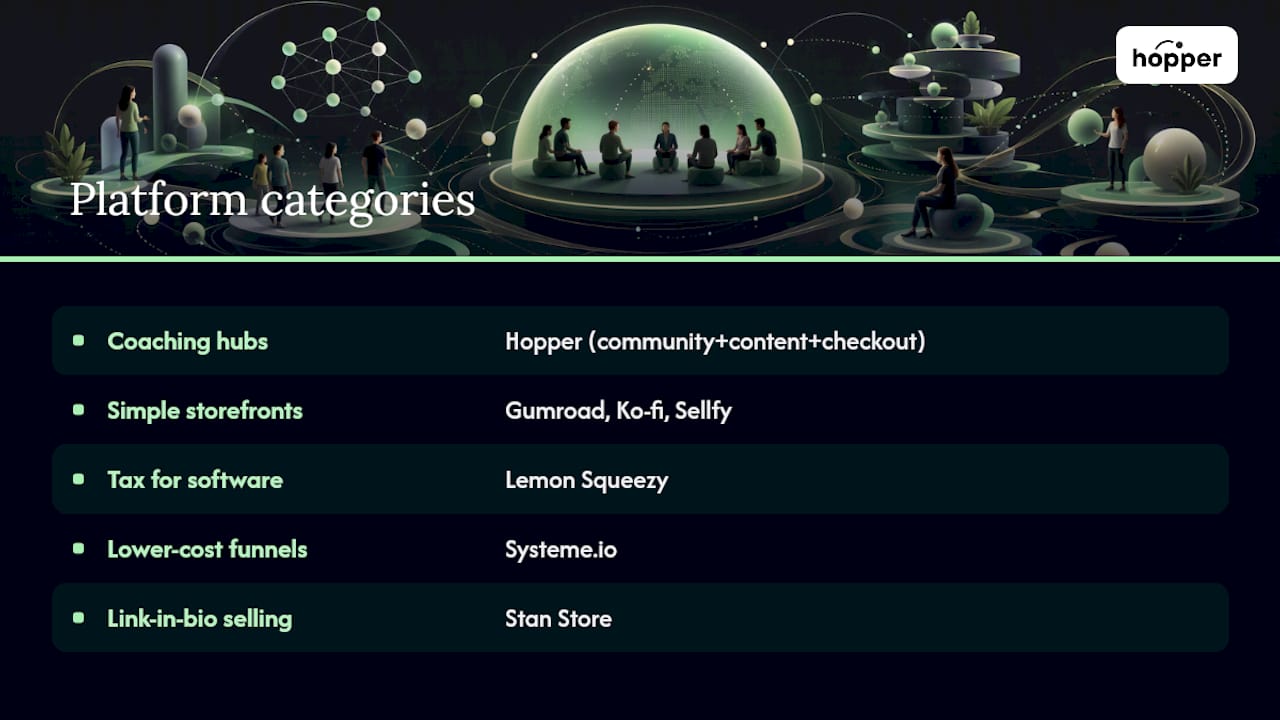
The platforms below split into a few real categories. Hopper covers coaching businesses that need community plus content plus checkout. Gumroad, Ko‑fi, and Sellfy cover simple digital product sales. Lemon Squeezy handles the tax headache for software sellers. Systeme.io and Stan Store serve creators optimizing for lower cost or link-in-bio simplicity. Knowing which bucket you're in saves you from six months on the wrong platform.
Comparing the Best Payhip Alternatives Side by Side
Every platform on this list solves a different piece of the "sell things online" puzzle. Hopper leads because it's the only one built specifically for coaches who need community, courses, and commerce in a single hub rather than three separate subscriptions. The rest split cleanly by what they're actually good at: simple storefronts, tax-handled checkout, or budget funnels.
A few fee-math notes worth sitting with. Percent-based free tiers, like Gumroad's, make sense at low volume because there's nothing to lose if sales are slow. But once monthly revenue climbs past roughly $500 to $3,500 depending on the plan, a flat subscription with 0% commission almost always wins. Lemon Squeezy's Merchant of Record model charges more per transaction but takes tax filing off your plate entirely, which matters once you're selling software across a dozen countries.
How Do You Choose the Right Payhip Alternative?
Start with the math, not the marketing page. Here's the order to work through it:
- Calculate your break-even point. If you're under roughly $500 a month, a free percent-based plan (Gumroad, Ko‑fi) costs you less than a subscription. Past that, run the numbers on flat-fee plans with 0% commission.
- Map your product mix. Downloads only? Almost anything works. Courses plus a paid community plus coaching calls? You need a platform built for that combination, not three tools duct-taped together.
- Check your EU sales exposure. If a meaningful share of revenue comes from EU customers, decide whether you want to manage VAT yourself (Payhip, Hopper) or hand it to a Merchant of Record like Lemon Squeezy.
- Test the mobile experience. A platform without a native app means your community lives in a browser tab, which kills engagement for anything coaching-adjacent.
- Confirm migration paths. Ask directly: can you export your member list, your content library, and your existing payment history? Some platforms make this trivial. Others make you rebuild from scratch.
Pro Tip: Before you commit, run a real payout through the free trial to understand how to collect dance studio payments online. Add a test product, buy it with a real card, and time how long the money takes to hit your bank account. That fifteen-minute test tells you more than any features page.*
Red flags during a trial: hidden caps on members or products, an "app" that's really just a mobile browser wrapper, or export tools that only work with a support ticket.
How Reliable Are These Platforms Day to Day?
Uptime is the boring metric nobody checks until a launch day checkout page goes dark. Established platforms like Shopify, Kajabi, and Teachable run on mature infrastructure with published status pages and years of uptime history, which is exactly why big commerce operations trust them. Newer or smaller tools vary more, and worth asking directly before you migrate a paying community onto them.
The practical test isn't a published percentage. It's what happens during your specific high-traffic moments: a course launch, a cart-close deadline, a live cohort kickoff. Ask any platform you're evaluating for their status page history and whether they've had outages during past high-volume sales events. If support can't answer that quickly, treat it as data.
Hopper's approach here is architectural rather than promotional: hubs run on a single infrastructure layer instead of stitching a course host, a community app, and a checkout tool together, which is often where reliability breaks down. When three separate vendors each have their own uptime record, your actual reliability is the weakest link, not the average.
What Support Can You Actually Expect?
Support quality separates the platforms fast once something breaks at 11 p.m. before a launch. Larger platforms like Shopify and Kajabi run tiered support: chat and email on lower plans, phone or priority queues on higher ones. That tiering means the plan you're not paying for might leave you waiting.
Smaller, creator-first tools like Podia and SendOwl tend to lean on email support with a real human answering, often within a business day. Community-driven platforms sometimes point you toward user forums first, which works for common questions but leaves you stuck on anything account-specific.
Response time matters more than channel count. A platform with just email support that replies in two hours beats one with five channels and a three-day queue. When you trial a platform, send a real question before you commit; the answer you get (and how fast) tells you more than any support page promises.
Is Your Data Actually Safe on These Platforms?
Payment security is table stakes now. Every platform on this list processes cards through PCI-compliant processors like Stripe or PayPal, so card data itself is rarely the risk. The real question is what happens to your member data, your course content, and your community conversations.
Look for platforms that publish clear data handling practices and support standard encryption in transit and at rest. Merchant of Record platforms like Lemon Squeezy carry additional responsibility since they process the transaction on your behalf, which is part of why their fee runs higher.
For coaches specifically, community and coaching conversations often involve sensitive personal disclosure. That's a different privacy bar than a simple digital download sale, and it's worth asking any platform directly how member conversations and private coaching threads are stored and who can access them.

Can You Actually Make the Storefront Look Like Yours?
Branding flexibility ranges wildly across this list. Shopify and WooCommerce sit at one end: full theme control, custom code, the works, if you're willing to spend the time. Squarespace splits the difference with polished templates and less flexibility underneath.
Creator-first platforms like Sellfy and Podia offer solid customization within a template structure: your logo, your colors, your domain, but you're not rebuilding the checkout flow from scratch. That's usually the right tradeoff for a coach who wants to look professional without hiring a developer.
The storefront question that matters most for coaching businesses isn't just "can I change the colors." It's whether your public landing page can showcase your community, your content library, and your products together, so a new visitor sees the whole business in one place instead of clicking between three different links.
When Should You Consolidate vs. Keep It Simple?
Consolidating onto one platform makes sense the moment you're paying for a course host, a community tool, and a checkout page separately, and still copying member lists between them by hand. Flat pricing, a native app, and no per-member caps usually pay for themselves within a few months for any coach running a real audience.
If you're selling a handful of downloads occasionally, don't overbuild. A lean storefront like Gumroad or Ko‑fi, with marketplace discovery built in, will outperform an all-in-one platform you're barely using. The checklist above still applies: know your fee math before you pick either direction.
— Cedrik
Hopper: One Place Instead of a Stitched-Together Stack
Hopper's math is simple: Hopper Base runs $58 a month with a 1% transaction fee, and Hopper Pro runs $108 a month with 0% transaction fees. No hidden caps on members, hubs, or products, on either plan.

What that replaces: a course host, a separate community tool, a checkout page, and a link-in-bio tool, each billed on its own schedule and each gating features behind a higher tier. Hopper's native iOS and Android apps come included at the flat price instead of locked behind a premium tier. One coach, Daniel Lim, cut $6,000 a year by consolidating his stack onto Hopper, and migration support exists specifically for coaches moving off Kajabi or Circle without rebuilding their content from scratch. If you're weighing what a legacy platform actually costs you at scale, this breakdown of what Kajabi, Skool, and Circle don't want compared is worth ten minutes. Start with a look at Hopper's plans and see whether Base or Pro fits your current transaction volume.
Sources
Fee math and break-even guidance come from Sellfy vs Payhip vs Gumroad's fee comparison. Merchant of Record context comes from the Lemon Squeezy review on MakerStack. Feature tradeoffs between Gumroad and Payhip come from RAQ Media's comparison, and the broader alternatives list draws on Software Advice's Payhip profile.
- Sellfy vs Payhip vs Gumroad in 2026: Honest Fee Comparison for Digital Product Sellers
- Lemon Squeezy Review (2026) - MakerStack
FAQ
What Are Some Free Alternatives to Payhip?
Ko‑fi's shop and Gumroad both let you start selling with no monthly fee, taking a percentage of sales instead. Ko‑fi's shop feature works well for creators who also accept tips, while Systeme.io offers a genuinely usable free tier for funnels and courses.
Is Gumroad Better Than Payhip?
Neither is strictly better; they solve different problems. Gumroad offers native software license keys and marketplace discovery, while Payhip focuses on lower transaction fees and EU VAT handling, so the right pick depends on whether discovery or fee control matters more to you.
Which Platform Is Better for Me, Payhip or Ko‑fi?
Ko‑fi suits creators selling occasional digital goods alongside tips or donations, with a simpler setup than Payhip. Payhip fits better if you're selling regularly and want more storefront customization and EU VAT tools built in.
Is Stan Store Better Than Payhip?
Stan Store is built for creators selling through social bio links and embeddable checkout widgets, while Payhip works better as a standalone storefront with its own product pages. If your audience lives on Instagram or TikTok and clicks through a bio link, Stan Store's checkout flow fits that path more directly.
What Does Hopper Cost Compared to Payhip?
Hopper Base runs $58 a month with a 1% transaction fee, and Hopper Pro runs $108 a month with 0% fees, both including community, courses, and a native mobile app. Payhip has no monthly fee on its free plan but takes a higher percentage per sale and doesn't include community or app features at all.
Recommended
On our list and want off? .