
Small Teams: Recover 60–80% of Failed Payments and Cut Membership Churn
A tactical playbook for small membership teams: use 90 day onboarding, engagement scoring, automated dunning, and cancel flow saves to cut churn within...
By the Hopper team
The fastest wins come from five levers: a structured 90-day onboarding sequence, an engagement score that flags at-risk members before they cancel, automated dunning, a disciplined cancel-flow save hierarchy, and a targeted win-back sequence. Dunning alone can recover up to 60 to 80% of failed payments, and onboarding is the single biggest driver of first-year retention. Start by checking two numbers this week: your monthly churn rate and your first-90-day retention rate. Everything else follows from those.
TL;DR:
- Automated dunning with multiple retries can recover up to 80% of failed payments, significantly reducing involuntary churn.
- A 90-day onboarding sequence with clear milestones boosts early engagement, which correlates strongly with higher first-year renewal rates.
- Tracking four key metrics monthly, especially churn rate and cohort retention, helps identify churn patterns and measure retention efforts effectively.
- Building an engagement score that incorporates login activity, participation, and payment status enables proactive outreach to at-risk members.
- Consolidating tools into a unified platform, like Hopper, reduces blind spots, streamlines data, and improves early detection of members in trouble.
Table of Contents
- Quick Checklist to Reduce Membership Churn This Week
- How Do You Spot At-Risk Members Before They Cancel?
- What Should a 90-Day Onboarding Sequence Look Like?
- How Do You Build Community That Keeps People Renewing?
- How Do You Stop Losing Members to Failed Payments?
- How Should Your Cancellation Flow Work?
- When Is the Best Time to Win Back Lapsed Members?
- What Metrics Should You Review Every Month?
- Which Tools Actually Support These Retention Plays?
- What Consolidating Tools Actually Does for Retention
- Where Small Teams Should Focus First
- A Simpler Way to Reduce the Friction That Drives Churn
- Sources
- FAQ
Quick Checklist to Reduce Membership Churn This Week
You don't need a new platform or a bigger budget to move the needle in the next seven days. You need to pick the highest-leverage actions and actually finish them.
Start here:
- Turn on automated dunning with at least three retry attempts over 7 to 14 days.
- Build (or dust off) a 90-day onboarding sequence with clear milestones.
- Create a simple engagement score from login frequency, event attendance, and payment status.
- Simplify renewal into a one-click or auto-renew flow with a visible grace period.
- Build a cancel flow with pause and downgrade options before any discount appears.
- Launch a 30-day and 60-day win-back sequence for anyone who already lapsed.
Why the 90-day window matters: members who stay active through their first 90 days renew at meaningfully higher rates than those who don't. Overall median first-year retention sits near [82%], while members without strong early engagement renew closer to 72%(https://www.i4a.com/guides/membership-retention/). That ten-point gap is almost entirely explained by what happens (or doesn't) in the first three months.
Track four numbers monthly: overall churn rate, cohort retention by signup month, first-year retention, and involuntary churn (the share caused by failed payments, not member choice). Gyms and associations typically treat monthly churn above a moderate level as a signal to act immediately, not wait for the quarterly report.
How Do You Spot At-Risk Members Before They Cancel?
Members rarely cancel out of nowhere. They drift first, and the drift leaves a trail if you know where to look.
The clearest warning signs show up in behavior, not intent. A member who logged in weekly and now hasn't shown up in three weeks is telling you something. So is someone who stopped opening your emails, skipped the last two events they'd normally attend, or had a payment fail and never updated their card. Any one of these alone might mean nothing. Together, they're a pattern.
A lightweight engagement score turns that pattern into something actionable. Here's a simple version you can build in a spreadsheet or a basic automation tool:
- Login or app activity in the last 14 days: 3 points if active, 0 if not.
- Event or content engagement in the last 30 days: 3 points for attendance or completion, 1 for a view, 0 for nothing.
- Payment status: 2 points for current, negative 3 for a failed or overdue payment.
- Community participation: 2 points for posting or commenting, 1 for reacting, 0 for silence.
Add it up. A score of 7 or higher is healthy. A score of 3 to 6 is medium risk and worth a nudge. Anything below 3 is at-risk and needs a human touch, not another automated email.
Automate the first response, not the last one. A medium-risk score can trigger an automated in-app prompt or a "we miss you" email with no strings attached. An at-risk score should route straight to a real person, whether that's a community manager or a coach, because by that point, generic messaging usually gets ignored.
Pro Tip: Weight payment failures heavily in your score. A member who's engaged but has a declined card is often one reminder away from staying. A member who's disengaged and current on payment is the harder save.
What Should a 90-Day Onboarding Sequence Look Like?
Retention gets decided early. Members who hit two or three activation milestones in their first 90 days renew at rates well above the median, and that gap doesn't close later. It's set in the first few weeks or it isn't.
Pick milestones that actually predict retention for your program. For a gym, that might be attending three classes in the first two weeks. For a professional association, it might be joining one committee or attending one event. For a paid community, it might be posting once and reacting to five other posts. Whatever it is, define it before launch, not after you notice churn creeping up.
A sequence that works for most membership types looks like this:
- Day 0: Welcome message with one clear next action, not five.
- Day 3: Prompt to complete a profile or preference setting, so future content feels relevant.
- Week 2: Direct invitation to a specific event, class, or discussion thread.
- Day 30: Personal check-in, ideally from a real person, not a template.
- Day 60: Nudge toward an underused resource or feature tied to their stated goals.
- Day 90: Milestone message acknowledging progress and setting up the next 90 days.
Target completion rates matter more than the messages themselves. If you're below those numbers, the sequence needs work before you add more content to it.
Track activation rate by milestone, not just overall churn, so you can see exactly where members are dropping off. Run one variable at a time: change the Day 0 message, hold everything else steady for a month, and compare cohort retention. Small, sequential tests beat overhauling the whole flow and guessing which change worked.
How Do You Build Community That Keeps People Renewing?
Value has to be felt, not just delivered. A member who consumes content passively is more replaceable, in their own mind, than a member who has a peer connection or a role in the community. That's the entire logic behind an engagement ladder.
Think of it in three rungs. Passive engagement is reading, watching, or lurking. Active engagement is attending, commenting, or completing something. Deep engagement is mentoring, leading a discussion, or organizing something for others. Most members start on the bottom rung. Retention improves as you move a meaningful share of them up.

Association research backs this up directly: networking is consistently cited as a top reason people join in the first place, and seeded forums, mentorship programs, and special interest groups measurably raise both participation and renewal rates. A gym sees the same effect when a member finds a regular class buddy or joins a challenge group. A solo learner rarely lasts as long as one who found their people.
Practical moves that shift members up the ladder:
- Seed forum discussions with real questions before members arrive, so the space never feels empty.
- Pair new members with a mentor or "buddy" in their first two weeks.
- Recognize milestones publicly, whether it's a class streak, a certification, or a years-of-membership badge.
- Segment content by where someone sits on the ladder, so a deeply engaged member isn't getting the same beginner email as a brand-new signup.
Pro Tip: *You don't need a personalization engine to segment well.
How Do You Stop Losing Members to Failed Payments?
A large share of cancellations aren't decisions at all. Members forget, cards expire, or a payment fails silently and nobody notices until the membership has already lapsed. Practitioner estimates put the share of non-renewals caused by simple forgetfulness at close to 28%, which makes this one of the cheapest problems to fix on the entire list.
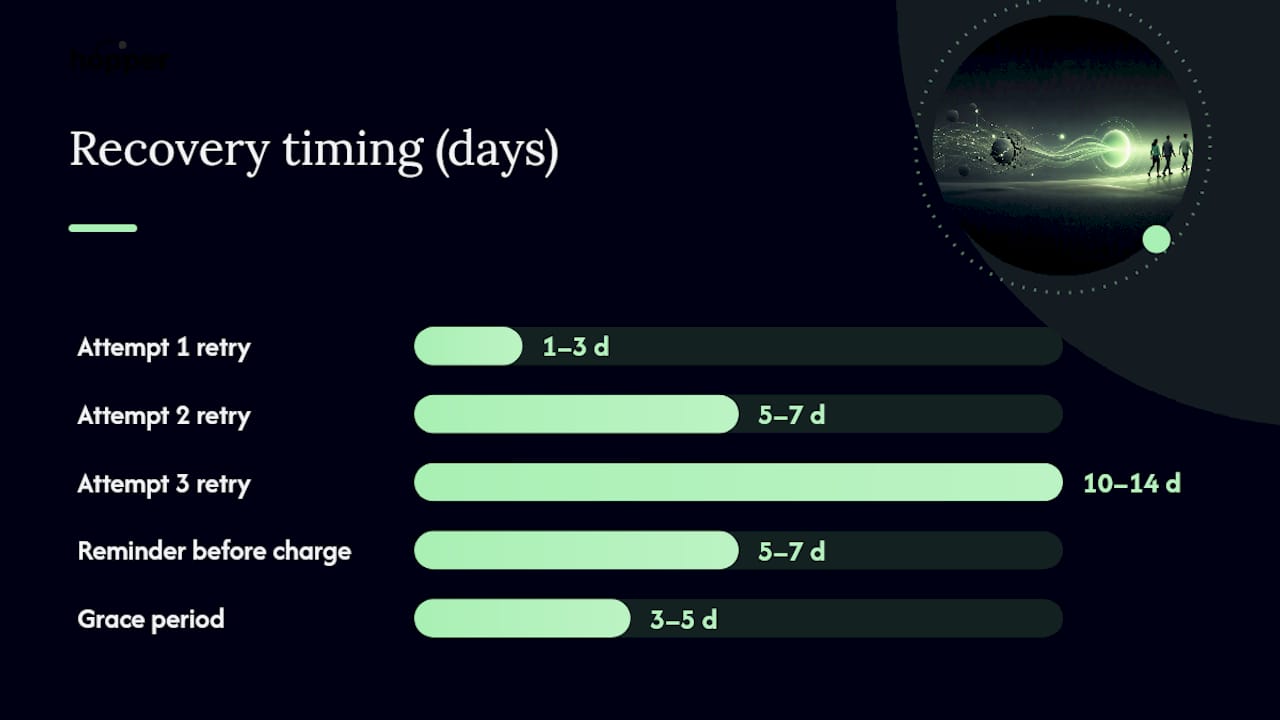
Dunning, done right, is retry logic with a purpose. A typical effective cadence looks like:
- Attempt 1: Retry the payment 1 to 3 days after failure, often with a card-updater tool that fixes expired cards automatically.
- Attempt 2: Retry again at day 5 to 7, paired with a friendly, non-alarming email.
- Attempt 3: Final retry at day 10 to 14, with a clear message that access ends soon if unresolved.
Structured programs following this kind of cadence recover 60 to 80% of failed payments, and mature systems often push involuntary churn below 3% of monthly revenue.
Auto-renew works best when it's honest about what's happening. Send a reminder 5 to 7 days before the charge, state the amount clearly, and give a short grace period (3 to 5 days is common) after a failed payment before access is cut off. Members who feel ambushed by a charge complain and churn. Members who see it coming rarely mind.
Check two operational numbers monthly at minimum: your failed-payment percentage and your expired-card rate. If either climbs, it usually means your card-updater isn't running correctly or your retry window is too short.
How Should Your Cancellation Flow Work?
The moment someone clicks "cancel" is not the moment to panic and throw discounts at them. It's the moment to understand why they're leaving and offer the smallest reasonable thing that solves their actual problem.
A cancellation flow that respects the member and protects revenue follows this order:
- Pause first. Offer 30 or 60 days of paused billing before anything else. Many cancellations are about timing, not dissatisfaction.
- Downgrade second. If pausing doesn't fit, offer a lighter, cheaper tier that keeps them in the system.
- Discount last, and only once. A short-term discount (one or two billing cycles) should be the final offer, not the first.
Guardrails matter here as much as the offers themselves. Cap save offers to once per member per 12 months, so members don't learn to threaten cancellation for a discount every renewal cycle. Set a maximum discount depth (many programs cap it around 20 to 30% for one or two cycles) and a maximum pause length (60 to 90 days), so the offer stays generous without becoming a permanent workaround.
Done this way, cancel flows with pause, downgrade, and discount tiers save 20 to 40% of cancellation sessions, which is a meaningful chunk of voluntary churn recovered without training your best members to expect discounts.
Before they leave, ask three questions on exit, no more. Keeping the exit survey to three questions preserves completion rates: why are you leaving, what would have kept you, and would you consider coming back. Tag the answers by root cause so you can spot patterns across dozens of cancellations instead of treating each one as a one-off.
When Is the Best Time to Win Back Lapsed Members?
The 30 to 60 day window after someone lapses is where win-back campaigns earn their keep. Wait longer than that and the habit of not being a member sets in; reach out too soon and it can feel like nagging.
A simple two-stage sequence covers most of the opportunity:
- Day 30: Send a "here's what you missed" digest, real event recaps, new content, community wins, nothing generic.
- Day 45: Offer a simplified rejoin flow that skips the full signup process and restores their previous settings or history if possible.
- Day 60: Extend a limited-time amnesty offer, such as waived setup fees or a short discount, framed as a one-time return path, not a standing deal.
Measure win-back ROI by tracking rejoin rate against the cost of the outreach and offer. If a segment isn't responding by day 60, stop spending effort there and let a slower, lower-cost sequence (quarterly newsletter, occasional event invite) carry the relationship instead. Chasing lapsed members indefinitely costs more than it returns.
What Metrics Should You Review Every Month?
Four numbers tell you almost everything: monthly churn rate, cohort retention curves (grouped by signup month), first-year retention, and involuntary churn as a percentage of revenue. Track them consistently and the story becomes obvious fast.
A 30-minute monthly review is enough if the agenda stays tight:
- Pull root-cause tags from exit surveys and rank them by frequency.
- Pick the top two plays to run next month, not five.
- Review results from whatever experiment ran last month before starting a new one.
| Metric | What it tells you | Review cadence |
|---|---|---|
| Monthly churn rate | Overall health, trending up or down | Monthly |
| Cohort retention curve | Whether onboarding changes are working | Monthly |
| First-year retention | Long-term program health | Quarterly |
| Involuntary churn % | Whether dunning is working | Monthly |
Run experiments as simple A/B or cohort comparisons: change one variable (a subject line, a milestone, a retry cadence), hold a control group steady, and compare outcomes after 30 to 60 days. Small improvements in retention compound because every retention gain reduces how much new-member recruitment you need to hit the same growth number.
Which Tools Actually Support These Retention Plays?
You don't need one platform to do everything, but you do need the tools you have to talk to each other. A billing system that can't trigger an engagement score, or a community platform that can't flag a failed payment, forces someone on your team to manually stitch the picture together every week.
Four categories cover most of what's needed:
- Engagement scoring: something that pulls login, attendance, and participation data into one score, ideally with alert rules built in.
- Billing and dunning: payment processing with automated retry logic and card-updater support baked in.
- Community platform: where members actually interact, post, and build the peer connections that drive retention.
- CRM or member database: the source of truth for who's active, who's at risk, and who's already lapsed.
Before choosing anything, check for four things: does it automate the retry and reminder logic you actually need, does it report cohort-level data (not just totals), does it support mobile access and single sign-on, and does it offer migration support if you're moving off an existing system. Unified systems that combine engagement, billing, and CRM data make it dramatically easier to spot churn signals early, because nobody has to cross-reference three separate dashboards to see the full member picture.
Consolidate when your current stack requires manual data transfer between tools to answer a simple question like "who's at risk this week." Keep tools separate only when one does something so specific and so well that no combined platform matches it, and even then, weigh that against the cost of the manual work required to bridge the gap.
What Consolidating Tools Actually Does for Retention
Tool sprawl doesn't just cost money. It creates the exact blind spots that let at-risk members slip through, because engagement data lives in one app, billing lives in another, and nobody has the full picture in one place.
Some platforms address this by combining community, content, coaching, and checkout inside one hub, allowing for unlimited members and moderators without contact caps as a program grows. A native iOS and Android app can come standard, so members engaging on mobile aren't a second-class experience bolted onto a desktop-first tool.
One documented case: Daniel Lim consolidated his stack onto Hopper and cut roughly $6,000 a year in software costs alone, on top of the operational time saved from no longer reconciling data across separate systems. That kind of consolidation matters for churn work specifically because a single source of truth for engagement data is exactly what makes an accurate at-risk score possible in the first place.
Where Small Teams Should Focus First
If you run a lean team, don't try to fix everything at once. Sequence matters more than ambition here.
Start with dunning automation. It's the fastest win because it's almost entirely automatable and the payoff shows up in your first month of data. Run the 90-day onboarding rollout next, since it takes longer to prove out across a full cohort but pays off for the life of every member who completes it. Save the cancel-flow save-offer test for third, once you have enough cancellation volume to make the pause and downgrade options statistically meaningful.
For a one- or two-person membership team, that sequence keeps the workload realistic: one automation project, one workflow rebuild, one flow redesign, spaced out rather than launched simultaneously. Trying to run all three at once usually means none of them get the follow-through they need to actually work.
— Cedrik
A Simpler Way to Reduce the Friction That Drives Churn
Most of the churn work above gets harder when your onboarding lives in one tool, your billing lives in another, and your community lives in a third. Hopper exists to close that gap: one hub with a community feed, a content library, async coaching, and a built-in storefront, so your engagement data and your billing data sit in the same place instead of three.

That matters most for teams already stretched thin. Daniel Lim's move to Hopper saved him about $6,000 a year in software costs, and three coaches have already migrated off Kajabi onto Hopper without rebuilding their businesses from scratch.
If your current stack is making it hard to see who's at risk before they cancel, that's usually a sign the tools aren't talking to each other. Start a trial and see how Hopper's hub model fits your program before committing to a full migration.
Sources
- Retention Guide: Move from 78% to 85%+ | i4a
- Preventing Customer Churn Strategies: 9 Plays for SaaS in 2026 | ChurnDefense
- Membership churn | MemberClicks
FAQ
What Does Reduced Churn Mean?
Reduced churn means fewer members cancel or lapse over a given period, usually measured as a lower percentage of total members lost per month or year compared to a prior benchmark.
What Does "Subscription Churn" Mean?
Subscription churn is the rate at which paying members cancel or fail to renew a recurring membership, typically calculated as members lost divided by total members at the start of the period.
How Can I Reduce My Churn Rate?
Focus first on the highest-return, most automatable plays: dunning for failed payments, a 90-day onboarding sequence, and an engagement score that flags at-risk members before they cancel, since together these address most involuntary and early voluntary churn.
What Does Preventing Churn Mean?
Preventing churn means addressing the causes of cancellation before a member reaches the cancel button, through early engagement scoring, strong onboarding, and proactive outreach rather than reactive save offers.
How Do I Calculate My Membership Churn Rate?
Divide the number of members lost during a period by the total number of members at the start of that period; track it monthly alongside cohort retention for a fuller picture.
Recommended
On our list and want off? .