
Sell Coaching Memberships That Retain Members and Save $6,000
A coach-first playbook to model, price, launch, and retain membership clients, plus platform moves that helped one coach save $6,000 a year.
By the Hopper team
Sell coaching memberships by matching a predictable tiered structure (sessions-per-period for 1:1 work, unlimited or group tiers for scalable offers) to how you actually deliver value, then pricing it from your existing session rate. The one thing to do today: write a single sentence that names your audience, the result you deliver, and the method you use to get them there. That sentence becomes your sales page headline, and everything else, pricing, platform, launch, gets built around it.
TL;DR:
- Memberships should match the actual time and resource cost of delivering value, with scalable digital content for members with minimal ongoing effort.
- Pricing should be based on your existing session rate and anchored to the highest tier first, with billing options designed to optimize cash flow and retention.
- Launch strategies are simple with a clear lead magnet, short nurture sequence, a live event, a defined open window, and straightforward onboarding.
- Key retention tactics include delivering quick wins early, maintaining a predictable content rhythm, and tracking engagement and churn to address drop-offs promptly.
- Using an all-in-one platform like Hopper can significantly reduce costs and operational complexity by consolidating billing, content, community, and native app access.
Table of Contents
- What Membership Models Actually Work for Coaches?
- How Should You Price Coaching Membership Tiers?
- What Platform Features Do You Need to Launch?
- How Do You Launch and Sell a Coaching Membership?
- How Do You Retain Coaching Membership Members Long Term?
- What Does Consolidating Your Coaching Tools Actually Save You?
- How Do You Handle Payment Failures and Cancellations?
- What Customer Support Practices Keep Membership Clients Happy?
- How Do You Upsell and Cross-Sell Inside a Coaching Membership?
- What Legal Basics Does a Coaching Membership Need?
- What Priorities Actually Matter When You Scale Into Memberships?
- How Hopper Puts This Playbook Into Practice
- Sources
- FAQ
What Membership Models Actually Work for Coaches?
Most coaches try to sell a membership the same way they sell 1:1 sessions, and it falls apart within a month. A membership needs a shape that matches how much of your time each new member actually costs you. Get that wrong and you either burn out fulfilling unlimited promises or leave money on the table capping something that costs you nothing to scale.
There are four practical shapes worth considering, and most successful coaching memberships are some combination of them.
- Sessions-per-period (retainer): members get a fixed number of live sessions each month, say two calls, which protects your calendar and keeps pricing predictable for both sides.
- Group coaching: one call, many members, priced far below 1:1 but scalable without adding hours.
- Mastermind: a smaller, higher-priced cohort that meets regularly and leans on peer accountability as much as your input.
- Self-serve library: members pay for access to recorded content, templates, and community, with no live time from you at all.
- Hybrid tiers: a base tier with library access, a middle tier that adds group calls, and a top tier with 1:1 time folded in.
The rule of thumb comes down to marginal cost. If an extra member costs you almost nothing to serve, digital content, a community thread, prefer an unlimited or high-cap tier. If an extra member costs you real time, another session, another response, cap it per period. That single distinction, outlined clearly in coaching membership research, is what separates coaches who scale from coaches who quietly overextend themselves.
A workable starter structure for a life or business coach might look like this: a Community tier (library plus discussion access), a Growth tier (adds one group call), and a Momentum tier (adds one 1:1 session), all priced relative to session value and delivery. That is the model MemberPress documents across one-on-one retainers, group coaching, and self-serve tiers as the backbone of most coaching subscription businesses.
To map your own delivery to a model, run through this quickly:
- Write down how many hours per member per month your current offer actually takes.
- Decide whether that number changes meaningfully if you add ten more members.
- If it barely changes, build toward unlimited or self-serve. If it scales linearly, cap sessions per period.
- Pick one primary tier to launch with, not three. Add tiers once the first one sells.
Start narrow. A single well-priced tier that sells beats three tiers that confuse everyone, including you.
How Should You Price Coaching Membership Tiers?
Price from a number you already know: your casual, one-off session rate. Discount modestly for monthly commitment and offer a larger incentive, such as one to two months free, for paying annually. That anchoring method, detailed in membership pricing guidance for coaches, keeps your pricing grounded in something the member can actually verify against your public rate card.
Pro Tip: Show your casual session rate on the sales page next to the membership price. Members do the math themselves, and the discount becomes the reason to join rather than something you have to argue for.
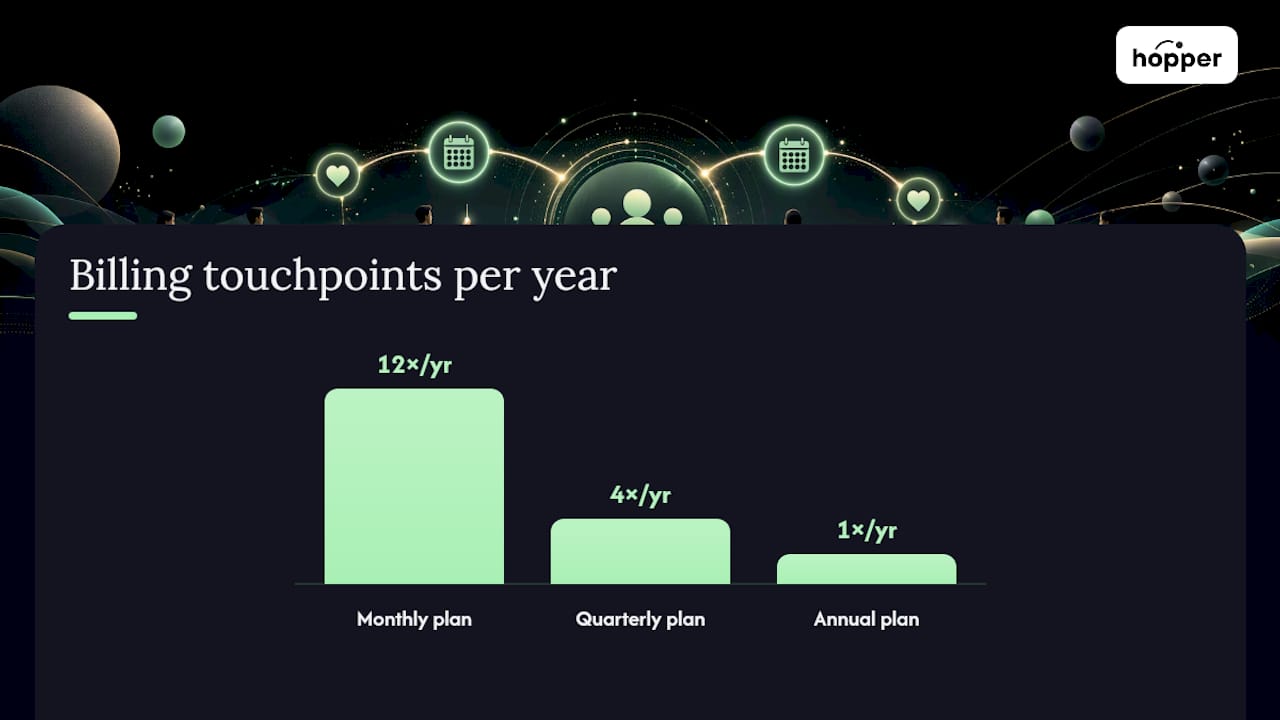
Billing cadence matters more than most coaches assume. Monthly billing lowers the barrier to join but increases the number of cancellation touchpoints across a year. Annual billing raises the barrier but locks in cash flow and cuts your churn exposure to once a year instead of twelve times.
- Monthly at $97: predictable enrollment, but you re-earn trust every 30 days.
- Annual at $970 (two months free on a $97 monthly rate): worse for cold conversions, better for cash flow and retention math.
- A middle path: quarterly billing at a smaller discount, which softens the annual commitment while still cutting billing friction three-fold.
Loyalty pricing, where longer-tenured members pay slightly less than new sign-ups, rewards the people least likely to churn without discounting your front door. It is a lever few coaching platforms offer by default, which is worth checking before you commit to one.
On session caps versus unlimited: cap when your time is the bottleneck, go unlimited when content or community is. A membership association like the Institute of Coaching structures its own tiers this way: cheaper access tiers with limited benefits, higher tiers with more direct engagement, which is a useful reference point for how established organizations think about tier economics.
For price anchoring on your sales page, list your highest tier first. Members judge the middle tier as reasonable once they have seen the top price, a pattern that shows up across nearly every well-converting membership page.
A quick revenue comparison: a group of members on a monthly plan generates predictable monthly income, while an annual plan locks in upfront revenue with less frequent billing and churn events.
What Platform Features Do You Need to Launch?
You need less than most coaches think, but you need it working together, not scattered across five separate logins.
The core feature set that shows up across platform comparisons for coaches again and again: recurring billing that handles failed payments automatically, a member library that gates content by tier, a community space for discussion, a storefront for one-off products alongside the membership, native mobile apps so members do not need a separate download, and migration or export support so your member data is never trapped.
Technical checklists built for WordPress-based setups add useful specifics here too: drip-fed content so members are not overwhelmed on day one, hard gates by tier, and direct payment integrations, features documented across membership plugin comparisons that apply whether you are on a plugin stack or an all-in-one platform.
A minimal viable setup, in order:
- Build the sales page with your one-sentence promise at the top.
- Connect checkout and recurring billing before you announce anything.
- Write a welcome sequence, one email or video that plays the moment someone joins.
- Set up the member dashboard so new members see exactly what to do first.
- Automate billing retries and dunning emails so a failed card does not silently cost you a member.
Treat each tier as its own product with its own identifier, so entitlements reset automatically through billing rather than through you manually checking a spreadsheet every time someone upgrades. That single operational habit, described in membership setup guidance, prevents the slow creep of reconciliation work that eats a solo coach's Friday afternoons.
On payment cadence, monthly billing on the first of the month simplifies your own bookkeeping. Watch transaction fees closely. Some platforms charge a percentage on top of your subscription fee, which quietly erodes margin as you scale past a few dozen members.
How Do You Launch and Sell a Coaching Membership?
You do not need a complicated funnel. You need five steps done in order, and a calendar that keeps you honest about deadlines.
- Lead magnet: a short, specific resource, a checklist or mini-training, that attracts your exact future member.
- Nurture emails: three to five emails over one to two weeks that build trust and preview what membership solves.
- Webinar, live demo, or challenge: a live event where you teach something real and mention the membership at the end, not before.
- Open cart: a defined window, five to seven days, with a clear close date that creates real urgency.
- Onboarding: the moment someone pays, not the moment they finish onboarding, is when retention work actually starts.
Your sales page needs six things and nothing more: the promise, who it is for, what is included tier by tier, one or two pieces of social proof, a clear call to action, and a plain statement of your refund or guarantee policy. Skip any one of these and conversion drops.
For promotion without a big budget:
- Email your existing list before you promote anywhere else. It converts at a far higher rate than cold traffic.
- Run one live webinar instead of a paid ad campaign for your first cohort.
- Partner with an adjacent coach or business for a joint webinar or referral swap.
- Post consistently in the weeks before cart open, not just on launch day.
Local service businesses face a similar enrollment problem, and tactics built for marketing professional services translate well here: specific offers to a specific audience beat broad, vague promotion every time.
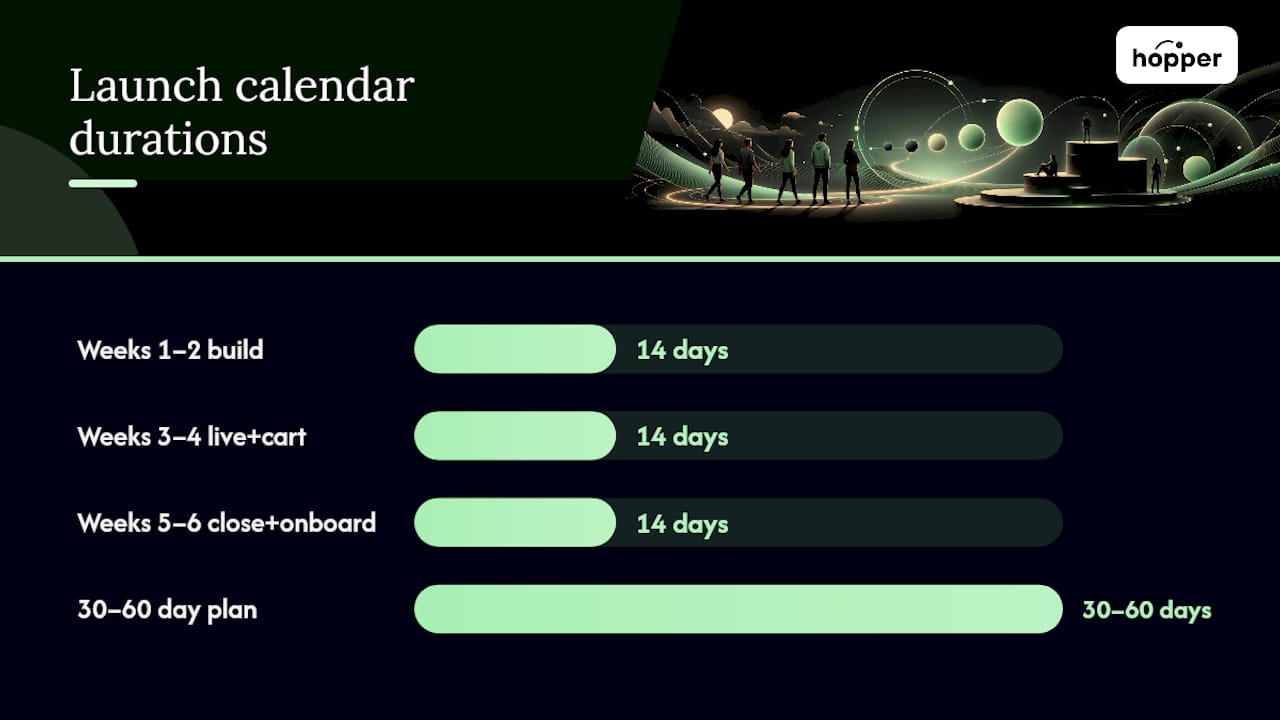
A simple 30 to 60 day calendar: weeks 1 to 2, build the lead magnet and nurture sequence. Weeks 3 to 4, run the live webinar and open cart. Weeks 5 to 6, close cart, onboard, and start the first monthly rhythm.
How Do You Retain Coaching Membership Members Long Term?
The first 30 days decide whether a member renews. A quick-win lesson delivered in the first 48 hours, something they can act on immediately, does more for retention than a month of polished content they never open. Follow it with a short welcome call or personal email, and a clear next step so nobody logs in wondering what to do.
After onboarding, retention runs on rhythm. A predictable monthly calendar, a theme for the month, one live session, one resource drop, a standing office-hours slot, keeps members engaged without you reinventing programming every four weeks. That kind of structured monthly rhythm is one of the clearest retention drivers documented across coaching membership research, alongside visible progress tracking that lets members see their own movement over time.
Three numbers to watch every month:
- Churn rate: the percentage of members who cancel, tracked monthly, not just annually.
- Monthly recurring revenue (MRR): your predictable income baseline, separate from one-off product sales.
- Active participation: logins, comments, session attendance, whatever signals someone is actually using what they paid for.
When any of these slip, three interventions work reliably: send a direct check-in email to inactive members asking what is missing, run a short win-back offer for members who canceled in the last 30 days, and audit your onboarding sequence for the exact point where drop-off spikes. Fix the leak nearest the entry point first. It usually has the biggest return.
What Does Consolidating Your Coaching Tools Actually Save You?
Most coaches run a membership across four or five separate tools: one for courses, one for community, one for checkout, one for the link-in-bio page. Each charges separately, and most gate features behind higher pricing tiers.
Some platforms consolidate multiple tools into one hub containing a community feed, a content library, async coaching, and a built-in storefront, starting at an affordable monthly rate with unlimited members, moderators, and products. One user, Daniel Lim, cut $6,000 a year moving his stack onto Hopper, savings that came from dropping redundant subscription fees, eliminating per-seat community costs, and reclaiming the hours he used to spend reconciling member access across separate tools.
Against the platform checklist covered earlier, Hopper maps directly:
- Recurring billing and a member library: built into every hub.
- Community hub: native discussions with spaces, threads, and video.
- Storefront: replaces a separate checkout tool entirely.
- Native iOS and Android apps: included at the base price, not gated behind a top tier.
- Migration support: available for coaches moving off Kajabi or Circle, without rebuilding from scratch.
Real member stories and further platform detail live on Hopper's testimonial page, and the full cost breakdown behind the Kajabi comparison is worth reading in detail on Hopper's blog.
How Do You Handle Payment Failures and Cancellations?
A failed card is not a lost member yet, it is a billing problem, and most of them are fixable if you respond fast. Set up automated dunning emails that retry the charge two or three times over a week and notify the member plainly: "Your card was declined, here's how to update it." Most failed payments get resolved within 48 hours when the member is told clearly and immediately, rather than discovering the lapse a month later when access quietly disappears.
For voluntary cancellations, build a short offboarding flow rather than an instant exit. A one-question survey, "What's the main reason you're leaving?", gives you real data instead of guesses, and a single win-back offer, a discounted month or a pause option instead of full cancellation, recovers a meaningful share of members who were leaving over price rather than dissatisfaction.
Offer a pause option, not just cancel or stay. Members going through a busy month often want a break, not an exit, and a 30 or 60-day pause keeps them in your ecosystem instead of forcing an all-or-nothing decision.
Write your refund policy before launch, not after your first complaint. State it plainly on the sales page: prorated refunds, no refunds after a certain date, or a satisfaction guarantee within the first seven days. Ambiguity here creates more support tickets than the policy itself ever will, regardless of which policy you pick.
Track cancellation reasons in a simple spreadsheet or your platform's built-in analytics. Patterns show up fast, and if "too expensive" or "not enough time" dominates, that is a pricing or onboarding problem, not a marketing problem, and it needs a different fix.
What Customer Support Practices Keep Membership Clients Happy?
Membership support is different from one-off client support because the relationship is ongoing, not transactional. A member who feels ignored for two weeks does not file a complaint, they just quietly stop logging in and cancel at the next billing cycle.
Set a response time standard and stick to it, whether that is 24 hours or 48. Members forgive a slower answer more easily than an inconsistent one. Post your standard somewhere visible, in the welcome email or a pinned community post, so expectations are clear from day one.
Use a single channel for support requests instead of scattering across email, direct messages, and comments. A dedicated support space inside your community hub keeps requests visible and prevents the same question from being asked five different ways in five different places.
Build a short FAQ or help doc for the questions that come up in the first week, every time. Billing questions, access issues, and "how do I find X" account for most support volume in a coaching membership, and a good FAQ resolves half of them before a human ever has to respond.
Check in proactively with members who go quiet, rather than waiting for them to reach out. A short "haven't seen you around, everything okay?" message, sent before cancellation rather than after, catches problems while they are still fixable and tells members someone is actually paying attention.
How Do You Upsell and Cross-Sell Inside a Coaching Membership?
The easiest upsell is the one members ask for themselves. If your base tier includes group calls, watch for members repeatedly requesting 1:1 time, that demand is your next tier, already validated before you build it.
Sequence your offers by outcome, not by price. A member who has been in your $97 Growth tier for three months and hit a specific milestone is a far better candidate for a $250 1:1 upgrade than a brand-new member who joined last week. Time the offer to the moment they have proof your method works for them specifically.
Cross-sell through your existing storefront rather than a separate sales process. A workbook, a templated toolkit, or a one-time intensive session sold alongside the membership captures revenue from members who are not ready for a bigger monthly commitment but will pay for a single specific outcome.
- Offer the upgrade inside the platform, not through a separate email campaign that feels disconnected from where members already are.
- Use milestone triggers (three months in, first goal hit) rather than blanket promotions to everyone at once.
- Bundle a limited-time upgrade discount for existing members only, which rewards loyalty rather than just chasing new sign-ups.
Never upsell in the first 30 days. A member still deciding whether the base membership was worth it will read an early upgrade pitch as pressure, not opportunity.
What Legal Basics Does a Coaching Membership Need?
A terms of service document is not optional paperwork, it is what protects you when a member disputes a charge or misunderstands what they signed up for. At minimum, it should state what is included at each tier, your cancellation and refund policy, and how disputes get handled.
A disclaimer matters more in coaching than most service businesses realize, because clients often expect specific results. State plainly that coaching supports personal or business development and does not guarantee outcomes, particularly if you coach in health, finance, or business growth, areas where regulators pay closer attention to result claims.
Privacy matters the moment you collect payment information or run a community where members share personal details. A basic privacy policy explaining what data you collect, how billing information is handled, and whether member content is visible to other members is a baseline expectation now, not a nice extra.
If you operate across state or country lines, note that consumer protection and cancellation rules can vary by the member's own location, not just yours. A blanket policy that ignores this can create real disputes with members governed by different local rules. When in doubt on a specific jurisdiction's requirements, a quick consult with a professional familiar with your specific setup is worth the cost, this is not an area to guess your way through.
What Priorities Actually Matter When You Scale Into Memberships?
The coaches who make memberships work get four things right early: a promise clear enough to fit in one sentence, a minimal viable library instead of an overbuilt one, automation handling billing from day one, and a real feedback loop with the first ten members before scaling promotion further.
The mistakes are just as consistent. Overbuilding content before launch delays revenue and rarely improves conversion, ship the starter library and build in public instead. Confusing pricing, too many tiers, unclear what each one includes, kills conversion faster than a price being "too high" ever does. Weak onboarding is the quiet killer: members who do not know what to do in week one cancel in week four, regardless of how good the coaching actually is.
Cedrik has watched enough coaches make this exact trade too early: chasing feature completeness over a working, revenue-generating structure.
— Cedrik
How Hopper Puts This Playbook Into Practice
Hopper implements most of what this article recommends directly, rather than requiring you to stitch it together. The built-in storefront replaces a separate checkout tool, member libraries gate by tier without extra plugins, and the community hub handles the monthly rhythm this article walks through, discussion threads, live session hosting, and progress visibility in one place.

Members reach everything through native iOS and Android apps included with the platform, rather than apps being locked behind higher pricing tiers as seen with some competitors. If you are moving off Kajabi or Circle, Hopper's free migration support moves your existing setup over without asking you to rebuild your library from scratch, the same friction reduction that helped Daniel Lim cut $6,000 a year from his stack.
This is Hopper's own platform, so weigh it against your specific setup. Real member stories and further detail live on the Hopper site if you want to see how other coaches structured their move before you start yours.
Sources
For a deeper look at membership design and pricing math, Sense Central's guide on selling coaching through memberships covers starter library structure and monthly rhythm in detail. For model selection specific to service delivery costs, BookAndGo's breakdown of coaching membership models is useful. MemberPress's guide to business coaching subscriptions covers retainer, group, and mastermind mechanics. For platform feature comparisons, see Paperbell's membership platform roundup and WPBeginner's plugin comparison. For tier pricing examples at the organizational level, the Institute of Coaching's membership FAQ is worth a read.
- How to sell coaching memberships (and get paid automatically) | BookAndGo
- 11 of the Best Membership Platforms for Coaches (2026)
FAQ
What Is the 70/30 Rule in Coaching?
The 70/30 rule generally refers to coaching conversations being 70% listening and questioning from the coach and 30% talking, a guideline for keeping sessions client-led rather than advice-heavy.
What Is the 80/20 Rule in Coaching?
The 80/20 rule in coaching typically applies the Pareto principle to focus: roughly 80% of a client's results tend to come from 20% of the actions or habits you help them prioritize, so effective coaching zeroes in on that smaller set first.
What Type of Coaching Makes the Most Money?
Business and executive coaching tend to command the highest rates because clients tie the investment directly to revenue or career outcomes, but recurring membership models, group coaching and hybrid tiers in particular, often generate more predictable total revenue than high-ticket 1:1 work alone.
What Are the 5 C's in Coaching?
Definitions of the "5 C's" vary by framework and source, so there is no single agreed-upon list; rather than assign one incorrectly, focus on the fundamentals this article covers: clarity of promise, consistency of delivery, and community engagement, which consistently show up as retention drivers.
Which Platform Should I Use to Sell Coaching Memberships?
The right platform depends on your setup, but coaches consolidating multiple tools, course hosting, community, checkout, into one system often cut both cost and admin time; Hopper is built specifically for this, combining billing, library, community, and storefront with a starting price that varies by plan.
Recommended
On our list and want off? .