
How to Sell Coaching Packages Without Losing Clients to Hesitation
Learn how to effectively sell coaching packages by focusing on client transformations, pricing for value, and simplifying the purchase process.
By the Hopper team
To sell coaching packages, sell a specific transformation in a tiered package, price it for the client's ROI, and make it purchasable in one click on a booking page. That's the whole game. Packages tied to an outcome, not a session count, convert better and command higher prices than open-ended single calls, because the client isn't buying your time. They're buying a result.
Here's the checklist to act on today:
- Define the one outcome your package delivers, in a sentence a stranger could understand.
- Build a single signature package before you ever build a starter or premium tier.
- Price it against the value of that outcome to the client, not against your hourly rate.
- Set up one-click booking and payment collection so a "yes" doesn't require five follow-up emails.
- Book a discovery call as the only path to purchase, so you diagnose before you pitch.
Everything below walks through each step: the transformation statement, the package blueprints, the pricing math, the booking setup, and the sales conversation that closes it.
Key Takeaways
Selling coaching packages successfully depends on naming a specific transformation, pricing for the client's ROI, and removing every unnecessary click between interest and payment.
| Point | Details |
|---|---|
| Lead with the transformation | State the exact before, after, and timeframe before you ever mention sessions or price. |
| Cap tiers at three | Starter, Signature, and Premium prevent the decision paralysis a longer menu creates. |
| Price below the client's ROI | Estimate what the outcome is worth to them, then price meaningfully under that number. |
| Sell on calls, qualify in DMs | Use DM questions to screen for fit, then close premium pricing on a discovery call. |
| Consolidate your setup on Hopper | Hopper's storefront, booking, and unlimited products remove the multi-tool friction that stalls most package launches. |
Table of Contents
- How Do You Sell Coaching Packages People Actually Want?
- What Should Actually Be Inside a Coaching Package?
- How Do You Price a Coaching Package?
- What Do You Need to Actually Sell a Coaching Package Online?
- How Do You Close the Sale on a Coaching Package?
- How Do You Deliver a Package That Earns You Referrals?
- What Contract Terms Does a Coaching Package Actually Need?
- How Do You Handle "It's Too Expensive" and Other Objections?
- How Do You Turn a Finished Package Into the Next Sale?
- Sources
- FAQ
How Do You Sell Coaching Packages People Actually Want?
Coaches lose sales in the first ten seconds, not the last. A prospect lands on your page, reads three sentences about "helping you unlock your potential," and leaves. They didn't leave because your coaching doesn't work. They left because they couldn't tell what problem you solve.
The fix is a transformation statement, one sentence that names the before, the after, and the timeframe. Use this template: "From [current state] to [desired state] in [timeframe] with [mechanism]." It forces you to be specific in a way that "life coaching" or "business mentorship" never will.
Three examples that work:
- "From scattered side hustle to $10,000 months in 90 days with a repeatable client acquisition system."
- "From burned-out manager to confident director in 12 weeks through weekly strategy sessions and a leadership scorecard."
- "From chronic overtraining to a sustainable 5K PR in 8 weeks with a periodized run plan and weekly check-ins."
Three that fail, and why:
- "Helping you become your best self." (No timeframe, no mechanism, no measurable end state.)
- "Business coaching for entrepreneurs." (Describes a category, not an outcome.)
- "Unlock your potential with proven strategies." (Could describe literally any service on earth.)
The rewrite pattern is always the same: replace the abstract noun (potential, growth, success) with a number, a title, or a behavior a third party could verify. "Becoming your best self" isn't verifiable. "Landing three retained clients" is.
Outcome-first language converts because it lets the prospect self-select before they ever talk to you. Someone who wants to lose 15 pounds skips past your page if you're selling executive leadership. That's a feature, not a loss. A vague promise pulls in more clicks and fewer buyers.
Pro Tip: Write your transformation statement, then hand it to someone outside your industry. If they can't repeat back what you help people do in one sentence, it's still too vague.
What Should Actually Be Inside a Coaching Package?
A package is not "six sessions." A package is a delivery system built around the outcome you promised, and the sessions are just one part of it. Three tiers cover most niches, and research on package design consistently finds that two or three tiers is the ideal configuration since a fourth tier tends to create decision paralysis instead of more sales.
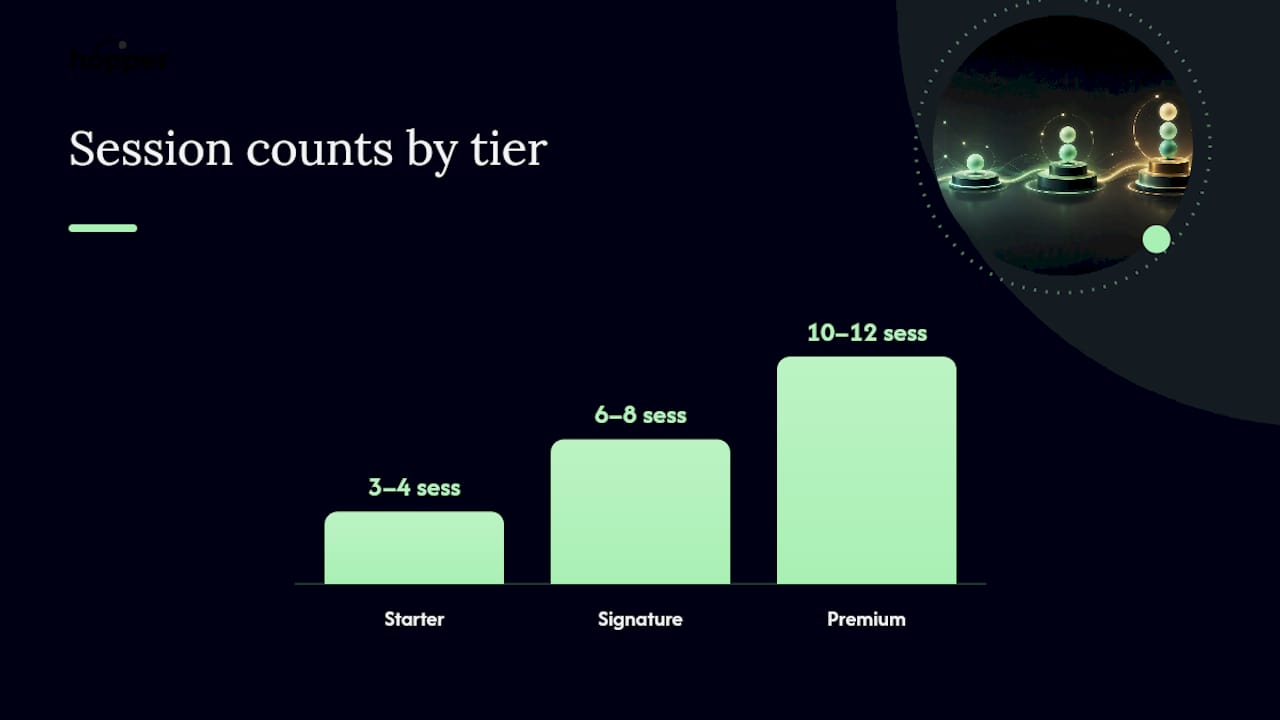
1. Starter (single-focus sprint). 3 to 4 sessions across 3 to 4 weeks. Best for a narrow, well-defined problem: a resume overhaul, a single habit change, a pitch deck review. Deliverables: session recordings, one workbook or template, async support between calls via message.
2. Signature (the core offer). 6 to 8 sessions across 8 to 12 weeks. This is the package you build first and the one most clients buy. Deliverables: structured curriculum tied to your named methodology, workbook or planner, recordings, weekly or biweekly check-ins, and a mid-program review session.
3. Premium (full partnership). 10 to 12 sessions across 3 to 6 months, sometimes longer for executive or high-ticket business coaching. Deliverables: everything in Signature, plus unlimited async messaging, priority scheduling, and a done-with-you component (templates filled in together, not just handed over).
What raises perceived value:
- A named framework or methodology ("The Momentum Method," not "my process"). Naming it signals you've systematized results, not improvised them.
- Workbooks, checklists, and session recordings the client keeps after the program ends.
- Structured check-ins between sessions, not just "text me anytime."
What to cut:
- Extra sessions added just to justify a higher price. Session count without a purpose is padding, and clients feel it.
- Vague "bonus" bullets nobody would pay for on their own (a "surprise gift," a generic ebook).
- Unlimited everything at every tier. If Starter and Premium both include unlimited messaging, you've erased the reason to upgrade.
The package structure itself sells better when the bundle feels tangible: sessions plus supporting resources like workbooks and recordings justify a higher price than sessions alone, because the client can see and touch what they're paying for even between calls.
How Do You Price a Coaching Package?
Start with value, not with your calendar. Value-based pricing means estimating what the outcome is worth to the client first, then pricing meaningfully below that number so the ROI is obvious even to a skeptic. If your business coaching package helps a client land $30,000 in new contracts, a $3,000 package is an easy yes. A $3,000 package built on "12 hours of my time" is a hard sell, even at the identical price.
A workable formula: pick a per-session baseline rate, then apply a tier discount so higher commitment reads as better value, not just more sessions. A common structure applies roughly 10% off baseline for Starter, 15% for Signature, and 20% for Premium, which is close to the tier discount approach many coaches use to create clear separation between tiers without inventing arbitrary numbers.
Example math for a coach with a $200 per-session baseline:
- Starter: 4 sessions x $200 = $800 baseline, minus 10% = $720.
- Signature: 8 sessions x $200 = $1,600 baseline, minus 15% = $1,360.
- Premium: 12 sessions x $200 = $2,400 baseline, minus 20% = $1,920.
Price ranges vary sharply by niche. Fitness and wellness starter packages often land between $300 and $900. Business and executive coaching signature packages commonly run $1,500 to $5,000, and premium partnership-style offers in high-ticket business coaching can clear $10,000 for multi-month engagements. Life and mindset coaching tends to sit in between, often $800 to $3,000 for a signature package, depending on how narrow and urgent the transformation is.
Session-based packages create predictable revenue and faster cash flow than per-session billing, along with fewer no-shows, since a client who has paid for eight sessions upfront has skin in the game a single-call buyer doesn't.
On payment structure: charging the full amount at booking gives you the cleanest cash flow and the strongest client commitment. For anything above roughly $1,500, offering a deposit (usually 25 to 50%) plus a two or three-installment plan removes the objection without sacrificing the upfront commitment entirely.
Raising prices should never be a guess. Test a new price with the next 3 to 5 new leads only, not your entire list. If close rates hold steady, roll the new price out to everyone. Once you have two or three testimonials citing a specific result, that's your signal to raise again. Price increases backed by proof close easier than price increases backed by hope.
What Do You Need to Actually Sell a Coaching Package Online?
A great package with no way to buy it is a hobby. The operational setup is what turns "let's talk" into a completed sale, and the sequence matters: publish the package page with a clear description and price, connect a payment processor, show real calendar availability for the first session, and collect an intake form the moment someone books.
Every extra step between "I want this" and "I've paid" costs you buyers. A package page that links directly to a booking calendar or intake form converts better than one that ends in "email me to get started," because every additional click is a chance for someone to close the tab and never come back.
Payment defaults that actually work:
- Collect full payment at booking for packages under roughly $1,500.
- Require a deposit (25 to 50%) plus a payment plan for anything higher priced, collected automatically on a schedule so you're never chasing invoices.
- Never start session one before payment or the first installment has cleared. Enforcing this once protects every client relationship after it.
The platform features that make this frictionless are worth checking off before you launch anything:
- Built-in payment processing, so you're not bouncing a client between your site and a separate checkout tool.
- Calendar sync that shows real, live availability instead of a "book a call" form that goes to your inbox.
- Video delivery with automatic recording, so clients get a replay without you exporting and uploading a file manually.
- A client vault or content library where workbooks, recordings, and check-ins live in one place the client can always find.
Pro Tip: If your booking flow takes more than two clicks from "view package" to "payment confirmed," you're losing sales you'll never see in your analytics. Time your own checkout flow like a stranger would experience it.
How Do You Close the Sale on a Coaching Package?
Selling a package is a sequence, not a pitch. The most reliable funnel runs content to DM to discovery call to close, and the discovery call is where premium prices actually get paid. Packages sold on a call convert far better than packages sold directly in a DM, which means your DMs should qualify people toward a call, not try to close them at a price point cold.
A discovery call that closes follows three moves, in order:
- Diagnose. Ask about the specific problem, how long it's persisted, and what they've already tried. This isn't small talk, it's the information you need to recommend the right tier.
- Match. Recommend one specific package based on what you just heard, not a menu of three options to choose from cold.
- Present and ask. State the price, state what's included, and ask directly: "Does this sound like the right fit to get started?" Silence after the ask is normal. Don't fill it with a discount.
For DM qualification before the call, three questions do most of the work: "What's the specific result you're hoping for?" "What have you tried so far?" and "What's your timeline for solving this?" Anyone who answers vaguely to all three isn't ready to buy yet, and that's fine. Nurture them instead of pushing.
Where to put your package CTA matters as much as what it says. List a starting price range on your public page (people filter themselves out faster with a number than without one), but require a discovery call before quoting an exact premium-tier price, since that number depends on the diagnosis. Reference the package by name in every relevant piece of content, whether that's an Instagram caption, a newsletter, or a podcast show note, and always link straight to the booking page.

For single-session clients who haven't upgraded yet, a short nurture sequence works better than a hard pitch. Three emails is usually enough: one sharing a client result from the package they haven't bought, one addressing the most common objection directly, and one with a clear deadline or bonus for booking a discovery call that week.
How Do You Deliver a Package That Earns You Referrals?
Delivery is where the sale either gets proven right or gets refunded. Cadence should match the package length: weekly sessions for a 3-session sprint, biweekly for a 6-session signature package once early momentum is established, and monthly touchpoints layered with async support for a 12-session partnership.
Between sessions, set expectations up front rather than leaving them ambiguous. Tell clients exactly how you support them between calls, whether that's a 48-hour message response window or a shared tracking document, so "why haven't you answered me" never becomes a source of friction.
Build in a mid-program review, roughly at the halfway point, to check progress against the original transformation statement and adjust the plan if needed. This single checkpoint does double duty: it keeps the client accountable and it's the natural moment to ask for a testimonial while the win is still fresh. Designing milestones around measurable moments, first result, halfway point, final outcome, gives you built-in testimonial collection points instead of an awkward ask at the very end. Programs built around structured milestone tracking, an approach also used in athletic development programs, tend to produce clearer proof of progress than open-ended coaching relationships.
At program's end, don't let the relationship just stop. Present a specific next-step offer, a maintenance package, a quarterly check-in retainer, or an upgrade to the next tier, timed to the final session while the result is still top of mind.
- Ask for the testimonial at the mid-program win, not just at the end.
- Offer the renewal before the client has time to drift.
- Keep between-session response times consistent across every client, every tier.
Pro Tip: Ask for testimonials with a specific prompt: "What's different for you now versus 8 weeks ago?" A specific answer sells better than "great coach, highly recommend."
How One Platform Turns a Package Idea Into a Purchasable Offer in a Week
Most coaches don't lose momentum because the idea is bad. They lose it stitching together a course host, a community tool, a checkout link, and a scheduling app before a single package ever goes live. Every one of those tools has its own login, its own pricing tier, and its own limits on how many members or products you can have.
One user cut $6,000 a year by consolidating that entire stack onto a single platform instead of paying separately for each piece. That's not a marketing figure, it's what happens when four subscriptions become one flat price.
The real cost of a stitched-together stack isn't just the monthly bill. It's the week you lose rebuilding your booking flow every time one tool changes its pricing tier.
What actually collapses the timeline from idea to purchasable package:
- A built-in storefront, so the package page, price, and checkout live in one place instead of a link-in-bio tool pointing to a separate host.
- Unlimited members and products, so you're never rebuilding your setup because you hit a plan cap mid-launch.
- A native mobile app included at the flat price, not gated behind a top-tier upgrade.
- Free migration support for coaches moving an existing package business over without rebuilding it from scratch.
What Contract Terms Does a Coaching Package Actually Need?
Every coaching package should be sold under a written agreement, even a short one, that spells out four things: what's included, the payment schedule, the cancellation policy, and the refund terms. Skipping this because "it's just coaching" is how disputes turn into chargebacks.
Cancellation and rescheduling policies need to be specific. A common structure: sessions can be rescheduled with 24 to 48 hours notice, and no-shows without notice forfeit that session rather than getting it added back to the package. Write this into the agreement, not just a verbal mention on the discovery call.
Refund policy is where most coaches either overpromise or say nothing at all. A defensible middle ground: offer a refund on unused sessions minus a cancellation fee (often 10 to 20% of the package price) rather than a blanket "no refunds" or a full money-back guarantee you can't sustain. State clearly whether partial refunds apply once sessions have started, since "I finished session two and want out" is a common scenario your contract should already answer.
For payment plans, spell out what happens on a missed installment: does access pause automatically, is there a grace period, does the balance become due in full? Leaving this unstated is where good client relationships turn into awkward collection conversations.
This isn't a substitute for legal advice specific to your location and business structure, but a written agreement covering scope, payment, cancellation, and refunds protects both sides of every package you sell. A simple template you adapt per client beats drafting one from scratch every time.
How Do You Handle "It's Too Expensive" and Other Objections?
Almost every objection you'll hear on a discovery call falls into one of three buckets: price, time, or trust. Treat each differently, because the same rebuttal doesn't work for all three.

Price objections ("that's more than I expected") usually mean the ROI hasn't landed yet, not that the number is actually wrong. Go back to the diagnosis: restate the specific cost of the problem staying unsolved, in their own words from earlier in the call, then restate the package price against that cost.
Time objections ("I don't have time for weekly sessions right now") often signal a tier mismatch, not a lost sale. Offer the shorter, more contained tier instead of dropping the price on the one you originally pitched.
Trust objections ("how do I know this will work for me specifically") respond best to specificity, not reassurance. A testimonial naming a comparable starting point and a comparable result does more work than "I've helped so many clients."
The worst response to any objection is an immediate discount. Discounting the moment someone hesitates trains every future prospect to hesitate on purpose. Instead, ask a clarifying question: "What would need to be true for this to feel like an easy yes?" Their answer usually reveals whether it's really about price, or about something you haven't addressed yet.
How Do You Turn a Finished Package Into the Next Sale?
The client who just finished your package is your easiest next sale, and most coaches let that window close by staying quiet. Reach out within a week of the final session, while the result is still fresh, rather than waiting for them to come back on their own.
A simple three-touch renewal sequence works for most coaches: a wrap-up message reflecting their specific progress, a next-step offer sent about two weeks later, and a check-in a month after that if they haven't responded. Each message should reference the actual outcome they achieved, not a generic "hope you're doing well."
Build your next-tier offer before you need it, not after a client asks. A maintenance package (monthly check-ins, lighter touch, lower price) captures clients who got their result and want ongoing support. A next-tier upgrade captures clients ready to tackle a bigger goal. Having both ready means you're never improvising a pitch on the spot.
- Message every completed client within a week, tied to their specific result.
- Offer a maintenance tier for clients who are done but want accountability.
- Ask past clients for referrals at the same moment you ask for a renewal decision, since a happy client is primed to do both at once.
Referrals from completed packages tend to convert faster than any funnel you can build, because the diagnosis and the trust already happened once.
A candid note on the mistake that kills most package launches
The coaches who struggle aren't the ones with bad skills. They're the ones who build a six-tier menu before they've sold a single package, or who bury the price so deep in a discovery call that prospects feel ambushed. Complexity feels like thoroughness, but to a buyer it just reads as confusion.
The coaches who move fastest do the opposite: one signature package, a visible starting price, and a straight line from content to booking page. If you take one thing from this article, make it this: publish one package, with one price range visible, this week. Everything else gets easier once that page exists.
— Cedrik
A faster path from package idea to first sale with Hopper
Hopper cuts the setup time between "I have a package idea" and "someone can actually pay me for it," because the storefront, booking, community, and content library all live in one hub instead of four separate logins.

The platform carries no cap on members or products, so a Starter, Signature, and Premium package can all live on one landing page without hitting a plan limit mid-launch. The native iOS and Android app comes included at the flat price rather than gated behind a top tier, and coaches moving from another platform get free migration support instead of rebuilding their package pages from zero.
If you want to see how other coaches structured their move, Hopper's user stories walk through real switches. Otherwise, start by publishing your first package on Hopper and connect payments the same day.
Sources
- How to Sell Coaching Packages Instead of Single Calls
- How to Sell Coaching Packages Online (Step-by-Step Guide for 2026) | Swanky Tools™
- Coaching Packages: How to Structure, Price, and Sell Them - Sam Eye Am
FAQ
What is the 70/30 rule in coaching?
It's a guideline suggesting roughly 70% of a session should focus on the client talking and reflecting, with the coach guiding for about 30%, keeping the client as the primary driver of insight rather than the coach lecturing.
How do I price a coaching package?
Estimate the value of the outcome to the client, then price your package meaningfully below that number using a per-session baseline with tiered discounts, commonly around 10% off for starter tiers, 15% for standard, and 20% for premium.
Do I need an LLC to be a life coach?
Requirements vary by location, but forming an LLC or similar entity isn't required to start coaching in most places; many coaches begin as sole proprietors and form a formal entity later for liability protection as revenue grows.
Where should I publish my coaching package for sale?
Publish it on a single landing page with a visible price range and a direct link to your booking calendar, a setup platforms like Hopper support through a built-in storefront rather than a separate checkout tool.
Recommended
On our list and want off? .