
Online Course Retention: How Coaches Keep Members Past Week Three
Online course retention for coaches: how to define it, why members drift away, and the onboarding, community and coaching habits that keep them learning.
By the Hopper team

Online course retention is the share of your members who stay enrolled and keep showing up until they reach the result they paid for. For a coach, the lever that matters most is not a clever email sequence. It is whether the program feels like a place people belong, with a clear path, people to talk to and a reason to come back this week. That is hard to build when the course lives in one tool, the community in another and checkout in a third. Keeping those pieces in one space is the foundation of everything below.
This guide is for coaches, healers, yoga and meditation teachers and educators who already have paying members. It covers what retention means, why people drift, what the research supports, and how to measure whether your changes work.
TL;DR
- Retention, completion, engagement and dropout are different measures. Pick one definition for your program and track it the same way every month.
- Research on online learners points to the same drivers: time pressure, weak course design, isolation and thin support. Each one is something you can design for.
- Clear onboarding, visible time estimates, a small active community and fast feedback are the best-supported habits.
- Keeping course, community, coaching and checkout in one place removes friction at the exact points where members slip away.
- Test changes on one cohort before you roll them out, because results that look great in one setting often shrink in another.
Table of Contents
- What online course retention actually means
- Why members drift away
- Start with onboarding, not content
- Design the path so the next step is obvious
- Build a small community that members want to return to
- Coach between sessions, not only during them
- Use reminders and milestones with intent
- Measure what is working
- A worked example: a 6-week cohort
- Where the platform decision shows up in retention
- Hopper: one flat plan for the whole member journey
- Our perspective
- FAQ
- Sources
What online course retention actually means
People use the words retention, persistence, completion and dropout as if they were the same thing. Researchers do not, and you should not either.
A scoping review in the Online Learning Consortium's journal found that persistence was usually measured by continued enrollment, term-to-term continuation or sustained participation. Retention was more often measured through enrollment status, re-enrollment or year-to-year continuation. The review also treated completion and engagement or belonging as their own categories.
Dropout is the slippery one. One doctoral thesis on online higher education notes that there is no universally accepted definition, and separates a true dropout from a stop-out, a temporary break that does not meet the dropout criteria.
For a coach, that translates into four plain numbers:
- Active share: the percentage of members who did something in the program (watched, posted, booked, replied) in the last 14 days.
- Completion: the percentage who finish the core path.
- Membership retention: the percentage of paying members who renew or stay month to month.
- Stop-outs: members who went quiet for a few weeks and came back. They are not lost, and they should be counted separately.
Choose your definitions once and write them down. A retention number you cannot compare to last quarter is only a feeling.
Why members drift away
Before fixing anything, it helps to know what pulls people out. A systematic review of online higher-education dropout lists health concerns, financial limits, technology problems, screen fatigue, isolation, workload, course quality, motivation, satisfaction and weak support services among the factors associated with leaving.
In a qualitative study of 34 learners across two online courses, time management, course design, how learners perceived the content and their social circumstances all shaped dropout, and 21 interviewees mentioned lack of time.
Read that list as a coach and three themes stand out.
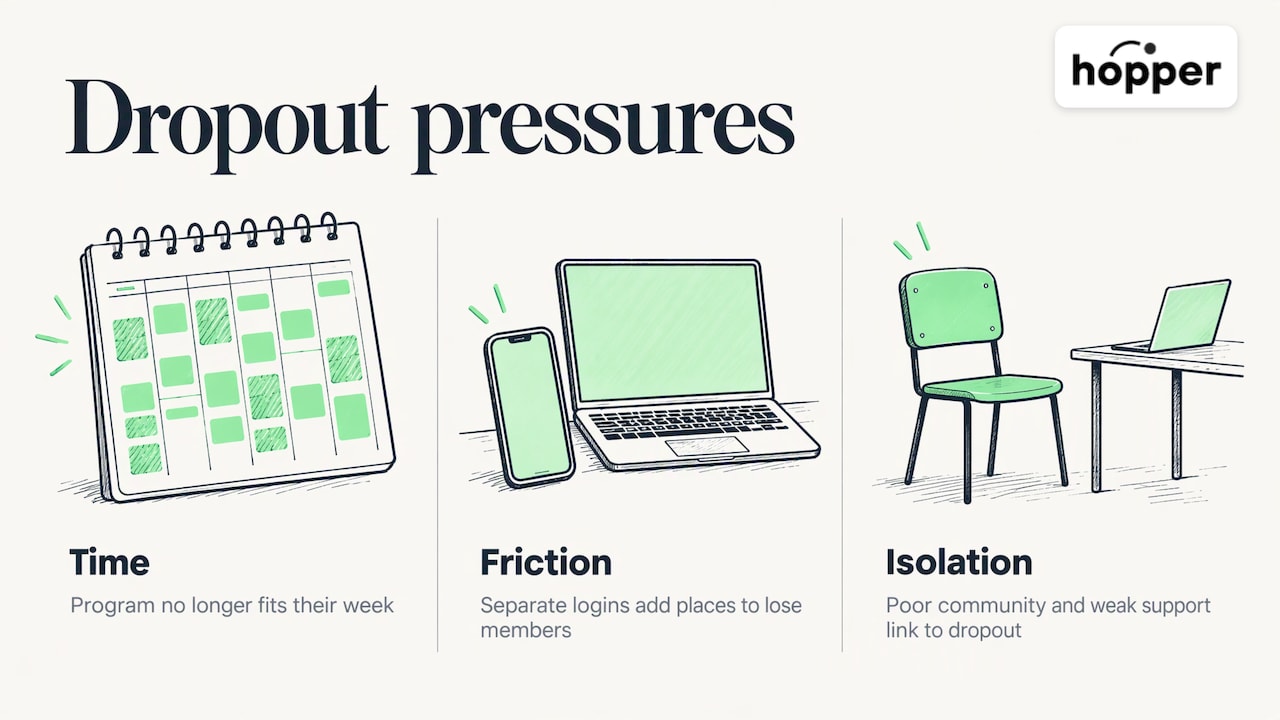
Time. Your members are parents, employees and caregivers. They did not stop caring. The program stopped fitting into their week.
Friction. Separate logins, a course in one place and a community in another, a payment page that looks different from everything else. Every extra step is a place to lose someone who is already tired.
Isolation. A 2024 meta-review of 47 reviews links high-quality online social interaction with engagement and performance, and links poor community, isolation and inadequate support with dropout.
None of those is a motivation problem. They are design problems, and design is yours to change.
Start with onboarding, not content
The first week sets the pattern. A member who does something meaningful in their first days, such as introducing themselves, finishing one short lesson or booking a first conversation, is far more likely to feel part of the program than one who is handed a login and a syllabus.
A workable first-week structure:
- Welcome in the place they will return to. A pinned post or a short video from you, in the same space where the community lives.
- One small win within 48 hours. A 10-minute lesson or a single reflection question, not the whole first module.
- A visible path. Show where they are going, what comes next and roughly how long each piece takes.
- An introduction thread. Members who see other people like them tend to stay to meet them again.
That third step has research behind it. Zhu and Bonk's 2022 review recommends flexible timelines and visible estimates of the time activities and modules take, so learners can plan study around the rest of their lives. Put "about 12 minutes" next to every lesson and let members move at a pace that fits.
For a deeper template on this phase, our five-phase student onboarding guide walks through it stage by stage.
Design the path so the next step is obvious
Members leave when they do not know what to do next. A library of 80 videos feels generous to you and overwhelming to them.
Three structural habits help:
- Work backward from the result. Decide what the member can do at the end, then build only the lessons that get them there. Our guide to learning path design calls this writing the capstone first.
- Release in a rhythm. Drip content so each week has one clear focus. A steady cadence gives members a reason to return that is not guilt.
- Use quizzes and certificates as markers. A short check at the end of a module tells members they are progressing. A certificate gives them something to point to.
The 2024 meta-review above also links meaningful, career-relevant activities and appropriately scaffolded challenge with engagement. In coaching terms: make each exercise something the member will actually use in their life or work this week, and make it just hard enough.
If you are moving a live program online, this guide to redesigning before you move explains why copying your live sessions into video is the quickest way to lose people.
Build a small community that members want to return to
A community is not a bonus feature. For many members, it is the reason they renew.
The evidence is nuanced, and worth knowing. A 2025 review of 55 empirical studies reports content and course design, interaction, feedback and learner factors as the main themes shaping engagement, and names instructor support and clear goals as ways to strengthen it. A 2019 review of 104 studies found that interaction with the course content itself related to grades and satisfaction. The takeaway is that community works best when it is attached to the work: members discussing the lesson they just watched, not chatting in a separate room.
Here is how to make that real:
- Give each lesson a conversation. End each module with one prompt that members answer in the community feed.
- Keep it small on purpose. Twenty active members beat two hundred silent ones.
- Reply fast, early. Your presence in the first weeks teaches members that posting is worth it.
- Use reactions and video replies. They lower the effort of taking part, which matters when people are short on time.
This is where tool sprawl hurts. If the community lives in a separate app from the course, members have to remember two places. Many coaches who started on a one-community-per-account tool or a link-in-bio store eventually feel that limit as they add programs. If you are comparing setups, our comparison of course platforms with community lays out the options.
Coach between sessions, not only during them
The 2019 systematic review by Muljana and Luo analyzed 40 studies and identified early intervention, ongoing student support, effective communication, quality feedback and faculty support among retention strategies. A 2023 scoping review of 42 studies describes support before, during and after study, including proactive support.
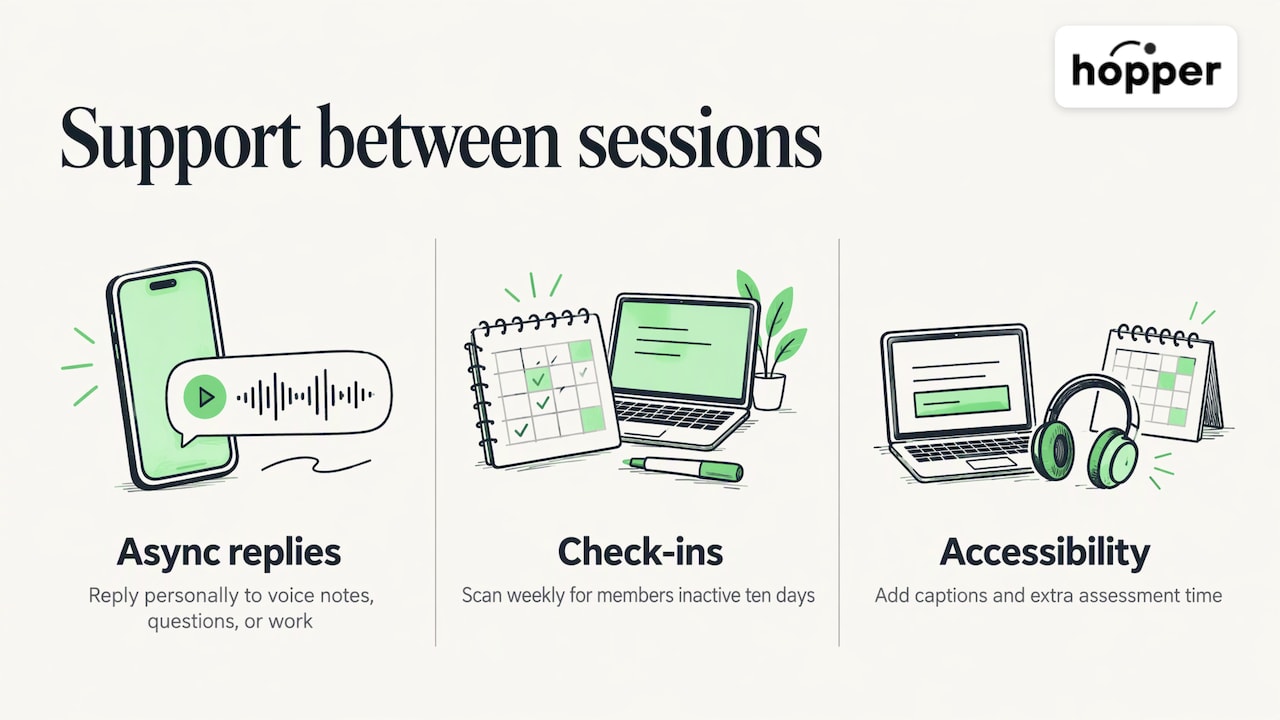
For a coach, that means your attention in the gaps matters as much as the live call. Asynchronous coaching is a practical way to give it: members send a voice note, a question or a piece of work when it suits them, and you reply with a personal answer when it suits you. It respects the time problem on both sides. We cover how to run it well in our playbook on asynchronous teaching.
Proactive support is simple to start. Once a week, scan for members who have not logged in for ten days and send them a short, human message. Not "we miss you" copy, but a specific one: "I saw you got through module two. Want a hand with the exercise?"
Accessibility belongs here too. The 2024 CHEPP accessibility white paper recommends Universal Design for Learning, accessible technology, captions and extra time on assessments. Captions help the member watching on a train as much as the member who is deaf, and extra flexibility on deadlines keeps people with health issues in the room.
Use reminders and milestones with intent
Nudges, progress markers and game-like rewards are popular, and they work best when they are tied to a specific behavior you want.
A 2020 study of behavioral interventions across 247 online courses at Harvard, MIT and Stanford, involving about a quarter-million learners, found that planning interventions raised early engagement. The same study found that the effect of a message can depend on context: value-relevance messages improved completion for learners in developing countries, but only in courses that showed a global achievement gap.
In practice, that means:
- Ask members at the start to choose when they will study this week. A plan is a small commitment that lifts early engagement.
- Tie milestones to meaning. A badge for finishing a module that unlocks a real skill beats points for logging in.
- Match the message to your members. A mother returning to work and a coach building a practice respond to different reasons.
If you want ideas, our list of research-backed gamification ideas for course creators shows what to try first.
Measure what is working
Researchers are careful about claiming too much, and you can be too. The 2020 behavioral study cautions that interventions that work in a few courses may lose much of their effect at scale, so test locally and learn which learners and settings benefit. The 2019 evidence review adds that positive links between engagement and outcomes are common, but strong causal evidence for many online strategies is still limited.
So treat every change as a small experiment:
- Pick one change. For example, a 48-hour first win in the welcome flow.
- Apply it to one cohort. Keep the previous cohort as your comparison.
- Track three numbers. The share of members active at day 14, the share who finish the first module, and the share still active at day 60.
- Ask five members why. Numbers tell you where people left. Conversations tell you why.
- Keep, adjust or drop. Then change the next thing.
A monthly page with these numbers, kept in one place, is enough. You do not need a data team. You need the same questions asked the same way each cohort.
A worked example: a 6-week cohort
Imagine a career coach running a 6-week cohort with 30 members. Here is what the retention design could look like.
- Day 0: Welcome video and an introduction thread in the community. Members choose their weekly study slot.
- Day 1 to 2: One 10-minute lesson with a single reflection question.
- Weekly: One module released on the same day, each with a time estimate, a short quiz and a discussion prompt.
- Between sessions: Members send questions asynchronously and get a personal reply within a day or two.
- Day 10: The coach messages anyone who has not logged in.
- Week 6: A certificate and a final reflection, with an invitation to a follow-on membership.
Nothing here is complicated. What makes it hard is holding it together across a course tool, a community app, a scheduling link and a payment page. When members have to cross those seams, some of them do not.
Where the platform decision shows up in retention
Retention is a design problem first, but the tools you choose either help or fight the design. Three places matter most.
One front door. Members should land in one branded space where they can see the course, the conversation and what else you offer. A public landing page showing the program and each product means people join or buy in one place.
A real app. Many members will never open a laptop for your program. A native app on their phone, where they already spend their time, makes returning a one-tap habit.
Predictable cost. Platforms that charge by tier, contact count or transaction can turn growth into a bill. Predictable pricing lets you invite more members into the community without worrying about what each one costs. That is a retention decision as well, because the coaches who can afford to keep a program open are the ones who keep serving it.
Hopper: one flat plan for the whole member journey
Hopper is an all-in-one platform for coaches, healers and educators who sell their teaching online. One plan holds the community, course and content library, asynchronous coaching, a storefront and landing pages, plus a native iOS and Android app for members.
Each hub has Discussions (a community feed with spaces, threads, reactions and native video), a Library with unlimited video, audio and live replays, drip content, quizzes and certificates, Async Sessions on the Pro plan, and a Landing Page that shows the hub and every product. One account runs unlimited hubs. The native app is on both plans, and Sprout, our built-in AI twin, answers students from your own lessons and escalates the rest.
Plans are Base at $58 per month ($580 per year) and Pro at $108 per month ($1,080 per year), with 0% fees on Pro. Migration and onboarding are free, done with you, so moving from Kajabi, Circle, Skool or a stack of separate tools does not mean rebuilding alone. You can see the details on the pricing section or join the waitlist.

Our perspective
I started Hopper because I kept watching good coaches spend their energy on plumbing. A course tool here, a community there, a checkout page somewhere else, and a member trying to find their way between them. We call it the Frankenstein stack, and the people who pay for it most are not the coaches. They are the members who quietly stop showing up.
We think retention is mostly about belonging. A member who feels like part of something returns. So we built Hopper around hubs: a self-contained space for a program or a business, with the conversation, the lessons and the coaching all in the same room. The lecture hall is closed. The playground is open.
We also think pricing should not punish you for growing. One flat plan, unlimited members, team and products, a native app on both plans and 0% fees on Pro. When you are not counting contacts, you can invite more people in, and a bigger community is a stickier one.
And switching should not be a weekend of copy and paste. That is why we do the migration with you, for free. Your members deserve a smooth landing, and so do you.
Cedrik, Founder at Hopper.so
FAQ
What is a good retention rate for an online course?
There is no single benchmark, because definitions of dropout, persistence and completion differ from study to study. A better target is your own: define active share, completion and renewal clearly, then improve each cohort against the last one. Small programs with a close community often hold members more tightly than large, self-paced libraries.
What is the fastest way to improve retention in an existing program?
Fix the first week. Add a welcome post, one short lesson that delivers a small win within 48 hours, and an introduction thread in your community. Then add time estimates to every lesson so members can plan around their lives.
Do reminders and gamification help members finish?
They help most when they support a specific behavior. Research on large online courses found that planning prompts raised early engagement, and that the effect of a message depends on who receives it. Tie milestones to real progress, such as finishing a module or applying a skill, and try them on one cohort first.
How does community affect retention?
Research links high-quality online social interaction with engagement, and links isolation and poor community with dropout. Keep the community small, active and attached to the lessons, and reply quickly in the first weeks so members learn that taking part is worthwhile.
Can I improve retention without moving platforms?
Yes, the habits above work anywhere. If your members are crossing several tools to learn, talk and pay, bringing them into one space with an app makes each of those habits easier to keep. Free migration and onboarding is part of how we make that move manageable.
Sources
- Mapping Evidence on Persistence and Retention Strategies, Online Learning Consortium journal
- Dropout, persistence, and retention in online higher education (thesis)
- Dropout in online higher education: a systematic literature review
- "Time is the bottleneck": a qualitative study of MOOC dropout
- What Factors Contribute to Effective Online Higher Education (2024 meta-review)
- Guidelines and strategies for fostering and sustaining learner engagement (Zhu and Bonk, 2022)
- What are the influencing factors of online learning engagement (2025 review)
- Online Instruction in Higher Education: Promising, Research-Based, and Evidence-Based Practices
- Strategies for Improvement (Muljana and Luo, 2019)
- Identifying dimensions and components of student support in virtual learning
- Online by Design: How Accessibility Is Fundamental (CHEPP, 2024)
- Scaling up behavioral science interventions in online education
Recommended
On our list and want off? .